Observations of Social Interactions Among Wild Assamese Macaques Reveal Benefits for Group Hierarchy Position
Researchers observed 46 male Assamese macaques in Thailand over two years and found that watching friendly interactions can lead to stronger social bonds and higher ranks.
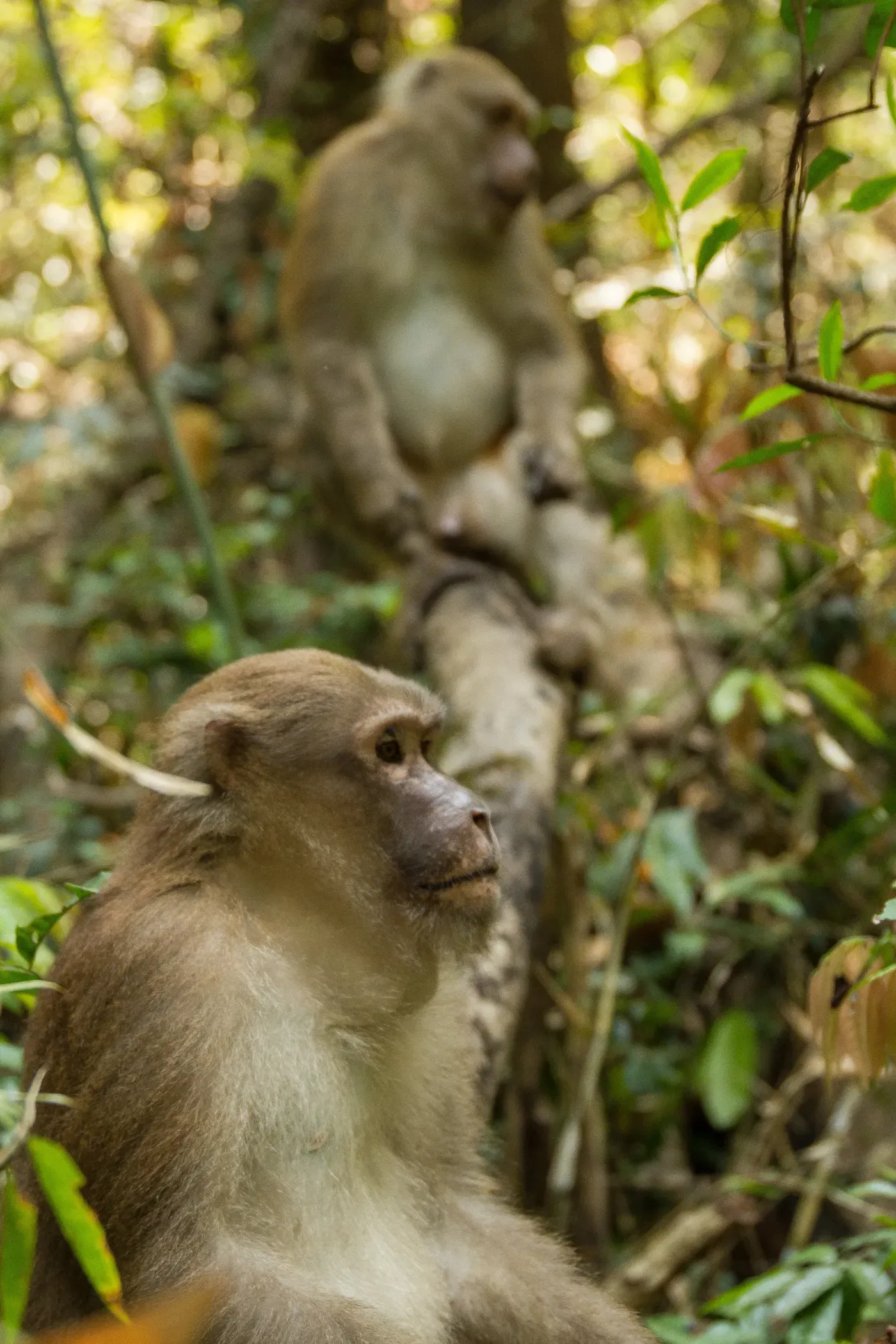
Observations of social interactions among wild Assamese macaques have revealed that watching others can be beneficial for an individual's position within the group hierarchy.
Researchers from Germany's DPZ and the University of Göttingen conducted a two-year study in Thailand, focusing on 46 male Assamese macaques. The team observed how long these animals spent observing other males interacting with each other during social encounters.
The scientists recorded more than 440 instances where a macaque watched two other males engage in interactions, which were categorized as either friendly or aggressive. These observations suggest that the ability to observe and evaluate social interactions may be an essential skill for macaques.
By studying how these animals allocate their attention towards others, researchers hope to gain insights into the evolution of social intelligence in primates.
Males that spent more time watching friendly interactions within their group developed closer social bonds with specific other males by the end of the first year.
These stronger bonds led to higher ranks in the dominance hierarchy for these males by the second year, a significant finding that highlights the importance of social connections in primate societies.
The research suggests that observing others is not just about learning new behaviors or gaining knowledge, but also about building relationships and alliances that ultimately contribute to social success. This understanding can be seen as a crucial step in deciphering the evolution of social intelligence in primates.
In fact, the data show that males who interfered more frequently in social situations had likely gained valuable information from their observations, which helped them decide when and how to intervene.
The researchers found that observing aggressive interactions did not have a direct impact on social bonding or dominance success among males. In fact, the amount of time they spent watching fights had no bearing on their position in the group hierarchy.
A different explanation seems to be at play when it comes to managing risk during conflicts. All males appeared to watch closely during fights, as none wanted to get drawn into a dispute against their will. This uniform behavior did not give any individual an advantage over others.
The study's findings suggest that observing others is linked to forming closer social bonds. These stronger relationships in turn lead to higher dominance ranks and greater mating success. According to the researchers, this sequence of events implies a causal relationship between observation and bonding.
Studies like this one help shed light on how social intelligence has evolved over time. Humans also tend to keep track of who gets along with whom and who is arguing. If observing others provides an advantage in other primates, it could offer clues about why this ability developed in our primate relatives, and potentially even in humans.
The researchers propose that observing others may have become a crucial skill for survival in social groups, ultimately contributing to the evolution of advanced social intelligence.
Observing others' interactions within a group may have played a crucial role in the evolution of advanced social intelligence among primates.
This idea is supported by research showing that male macaques who pay attention to their peers' behavior are more likely to achieve higher ranks and secure mating opportunities.
Facts based on reporting originally published by Phys.org.
You may republish this story, in full or in part, if you credit News Central Site and link to it (licence CC BY 4.0). Photos are not included.