Breakthrough Discovery Explains Origin of Anna's Hummingbird's Magenta Feathers
A team led by Sangyeop Kim has identified a hidden layer inside the feathers of male Anna's hummingbirds that produces the blue reflection necessary for their distinctive magenta color.
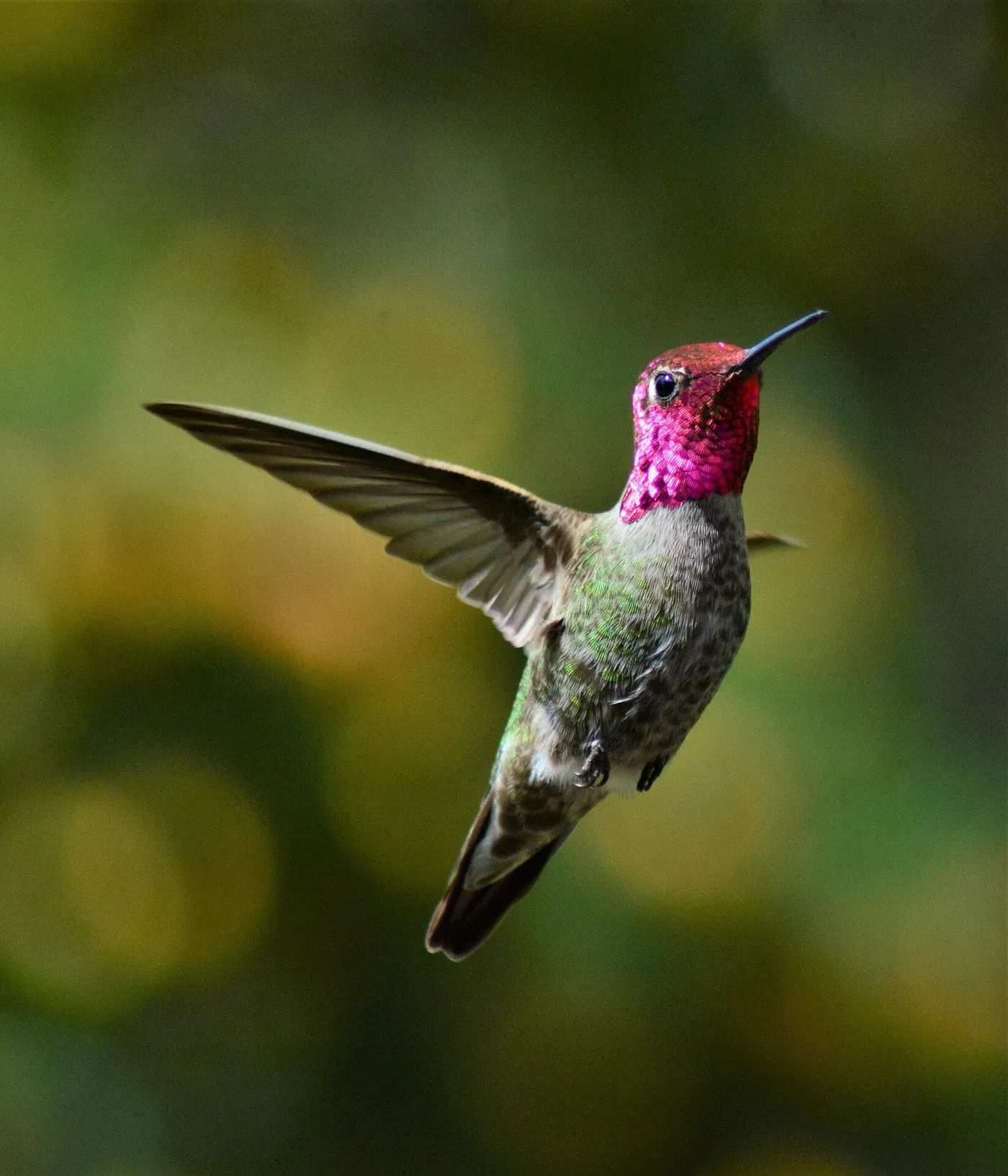
A team of scientists has made a breakthrough discovery about the brilliant magenta feathers found on the head and throat of male Anna's hummingbirds. These vibrant colors have long been a subject of fascination, but their origin has remained somewhat of an optical puzzle.
Magenta is not a color that can be produced by a single wavelength of light, which means that the feathers must reflect a combination of different wavelengths to achieve this distinctive hue. While the strong red reflection in these feathers was already understood, scientists struggled to explain the weaker blue component. This has been a long-standing mystery in the field of ornithology.
A team led by Sangyeop Kim from Yonsei University has now identified a previously overlooked region inside the feathers that plays a crucial role in producing the blue reflection. According to their research, this hidden layer works together with material near the surface of the feather to create the distinctive magenta color.
The scientists tested their theory by gradually eroding the surface of the feather, which resulted in a significant decrease in the blue reflection. As the blue component faded, the feathers' appearance changed from magenta to orange, providing visual evidence for the team's explanation.
This breakthrough builds on previous research that revealed the internal architecture of these feathers is responsible for their shimmering appearance. A 2018 study had already shown how stacked structures inside the feathers produce both the strong red and weaker blue reflections, but it was unable to fully reproduce the blue component.
The research delved deeper into the structures within the feathers of Anna's hummingbird to understand their role in producing the bird's vibrant plumage. Specifically, it focused on the stacks of melanosomes and air cavities found inside barbules, which are tiny branches extending from a feather's main stem.
Each stack consists of flattened melanosomes containing melanin pigment, as well as air cavities embedded within a matrix of protein. The interaction between light waves reflected from the boundaries between these different materials contributes to the final color we see. This phenomenon is influenced by the thickness and arrangement of the layers.
The study's findings revealed that earlier descriptions of the melanosomes' size and distribution were incomplete. Electron microscopy images showed a more nuanced picture, with a gradual transition from smaller structures near the surface to larger ones deeper inside. A significant portion of this difference was due to variations in the size of air pockets within the melanosomes.
Computer simulations demonstrated how including the intermediate layers affected the color produced by the feather's structure. When these layers were omitted or treated as uniformly thick, a strong red reflection resulted but without a distinct blue peak. However, when the intermediate layers were included, the blue peak became visible, highlighting their crucial role in producing the bird's magenta feathers.
The researchers used oxygen plasma etching to gradually remove surface material from real hummingbird feathers and observe how their color changed over time.
After 60 seconds of treatment, the outer protein covering was almost completely gone, revealing reddish-orange barbules underneath. By this stage, the color had already begun to shift away from its original appearance. Further erosion revealed air cavities in the upper melanosomes after another 60 seconds.
Measurements showed that as the surface material continued to erode, the blue reflection weakened and eventually disappeared. At the same time, the dominant red reflection shifted towards shorter wavelengths, giving it an orange hue. This transformation supported the researchers' models of how the middle and surface regions work together to produce color.
The study raises questions about how the different-sized structures within a feather develop as it grows. Researchers also do not yet know whether other hummingbird species have the same arrangement in their feathers.
Tiny differences in buried air pockets are crucial to determining whether the reflected light from the feather appears orange or produces a vibrant flash of magenta. This unique structure could potentially inspire the development of materials with adjustable colors for use in displays or security markings.
The discovery of a hidden middle layer in Anna's hummingbird feathers has shed new light on the bird's brilliant magenta coloration. This unique structure, which is made up of tiny, intricately arranged melanin granules, plays a crucial role in producing the bird's distinctive plumage.
This middle layer acts as a "photonic mechanism" that amplifies and modifies the colors produced by the outer layers of the feather, resulting in the vibrant magenta hue. The researchers' findings suggest that this multi-periodic structure could potentially be replicated to create materials with adjustable colors for use in displays or security markings. This breakthrough has significant implications for our understanding of color production in nature and its potential applications in technology.
Facts based on reporting originally published by Phys.org.
You may republish this story, in full or in part, if you credit News Central Site and link to it (licence CC BY 4.0). Photos are not included.