Nokia 6300 Faces Uncertain Future as Carriers Phase Out 2G Networks
The Nokia 6300's 2G connectivity is becoming increasingly obsolete as carriers upgrade their networks.
Nokia's iconic 2G phone, the Nokia 6300, is facing an uncertain future as carriers begin to phase out their old networks in favor of more modern technologies. Released nearly two decades ago, this device surprisingly became one of Nokia's top-selling phones due to its sleek design and user-friendly interface.
The main issue now is that the 6300 relies on a technology that is rapidly becoming obsolete - 2G connectivity. As carriers continue to upgrade their networks, it's getting harder for users to find a provider that still supports this outdated standard. This limitation severely restricts the phone's ability to access the modern internet.
One of the key problems with the Nokia 6300's browser is its inability to adapt to changing security protocols. The device uses TLS 1.0, which was once considered secure but has since been deprecated by major tech players like Apple, Google, Microsoft, and Mozilla in 2020. As a result, fewer than 25 percent of websites can still support TSL 1.0 connections as of last year.
Despite these challenges, a resourceful coder has developed an innovative solution to bypass the phone's dated browser using advanced chatbots. This clever workaround allows users to access certain online services through this older device, breathing new life into the seemingly obsolete Nokia 6300.
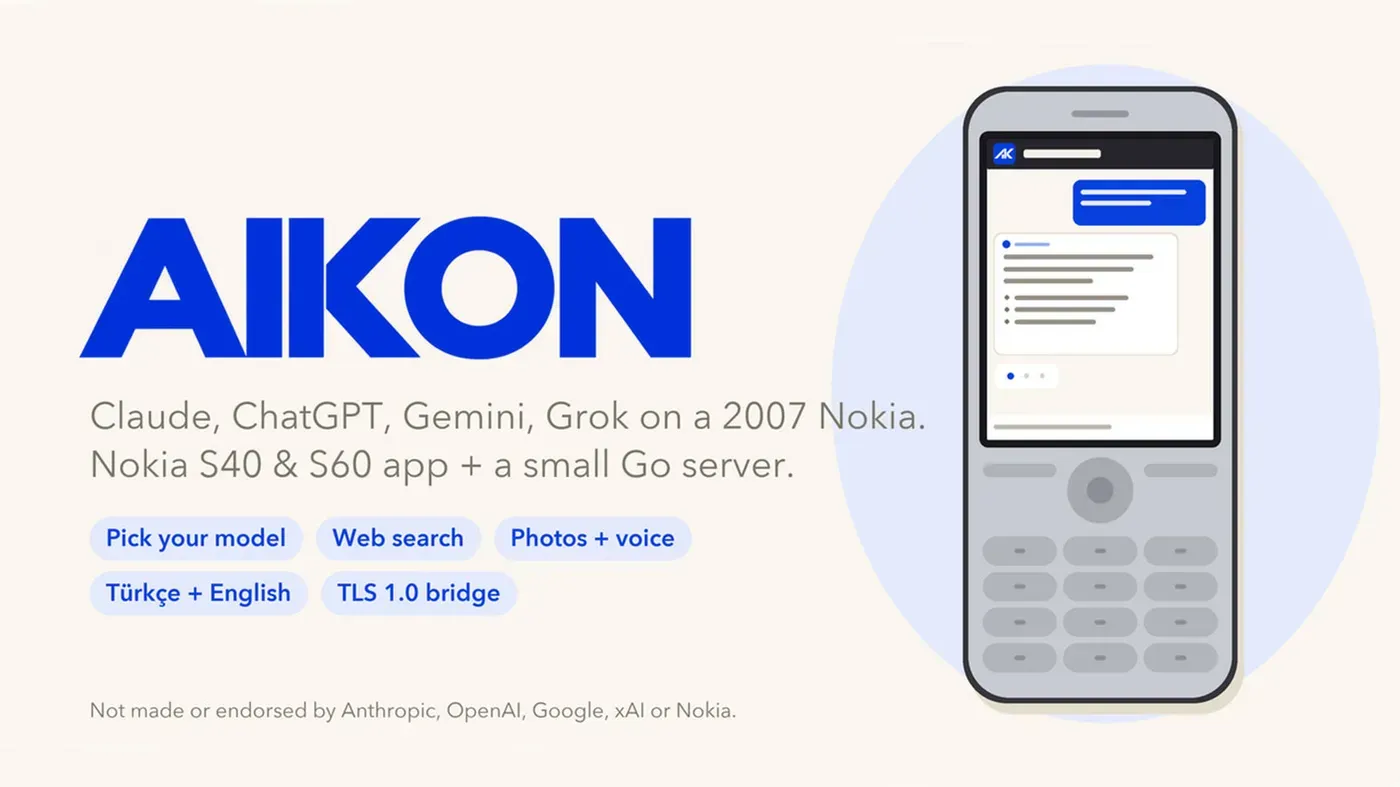
A clever workaround for older devices like the Nokia 6300 has been achieved through an innovative app developed by Emir Karşıyakalı. This app, initially known as Claude S40 and later renamed Aikon, enables users to access various online services on their outdated phones.
To function properly, Aikon relies on a Go server that holds the API key from prominent companies such as Anthropic, Google, OpenAI, or SpaceXSI. This server serves as an intermediary between the user's phone and the chatbots, including Claude, ChatGPT, Gemini, and Grok. It truncates their responses into manageable 8kB blocks that can be read by the old Nokia device.
A key aspect of Aikon is its robust design, which allows users to interact with chatbots on their phones in a relatively seamless manner. For instance, the app includes a reading mode, accessible via a dedicated keypad shortcut, to make text consumption more comfortable on the 240x320 display.
In addition to its core functionality, Aikon offers several convenient features, including the ability to save responses for offline reading and send photos or voice messages to chatbots for analysis. The app also supports multiple languages, such as English, Spanish, Portuguese, French, German, Russian, Indonesian, and Turkish.
To facilitate communication between the phone and server, users will need to set up token billing through each company's API. This ensures that Aikon can communicate with various chatbots without any technical issues.
Karşıyakalı has taken steps to ensure that his app remains open-source, allowing other developers to build upon and improve its functionality further.
The AI-powered upgrade for Nokia phones is limited by geographical location. In the US, for instance, users won't be able to access this app as it relies on a 2G network that's no longer operational.
This limitation applies specifically due to T-Mobile's shutdown of its GSM network in August. However, those living outside North America can still explore the app by visiting Github and following the installation instructions.
Facts based on reporting originally published by Engadget.
You may republish this story, in full or in part, if you credit News Central Site and link to it (licence CC BY 4.0). Photos are not included.