New species of ancient crocodile relative discovered in Morocco
A team of scientists has identified a new species of ancient crocodile relative, Ctenosuchus tenuidens, which lived during the age of dinosaurs.
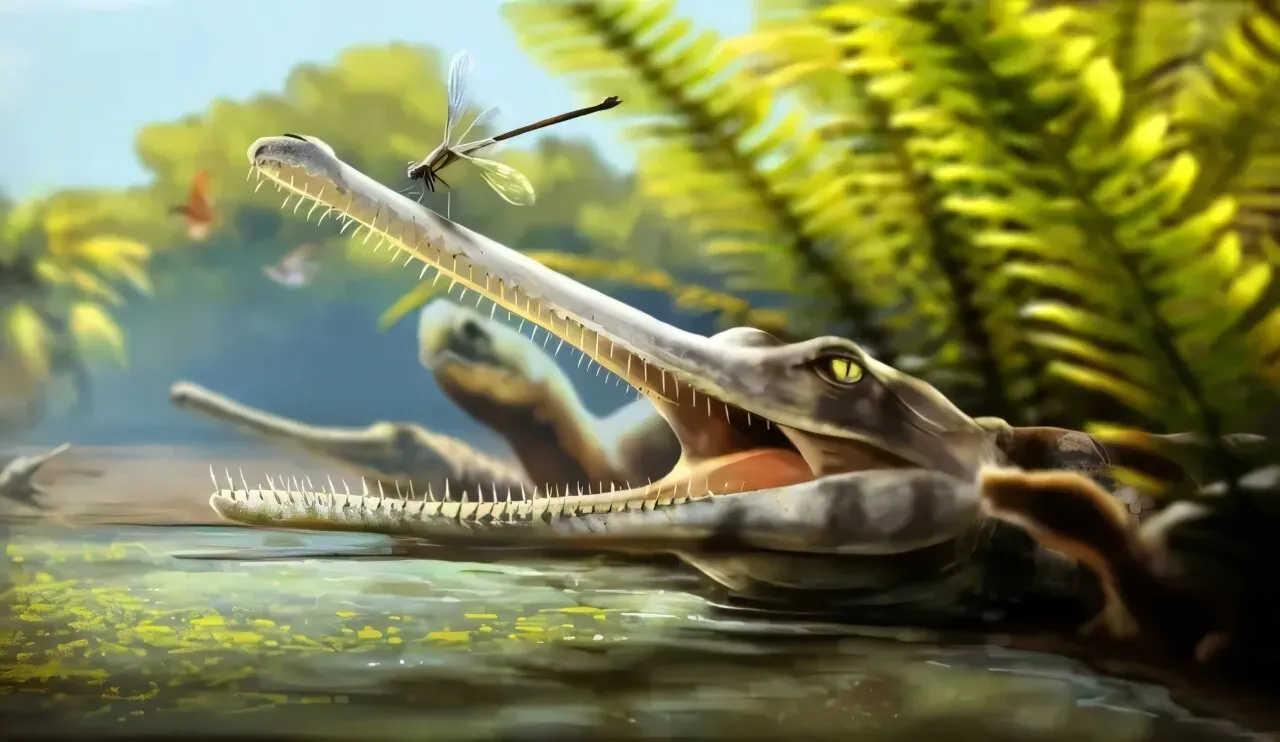
A new species of ancient crocodile relative has been discovered in Morocco by a team of scientists from the University of Portsmouth and Hassan II University of Casablanca. The discovery was made in rocks that formed in ancient rivers and lakes in the Atlas Mountains of southeastern Morocco.
The newly identified species, Ctenosuchus tenuidens, belongs to a group of marine and freshwater reptiles known as thalattosuchians, which lived during the age of the dinosaurs. This group includes a variety of crocodile-like animals that dominated Earth's oceans and coastlines around 170 million years ago.
The distinguishing feature of Ctenosuchus tenuidens is its unusually slender teeth. Unlike most crocodiles, whose teeth are broad and robust, these teeth are long and narrow, resembling needlelike structures. This characteristic suggests that the animal had a unique diet.
The fossils were found in rocks that have been preserved for millions of years, providing valuable insights into the evolution of ancient species. The discovery was made possible by the collaboration between researchers from two institutions, who carefully excavated and analyzed the fossil remains.
A closer examination of one of the fossils revealed small black circles on either side of a long bone, which were initially thought to be imperfections. However, further investigation using a microscope showed that these "black circles" were actually incredibly thin teeth, measuring only a few millimeters in length.
The unique dental structure of Ctenosuchus tenuidens has provided a crucial clue to its feeding habits. The teeth, which resemble a comb, have specialized ridges and are closely spaced, indicating that this Jurassic crocodile species had an unusual diet.
Further analysis under powerful microscopes revealed the internal structure of these teeth, confirming their slender nature. These findings suggest that Ctenosuchus tenuidens was not equipped to tackle large prey, but rather fed on smaller aquatic creatures such as shrimp and tiny fish.
The delicate nature of its teeth implies that they would be easily damaged if subjected to forceful resistance from larger prey. Imran's team believes that the animal likely consumed soft-bodied organisms like worms and small crustaceans to avoid damaging its teeth.
This discovery highlights the diversity in feeding habits among ancient crocodile relatives, particularly those living on the southern supercontinent Gondwana. The research also underscores the independent evolution of similar adaptations in different groups of prehistoric animals.
The resemblance between Ctenosuchus tenuidens' teeth and those found in mesosaurs and certain long-snouted pterosaurs is a testament to convergent evolution, where unrelated species develop similar traits in response to environmental pressures.
The discovery of Ctenosuchus tenuidens has shed new light on the diversity of Jurassic crocodile relatives.
Fossils from eastern Morocco reveal that these prehistoric creatures had a range of habitats and feeding roles beyond what was previously thought. The jaws and teeth of Ctenosuchus have striking similarities with those found in certain pterosaurs, such as Gnathosaurus and Ctenochasma, which scientists believe were filter feeders.
This similarity suggests that Ctenosuchus may have had a similar feeding behavior, potentially using its slender teeth to capture small prey like shrimp and tiny fish. The discovery highlights the complexity of prehistoric ecosystems in Morocco during the Jurassic period.
The finding underscores the vast potential for new discoveries in this field, with Imran noting that there is still much more to be explored in the rich fossil history of Morocco.
Facts based on reporting originally published by Phys.org.
You may republish this story, in full or in part, if you credit News Central Site and link to it (licence CC BY 4.0). Photos are not included.