National Institute for Materials Science Develops Novel Bonding Technology
Researchers at the National Institute for Materials Science have developed a novel technology to bond dissimilar materials together using a porous layer as an anchor.
Researchers at the National Institute for Materials Science have developed a novel technology to bond dissimilar materials together using a porous layer as an anchor. This innovative approach has been found to be effective in bonding materials that are normally difficult to join.
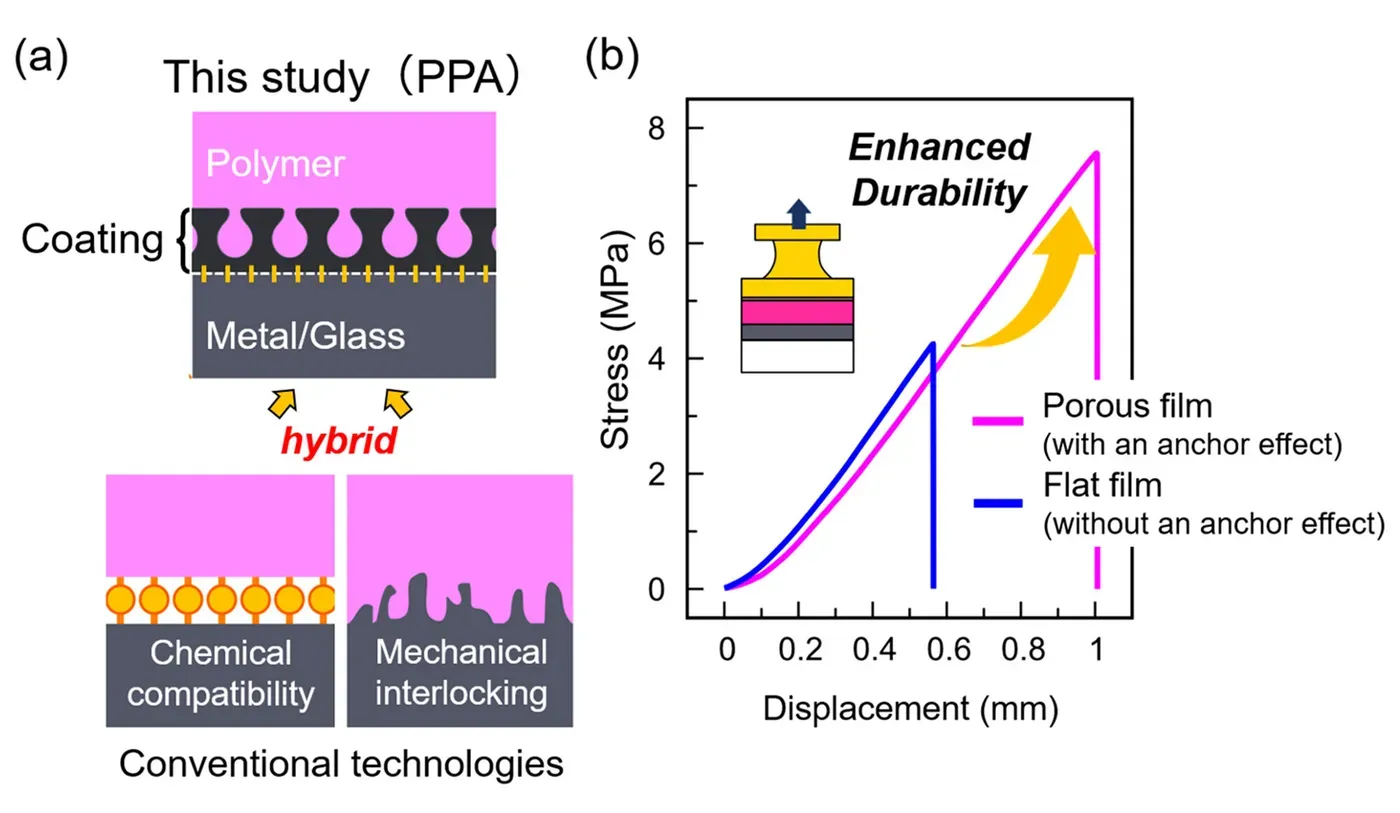
The method involves coating one material with a solution and allowing it to dry, forming a porous layer. The porous layer acts as an anchor, adhering to the first material through chemical affinity while creating tiny pores that physically interlock with another material. This hybrid approach enables the creation of strong bonds between materials that would otherwise be difficult or impossible to join.
The development of multi-material structures is becoming increasingly important for various applications, including lightweight vehicles, flexible electronics, and soft robots. These structures combine hard materials like metals, glass, and ceramics with softer polymers such as rubber and plastics.
Conventional methods of bonding dissimilar materials involve designing adhesives that are compatible with specific material combinations. However, this approach can be time-consuming and requires significant resources. Another method involves roughening the surface of a substrate through mechanical or chemical means, but this process raises concerns about energy consumption and environmental impact.
The porous anchor technology has been found to produce bonds with strengths exceeding 7 MPa, making it a promising solution for various industries that require strong and durable multi-material structures.
The research team has made significant progress in developing a method for joining dissimilar materials by structuring the adhesive layer. This involves creating a mesh-like porous anchor layer with nanometer- to micrometer-sized pores through a process called "viscoelastic phase separation". The solution is coated and then dried, resulting in a printable porous anchor (PPA) that can be used to bond various materials.
The PPA has proven to be effective in bonding even the most challenging combinations of materials. In one experiment, it achieved a remarkable bonding strength exceeding 7 megapascals (MPa) when paired with a flexible polymer and glass. This is particularly noteworthy given the low adhesion between these two materials, making them difficult to bond using conventional methods.
The PPA's success can be attributed to its hybrid approach, which combines chemical affinity with physical interlocking. As the adhesive layer forms, it bonds to the glass through chemical affinity while incorporating the polymer into its tiny pores, effectively creating a strong and durable connection. This method breaks away from traditional approaches that require developing adhesives tailored to specific material combinations.
To further expand the versatility of the PPA, the research team is exploring two new avenues for development. One involves imparting conductivity to ensure heat dissipation and electrical connectivity at bonded interfaces. The other aims to use highly heat-resistant materials capable of withstanding harsh environments, making the PPA a promising solution for various industries that require strong and durable multi-material structures.
The porous anchor technology is poised to cater to the diverse bonding needs of various industries, enabling the creation of complex multi-material structures that will be essential for next-generation mobility, wearable devices, and soft robotics.
This innovative solution will provide manufacturers with greater design flexibility in their production processes, allowing them to create more sophisticated products that combine different materials seamlessly. The technology's potential applications extend across multiple sectors, where strong and durable bonding is crucial. This breakthrough has the potential to transform manufacturing processes.
Facts based on reporting originally published by Phys.org.
You may republish this story, in full or in part, if you credit News Central Site and link to it (licence CC BY 4.0). Photos are not included.