National Geographic Photographer Spends 25 Years Capturing Big Cats
Steve Winter has spent over two decades photographing big cats for National Geographic, capturing incredible images around the world.
For decades, photojournalist Steve Winter has traveled extensively across the globe capturing incredible images of big cats as part of his work for National Geographic. His remarkable career spans over 25 years and is marked by numerous high-profile assignments that have had a significant impact on the world's understanding of these majestic predators.
However, despite his extensive experience with wildlife photography, Steve Winter surprisingly didn't take his first professional photograph until he was 34 years old. This late start in his career may seem unusual for someone who has gone on to achieve such great success and acclaim in the field.
In a conversation with Live Science, Winter revealed that his initial reluctance to work with big cats stemmed from a lack of knowledge about these animals. He candidly admitted that if anyone had told him he would be working with big cats for 25 years of his career, he would have been skeptical and uncertain. However, through his experiences and interactions with scientists and local people, Winter was able to gain valuable insights and develop a deep appreciation for the natural world.
Winter's passion for wildlife photography has taken him on countless assignments around the globe, from steamy jungles to vast grasslands and even as high as 15,000 feet in the Himalayas. His commitment to capturing the beauty and secret behaviors of big cats has resulted in numerous international awards and accolades, including being named BBC Wildlife Photographer of the Year and BBC Wildlife Photojournalist of the Year.
Throughout his career, Steve Winter has been driven by a desire to raise awareness about the plight of big cats and the challenges they face. His work has not only shed light on the fragility of these predators but also highlighted the conservation efforts underway to protect them. In his new book, "Big Cats," co-authored with Guynup, Winter provides a retrospective look at his career, examining both the progress made in big cat conservation and the ongoing challenges that still need to be addressed.
In addition to his work as a photographer, Steve Winter is also an accomplished lecturer on photography and conservation issues. He has spoken internationally about the importance of preserving our natural world and has been featured on major news programs such as CBS Nightly News, 60 Minutes, NPR, BBC, and CNN. His contributions to National Geographic magazine are regular and often involve spending months working on a single story.
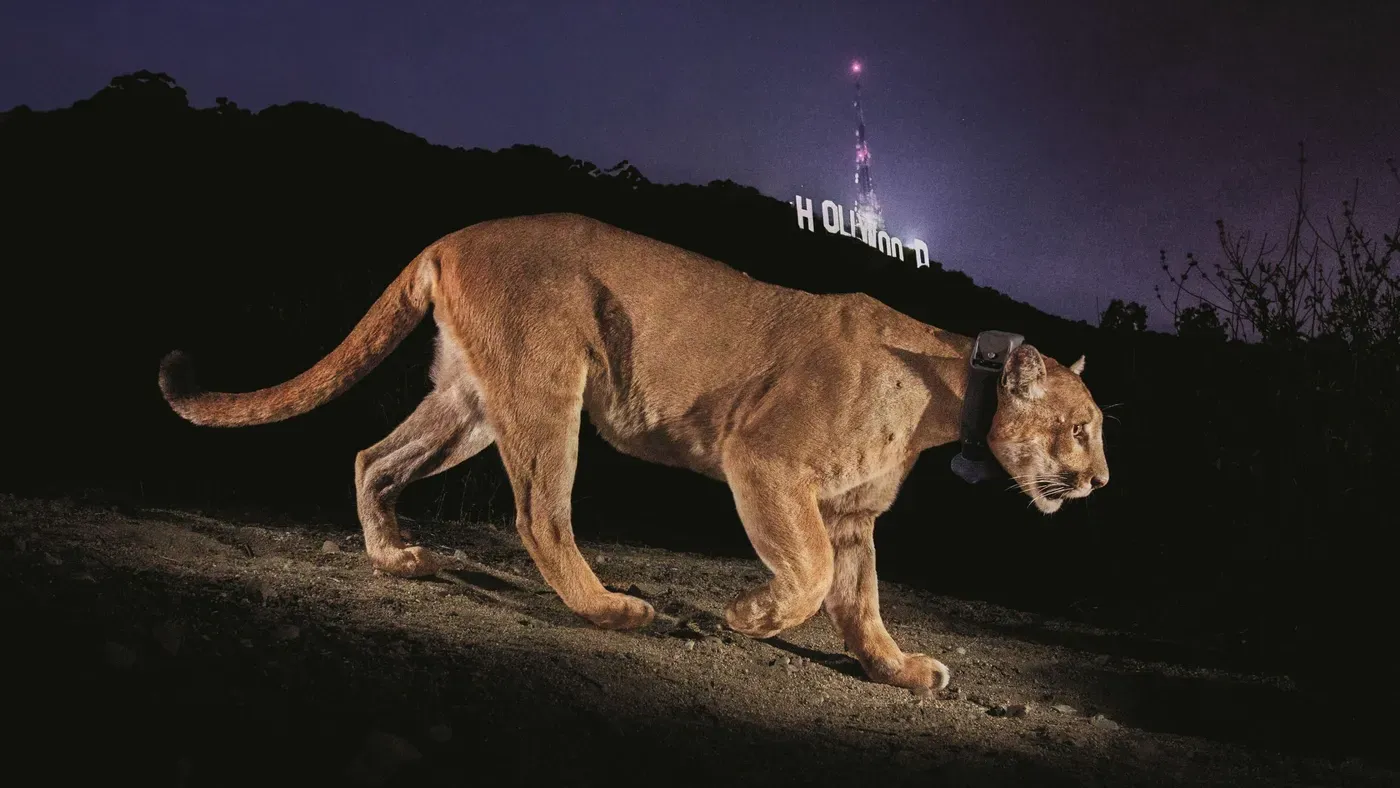
Winter's experience in capturing iconic images of big cats is unparalleled, and one photograph that stands out for him is the image of the cougar P-22 beneath the Hollywood sign in California. This powerful image ultimately led to the creation of the world's largest highway wildlife corridor over Highway 101 in California, demonstrating the lasting impact of his work on conservation efforts.
The impact of Steve Winter's work extends far beyond his iconic photograph of the Hollywood cougar. This powerful image has led to significant changes in Los Angeles, transforming the city's relationship with its wildlife.
Winter's photograph of P-22 under the Hollywood sign has become a symbol of urban conservation efforts. It has inspired the creation of the Wallis Annenberg Wildlife Crossing over Highway 101, which is set to open on December 2nd.
The crossing is a testament to the lasting impact of Winter's work on conservation efforts. By providing a safe passage for wildlife to cross the highway, it aims to reduce collisions and protect the city's native species.
P-22 has become a beloved figure in Los Angeles, with his own day dedicated to celebrating urban wildlife. Schools are now incorporating P-22 into their curriculum, teaching students about the importance of coexisting with nature.
The LA Natural History Museum has also recognized P-22's significance by featuring Winter's photograph in its permanent exhibit. It serves as a reminder of the city's commitment to preserving its natural heritage.
Winter's experience capturing P-22's image was not without its challenges. He had to wait eight months for the opportunity to take the shot, which required patience and persistence on his part.
The success of Winter's photograph has also led to increased awareness about urban wildlife conservation. It highlights the importance of protecting native species and their habitats, even in densely populated areas like Los Angeles.
Steve Winter's experience as a photojournalist has taken him to some of the most remote and inhospitable places on earth. He recalls one particular story where he had to set up camera traps in a cloud forest in Guatemala to capture images of a sacred bird known as the quetzal.
The quetzal, with its impressive three-foot-long tail, was not only a stunning sight but also steeped in historical significance. Winter notes that the bird's feathers were once used as a form of currency by ancient civilizations such as the Maya and Aztecs.
Setting up camera traps allowed Winter to work without having to physically sit for long periods, a technique he learned early on in his career. However, this method had its drawbacks, particularly when it came to capturing intimate moments of the quetzal's behavior.
One evening, while reading in his small shack, Winter was startled by strange noises coming from outside the door. He heard creaking stairs, floorboards, and scratching sounds, which sent a tingling sensation down his spine.
Intrigued, Winter grabbed his walkie-talkie to alert Juan Carlos, the naturalist who had helped him locate the quetzal nests. However, as he waited for an explanation, the strange noises continued, leaving Winter with more questions than answers.
The experience was a poignant reminder of the complex and often unseen lives of wild animals. Winter's work has taken him to many parts of the world, from dense rainforests to vast savannas, where he has witnessed both beauty and brutality.
Despite being immersed in these environments for extended periods, Winter remains fascinated by the intricacies of animal behavior and the importance of preserving their habitats.
Working in Thailand and Sumatra was a top priority for Steve Winter due to concerns about the two subspecies facing extinction.
The photographer collaborated with an exceptional team of scientists who were dedicated to saving the Indo-Chinese tiger in Thailand.
However, there was another entity operating in the same region that raised suspicions - the Thai Tiger Temple, a Buddhist monastery turned tourist attraction.
The abbot had initially adopted a tiger cub 10 years prior and developed a fondness for these majestic animals, leading him to establish a lucrative tourism operation that generated at least $3 million annually.
As Winter observed the temple's practices, he sensed something was amiss - despite claims of hosting 150 tigers, visitors were allowed to interact with cubs in ways that didn't seem sustainable or humane.
The photographer noticed discrepancies between the number of tigers being bred and the mortality rate, which indicated a problem with their conservation efforts.
The investigation into the Tiger Temple's abuse and connections with the illegal wildlife trade was a long and grueling process, with multiple stories published over several months.
Sharon's research and writing were instrumental in exposing the temple's horrific practices, which eventually led to its shutdown by the Thai government.
Our team had already gathered significant evidence, including photographs taken during previous visits to the temple, but we felt it was essential to document the situation further through a video investigation.
The footage, which was later broadcast on local TV stations, helped raise public awareness and put pressure on authorities to take action against the temple.
As the story gained momentum, Sharon continued to write follow-up articles, shedding light on the darker side of the wildlife trade and its connections to the temple.
The Thai government ultimately shut down the Tiger Temple in a dramatic raid, which was widely covered by local media outlets.
During the raid, investigators made a shocking discovery: tigers were being kept in freezers, while cubs were stored in jars with small flags attached, highlighting the temple's blatant disregard for animal welfare.
The passage of the Big Cat Public Safety Act was a significant milestone in the fight against wildlife trafficking.
President Biden's signature on this landmark legislation outlawed various activities related to big cat ownership, marking a major shift in conservation efforts.
As a photojournalist who has dedicated his career to documenting the natural world, Steve Winter has witnessed firsthand the impact of human actions on animal populations.
Winter has worked closely with organizations like Panthera, a nonprofit devoted to protecting wild cats, to raise awareness about the importance of connectivity and habitat preservation.
The concept of connectivity refers to the idea that animals need corridors to migrate and move through their natural habitats without being hindered by human development such as roads.
This notion has been at the forefront of conservation efforts in recent years, with scientists and experts advocating for the creation of wildlife corridors to allow animals to roam freely.
Facts based on reporting originally published by Live Science.
You may republish this story, in full or in part, if you credit News Central Site and link to it (licence CC BY 4.0). Photos are not included.