Methane conversion breakthrough achieved with lanthanoid-based high-entropy oxide catalysts
Researchers at the Institute of Science Tokyo have developed lanthanoid-based high-entropy oxide (HEO) catalysts that efficiently convert methane into higher-value hydrocarbons, overcoming previous challenges.
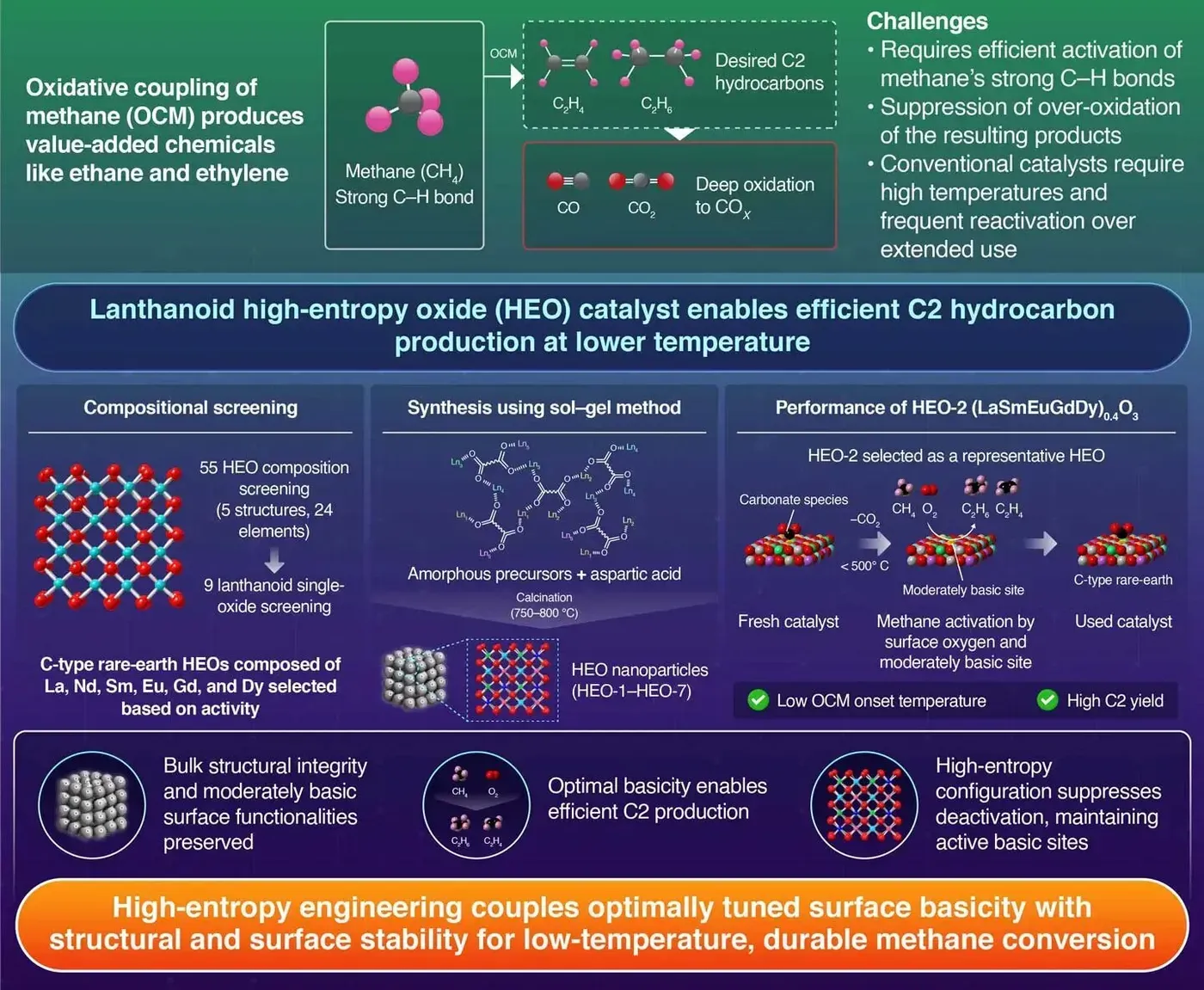
Researchers at the Institute of Science Tokyo in Japan have made significant strides in cracking the complex chemistry of methane conversion. Methane, the primary component of natural gas, is being directly converted into higher-value hydrocarbons like ethane and ethylene through an oxidative coupling reaction.
However, this process poses a major challenge due to the stability of methane's carbon-hydrogen bonds, which resist activation at low temperatures. Furthermore, the resulting ethane and ethylene are highly reactive and tend to overoxidize into carbon oxides, further complicating the conversion process.
Conventional catalysts used in this reaction typically require operating temperatures near 800°C but often deactivate quickly, limiting their industrial application. Despite numerous attempts with various catalysts, achieving a balance between low-temperature activity, high product yields, and long-term stability remains an elusive goal.
To address these challenges, the researchers have developed lanthanoid-based high-entropy oxide (HEO) catalysts, which incorporate five or more metallic elements into a single crystal structure.
The researchers have identified lanthanoid-containing high-entropy oxide (HEO) systems as promising candidates for methane conversion due to their exceptional low-temperature activity and long-term stability.
A total of 55 HEO compositions were screened across five different crystal structures and 24 elements to determine the most effective catalysts. The study revealed that certain combinations of lanthanoid elements exhibited high yields of C2 hydrocarbons while maintaining structural stability.
Seven HEO systems were synthesized as nanoparticle catalysts using a sol-gel method developed in-house. These HEOs featured five homogeneously integrated elements, which were obtained by calcining amorphous precursors prepared from metal acetates and aspartic acid at high temperatures.
Further investigation led to the selection of one particular HEO system, known as HEO-2, which consisted of a specific combination of lanthanoid elements. This composition was chosen for detailed study due to its promising properties.
HEO-2 demonstrated exceptional performance in catalytic tests, initiating C2 hydrocarbon formation at an unusually low temperature of 525°C. At a slightly higher temperature of 600°C, HEO-2 achieved a notable C2 yield of 12.3%.
The researchers found that the catalyst's low-temperature activity is linked to its surface basicity. Specifically, moderately basic sites are most favorable for the conversion process, as excessively strong basicity can lead to overoxidation of carbon dioxide or strong CO2 adsorption.
The team discovered that the surface basicity of the catalyst can be systematically tuned by varying the average ionic radius of the lanthanoid elements used in its composition. This is significant because it provides a way to optimize the catalyst's performance for specific applications.
HEO-2, with an average ionic radius of 0.957 Å, exhibits CO2 desorption predominantly in the range of 300-400°C. This temperature range corresponds to moderately basic sites that are effective for producing carbon dioxide.
At 600°C, HEO-2 maintained its initial performance even after 240 hours of operation, with a calculated deactivation rate of 1.0 mmol C2 g cat^-1 h^-2. This is more than 25 times lower than the corresponding single oxides, indicating that HEO-2's high-entropy configuration helps to stabilize its active surface functionalities during long-term operation.
The new catalyst has shown remarkable stability and performance in converting methane at lower temperatures.
Surface analysis revealed that the moderately basic sites remained intact after the reaction, while the HEO-2 also retained its polycrystalline framework. In contrast, single oxides underwent structural changes or lost their active basic sites over time. This indicates that the high-entropy configuration of HEO-2 plays a crucial role in stabilizing its surface functionalities.
The findings demonstrate how compositional entropy can simultaneously tune surface chemistry and stabilize active catalyst structures. By establishing the average ionic radius as a descriptor for surface basicity, researchers have provided a rational framework for designing selective oxidation catalysts that convert methane at lower temperatures with sustained activity.
Facts based on reporting originally published by Phys.org.
You may republish this story, in full or in part, if you credit News Central Site and link to it (licence CC BY 4.0). Photos are not included.