Massive Star-Forming Region G40.282−0.219 Yields Three Dense Cores
Astronomers using data from ALMA identified three dense cores at different stages of evolution within the massive star-forming region G40.282−0.219.
Astronomers have made a significant discovery within a massive star-forming region known as G40.282−0.219.
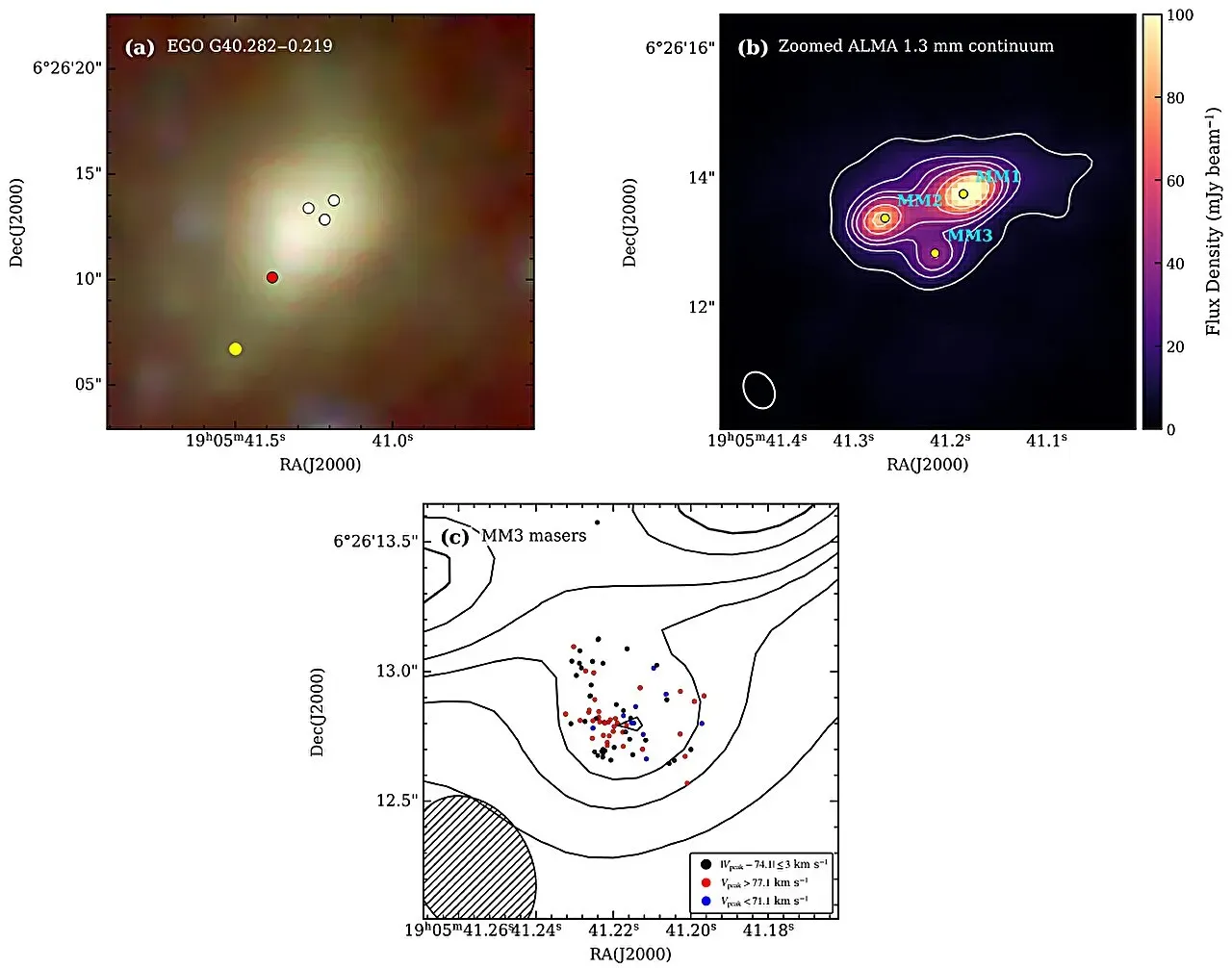
Using data from the Atacama Large Millimeter/submillimeter Array (ALMA), researchers identified three dense cores at different stages of evolution within this clump.
These cores are not isolated entities but rather part of a larger complex, challenging previous assumptions about their individual properties and development.
The study's findings highlight the complexity of massive star-forming regions, where multiple cores can coexist with distinct characteristics despite being closely situated.
According to the researchers' observations, each core exhibits unique physicochemical features that reflect its specific evolutionary stage.
The gas clump G40.282−0.219 is situated approximately 3.4 kiloparsecs from Earth and was previously identified as a massive young stellar object through low-resolution observations.
Within this clump, three dense cores have been resolved using data from the Atacama Large Millimeter/submillimeter Array (ALMA) in the 1.3 millimeter band: MM1, MM2, and MM3. These cores are located within the same parental gas cloud.
MM1 is notable for its substantial mass of approximately 24.6 solar masses but exhibits a surprisingly low number of detected molecular spectral lines. Furthermore, no outflows or masers were found to be associated with this core.
In contrast, MM2 has a significantly lower mass at around 8.4 solar masses yet drives an impressive outflow at speeds of about 25 kilometers per second. This outflow is characterized by the presence of a silicon monoxide jet.
MM3 stands out as having the smallest mass among the three cores, with approximately 5.2 solar masses. However, its dust temperature is particularly high and it hosts a diverse range of molecular species, including a Class II methanol maser operating at a frequency of 6.7 gigahertz.
A cluster of young stellar objects within a massive gas clump has been found to host three distinct star-forming cores at different stages of development.
These cores are embedded within the dense molecular cloud G40.282-0.219 and have been detected through their strong millimeter compact emission, which is indicative of the presence of warm dust, according to the researchers. One core shows signs of being a Class 0 protostar, while another exhibits characteristics of an intermediate-mass star.
Facts based on reporting originally published by Phys.org.
You may republish this story, in full or in part, if you credit News Central Site and link to it (licence CC BY 4.0). Photos are not included.