Mars Scientists Discover Unique Cloud Formation Process
Researchers using data from the European Space Agency's Mars Express and advanced meteorological models have discovered a unique physical process at play in the formation of the Arsia Mons Elongated Cloud.
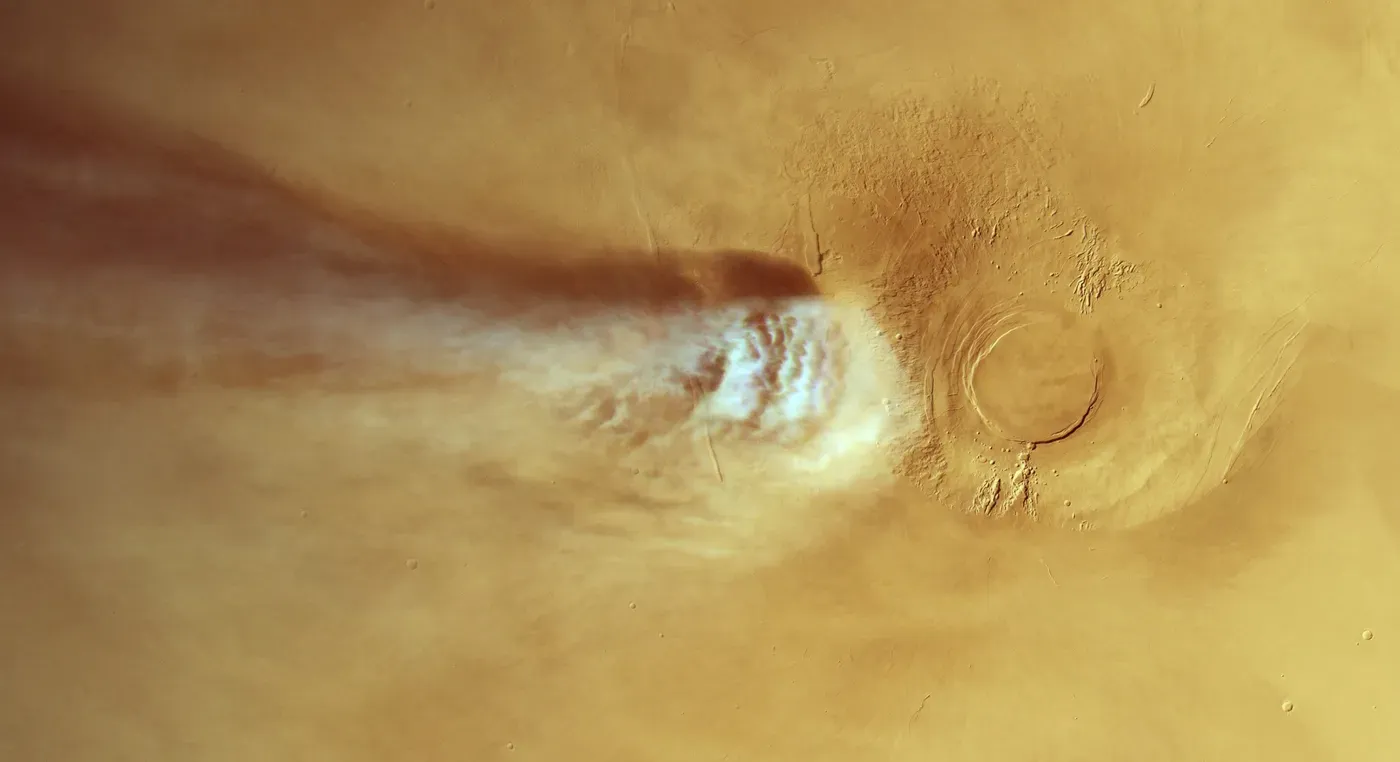
Scientists have made a fascinating discovery about Mars' most striking cloud using data from the European Space Agency's Mars Express and advanced meteorological models of the Red Planet. The research suggests that there may be unique physical processes at play in the formation of this extraordinary cloud.
Every year during Mars' southern hemisphere spring and summer, a remarkable cloud appears: the Arsia Mons Elongated Cloud (AMEC). This striking phenomenon is seen to emerge downwind of the towering 20-kilometer-high Arsia Mons volcano. The AMEC cloud stretches out for up to 1,800 kilometers before quickly evaporating.
The researchers have observed this daily cycle of formation and evaporation repeating over several months, with the cloud growing and shrinking in a matter of hours. This recurring phenomenon has been closely studied by Mars Express since its initial detection in 2018. The data collected has provided valuable insights into the AMEC's behavior and dynamics.
Further analysis revealed that the AMEC is an orographic cloud, similar to those found on Earth, which form when wind flows over mountainous terrain. However, the unique conditions on Mars have led researchers to propose a more complex explanation for the AMEC's formation.
The findings of this study suggest that there may be exotic physical processes at play in the formation of the Arsia Mons Elongated Cloud, warranting further investigation into its behavior and properties.
The formation of the Arsia Mons Elongated Cloud (AMEC) has long been a subject of fascination for scientists studying Martian weather patterns.
To accurately replicate the AMEC in computer simulations, researchers had to incorporate some unconventional physical processes that are typically considered theoretical and rarely observed in nature.
According to Jorge Hernández-Bernal, lead author of the study, including these exotic physics in their models allowed them to successfully recreate the AMEC, which emerged as expected when the simulations were run.
The process by which clouds form on Earth is well understood, involving the condensation of water vapor onto specks of dust or other particles present in the atmosphere. This heterogeneous nucleation requires a catalyst for cloud formation to occur.
However, the researchers found that the AMEC forms through a different mechanism, one where water vapor directly turns into icy cloud particles without any need for a mid-step catalyst, a phenomenon known as homogeneous nucleation.
The conditions necessary for this rare process to occur are extremely specific, requiring relative humidity levels far beyond what's typically experienced on Earth.
Researchers have long been fascinated by the possibility of seeing homogeneous nucleation in action on other planets, particularly Earth and Venus, but so far it has remained elusive.
However, the discovery of AMEC on Mars suggests that such extreme humidity conditions may be more common than previously thought, with temperatures and humidity levels fluctuating dramatically near Arsia Mons volcano.
The towering height of Arsia Mons creates a unique environment where winds flowing past the volcano trigger powerful waves that lift moist air parcels several kilometers in a matter of minutes.
This rapid cooling causes temperatures to plummet by 30 degrees Celsius in just 10 minutes, resulting in an explosive increase in relative humidity levels and allowing water vapor to spontaneously freeze directly into cloud particles.
The researchers behind the modeling of Mars' odd cloud have achieved a significant milestone in their study.
Their model is based on data from three cameras aboard the Mars Express spacecraft: the Visual Monitoring Camera, High Resolution Stereo Camera, and OMEGA. These cameras are able to capture high-resolution images of large areas of the Martian surface and can observe during morning hours when the unusual cloud is present.
The ability to image and track changes in the cloud over short periods of time has proven invaluable for scientists studying this phenomenon. Mars Express' capabilities allow researchers to monitor the cloud's behavior on a timescale of mere hours, providing an unparalleled view of short-lived events on the planet.
This achievement is a testament to the mission's success and the dedication of its scientists. By using data from Mars Express, researchers are now one step closer to unraveling the secrets surrounding the formation of this enigmatic cloud.
The significance of this finding extends beyond understanding atmospheric processes on Mars, as it also highlights the importance of considering unusual or unlikely processes when exploring other planets in our universe.
The discovery of an unusual cloud formation on Mars has led researchers to reevaluate their understanding of atmospheric processes on the Red Planet. This peculiar cloud, characterized by its elongated shape, was initially thought to be a result of homogeneous ice nucleation from water vapor.
Further investigation into this phenomenon has revealed that it may not follow the same rules as clouds on Earth, suggesting that exotic physics could be at play. The findings of this research have significant implications for future planetary explorations, highlighting the importance of considering unusual or unlikely processes when studying other worlds in our universe.
Facts based on reporting originally published by Phys.org.
You may republish this story, in full or in part, if you credit News Central Site and link to it (licence CC BY 4.0). Photos are not included.