Breakthrough in Wastewater Treatment Removes Toxic Metals and Recovers Rare Earth Elements
Researchers at the Indian Institute of Technology Gandhinagar, the University of Cambridge, and the University of Birmingham have developed a protocol using metal-organic frameworks to capture toxic metals and recover rare earth elements from wastewater.
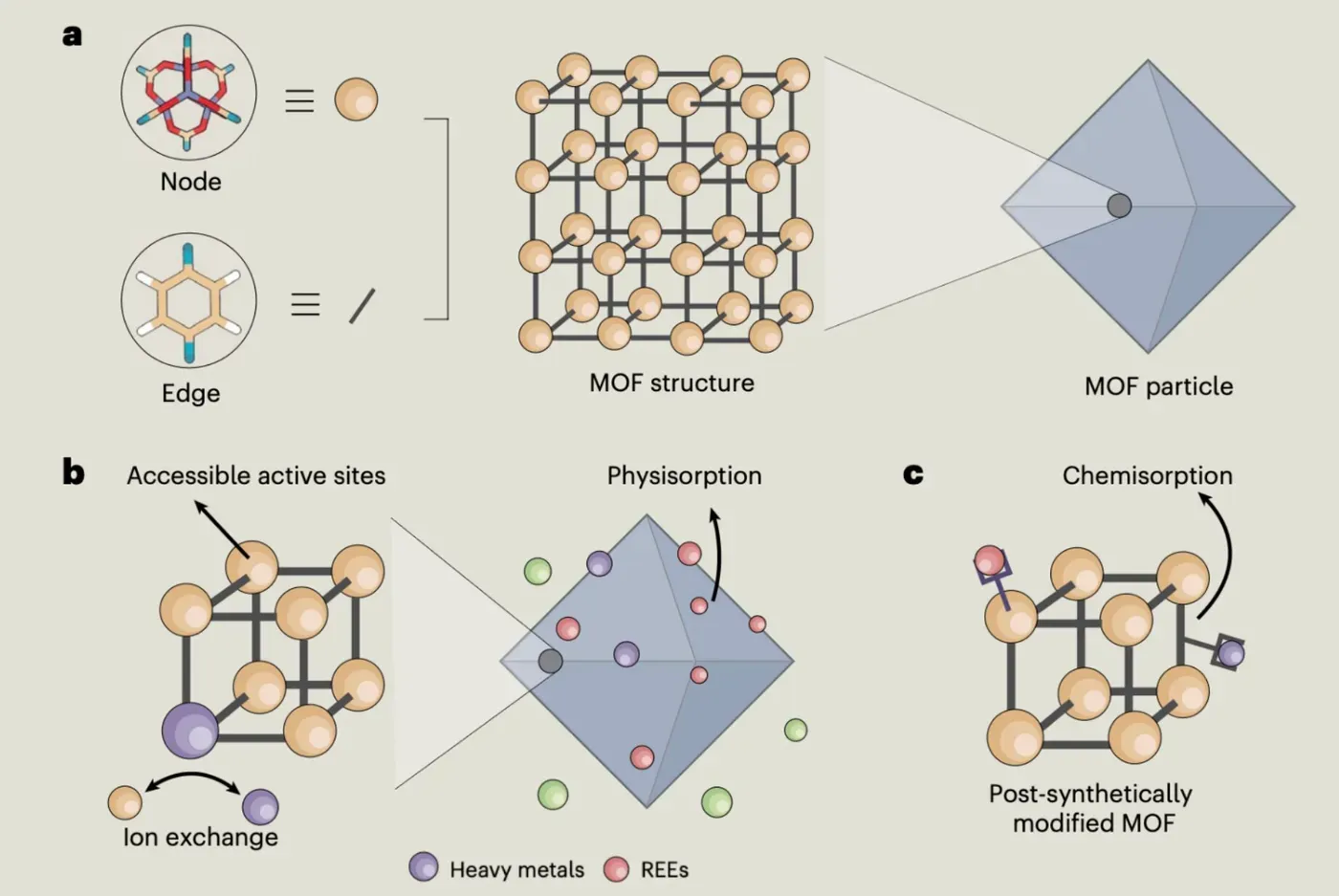
A breakthrough in wastewater treatment has been achieved by researchers who have developed a dual-purpose approach to remove toxic metals and recover rare earth elements from contaminated water.
The problem of toxic metal pollution in water is compounded by the presence of valuable rare earth elements (REEs) in industrial waste streams, which are difficult to recover once they enter the environment. These elements have a range of applications, including in magnets, superconductivity, optics, and batteries. However, their extraction from wastewater poses significant challenges.
Researchers at the Indian Institute of Technology Gandhinagar (IITGN), the University of Cambridge, and the University of Birmingham have addressed this issue by developing a protocol that uses metal-organic frameworks (MOFs) to capture toxic metals and recover REEs. MOFs are highly porous materials with exceptional absorption capacities.
The use of MOFs has enabled researchers to tackle two pressing environmental issues simultaneously: removing pollutants from water and recovering valuable resources. This dual-purpose approach could have far-reaching implications for industries that generate significant amounts of wastewater, including electronics manufacturing and metal processing.
The effectiveness of this protocol in capturing toxic metals and recovering REEs will be crucial in determining its potential impact on the environment and industry. Further research is needed to refine and scale up the technology before it can be implemented on a large scale.
The study's framework for designing MOFs offers a new approach to water remediation and circular resource applications.
The MOF functions like a molecular fishing net, with its countless pores providing a vast surface area for capture and specially designed chemical sites acting as hooks that can latch onto specific metals.
This selective trapping ability is achieved through careful tuning of the MOF's properties, allowing researchers to identify and target particular metals within a complex mixture.
MOFs have a unique property: their internal surface areas can reach up to 7,000 square meters per gram, making them highly effective as adsorbents that capture substances on their surfaces.
Their ability to operate across a wide pH range makes MOFs an attractive alternative to conventional methods like precipitation, coagulation and flocculation.
These industrial effluents discharged into bodies of water are complex mixtures containing multiple metals along with other pollutants such as pesticides, detergents, and organic compounds. The presence of these contaminants poses significant environmental risks and challenges for effective treatment.
One major issue with conventional methods is the requirement for extensive infrastructure, resulting in substantial economic costs and environmental burdens. Moreover, these processes generate large amounts of sludge that must be handled and disposed of, further exacerbating the problem.
Adsorption-based approaches offer a promising alternative to traditional methods, providing simplicity in operation and broad applicability. This method leverages the affinity between target metals and tailored surfaces, allowing for highly selective removal of contaminants with efficiency rates exceeding 90%.
MOFs stand out among adsorbents due to their exceptional design flexibility, enabling them to effectively capture and recover metals under controlled conditions. Their unique properties make them an attractive option for replacing conventional methods.
The protocol developed in this study demonstrates the effectiveness of MOFs as adsorbents in real-world scenarios. Testing was conducted using wastewater with high pH levels, turbidity, and dissolved solid impurities, as well as artificial seawater and e-waste-derived samples.
The workflow established in this research can be adapted for use with other adsorbents and contaminants, offering a versatile solution for addressing the complex challenges of industrial effluent treatment.
The researchers observed that their MOF demonstrated substantial adsorption capacities during the experiments. This was a key finding for Dhruv Menon, who noted the impressive performance of the copper-based material.
One gram of the MOF could capture nearly half a gram of lead and roughly a quarter of a gram each of cadmium and manganese, according to the data collected from the experiments. Additionally, it showed a strong affinity for rare earth elements, capturing around one-third of a gram per gram of neodymium, yttrium, dysprosium, terbium, and europium.
The team's focus was on engineering the performance of MOFs to employ them for environmental remediation applications. This involved developing a protocol that could tackle multiple environmental challenges simultaneously. Professor Misra emphasized the importance of understanding the limitations of controlled batch experiments in predicting behaviors in complex wastewater.
The researchers acknowledged that there are several factors that need to be considered, including large-scale fabrication, cost analyses, MOF life-cycle assessment and regulatory testing. These considerations are crucial for translating their laboratory findings into practical solutions for industrial effluent treatment.
The research team, which included several experts from the Indian Institute of Technology Gandhinagar and the University of Birmingham, has made significant progress in developing a 2-in-1 approach for capturing toxic metals and recovering rare earth elements from wastewater.
This innovative method leverages metal-organic frameworks to selectively sequester heavy metals while also facilitating the recovery of valuable rare earth elements.
Facts based on reporting originally published by Phys.org.
You may republish this story, in full or in part, if you credit News Central Site and link to it (licence CC BY 4.0). Photos are not included.