Mitochondria's inner membrane crucial for regulating energy production
A new study has shed light on the function of the protein complex MICOS, which plays a vital role in maintaining the structure and function of mitochondria.
Mitochondria, the powerhouses of our cells, are constantly at work producing energy from the food we eat, and this process is crucial for maintaining our bodily functions. However, their inner membrane's intricate structure plays a vital role in regulating access to these energy-producing pockets, known as cristae.
Cristae must maintain their precise shape while carefully controlling which molecules enter or exit, and any disruption to this architecture can have serious consequences, including neurodegenerative diseases and cancer. The protein complex MICOS is responsible for stabilizing these cristae and acting as a molecular filter at the narrow entrances of the pockets.
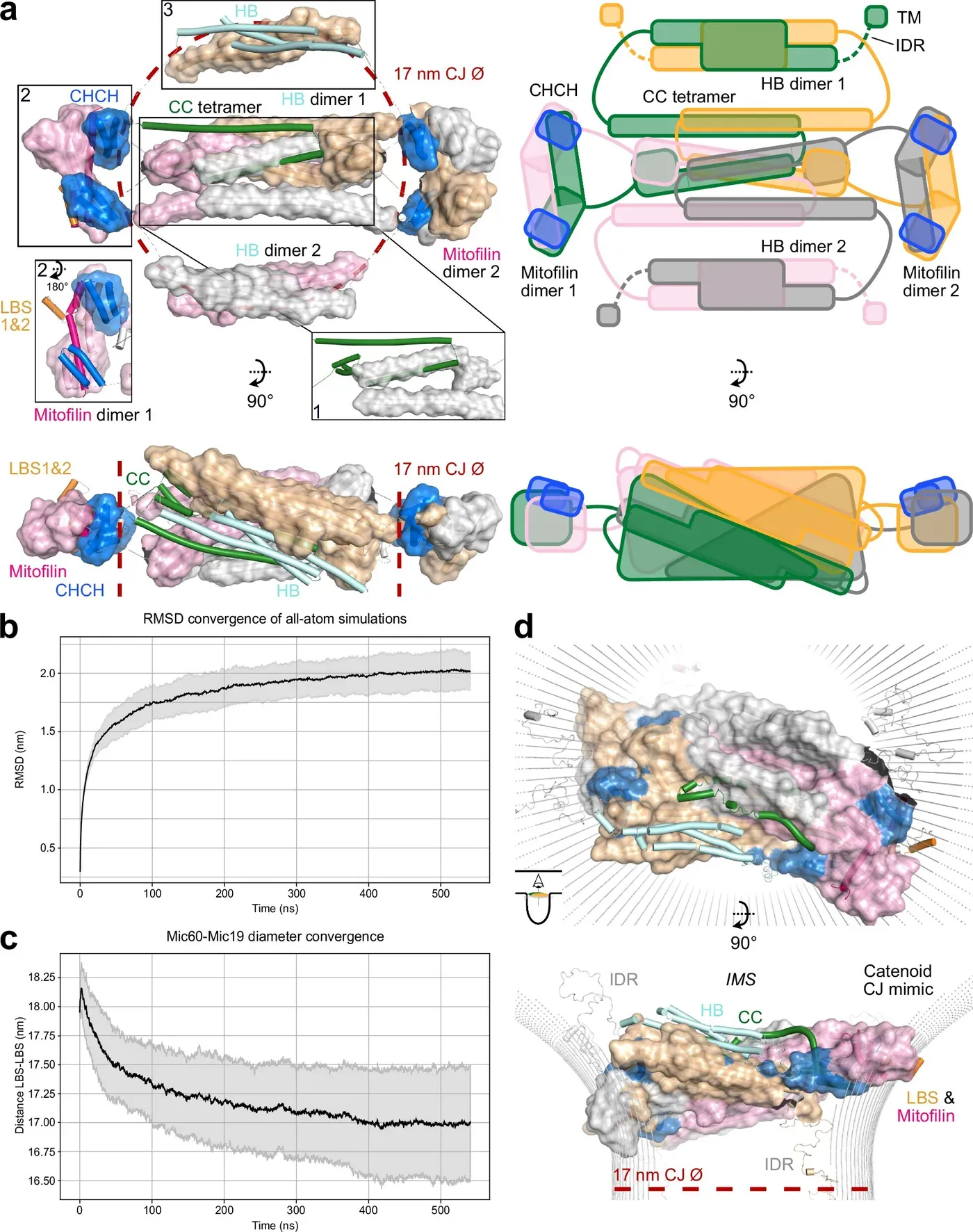
Researchers have long been puzzled about how MICOS works, but a new study has shed light on its function by modeling the human Mic60-Mic19 subcomplex, a key component of MICOS. This part of the complex is crucial for maintaining cristae structure and regulating access to the energy-producing regions within mitochondria.
The team's simulations show that the flexible structure of the Mic60-Mic19 subcomplex spans the entrance of the cristae, allowing smaller molecules to pass through while blocking larger proteins. These findings provide valuable insights into the workings of MICOS and its role in maintaining cellular health.
These simulations offer a detailed look at how the human Mic60-Mic19 subcomplex functions, but further research is needed to fully understand the intricacies of MICOS and its role in regulating mitochondrial function. The team's work has significant implications for understanding various diseases that arise from mitochondrial dysfunction.
The research team's efforts to understand the molecular architecture of MICOS have led to significant breakthroughs in modeling dynamic protein complexes.
MICOS is a complex composed of multiple copies of various proteins, with its largest component being the Mic60-Mic19 subcomplex. This subcomplex contains a long, disordered region that lacks a fixed shape and structure, making it challenging to image or model accurately.
To build an accurate model of the human MICOS subcomplex, the team employed a multi-faceted approach. They began by using X-ray crystallography to determine the structure of a specific section of Mic60 found in animal cells. This information was then combined with fungal structures and predictions from artificial intelligence algorithms to create a virtual representation of the human version.
However, the initial model had a major limitation - it was static and failed to account for the subcomplex's flexibility. To address this issue, the researchers collaborated with the Clementi Lab to computationally simulate the Mic60-Mic19 subcomplex's movements.
The team validated their model by comparing its predictions with structural data from human mitochondria provided by Dr. Fan Liu's laboratory at the Leibniz-Forschungsinstitut für Molekulare Pharmakologie (FMP). Notably, they found a high degree of correspondence between the model and actual data, with 97% similarity, indicating that their model closely reflects the structure of the human subcomplex.
The researchers tested their model's gatekeeping function by simulating the passage of proteins of varying sizes through the subcomplex. They added spheres to represent different-sized proteins and found that the subcomplex blocked those with a radius larger than 2 nanometers from entering. This ability to regulate protein access is crucial for maintaining mitochondrial health, as uncontrolled entry can disrupt normal cellular function.
The disordered regions within the subcomplex played a key role in its gatekeeping function. According to Nathanail, these dynamic structures allowed the subcomplex to effectively "swat away" larger spheres. The use of computational methods enabled the team to visualize this process and understand how it works.
Daumke noted that computational models often provide impressive visualizations but can be difficult to verify experimentally. However, the current study offers a way to bridge this gap by providing a model that can be tested against real-world data. This approach has significant implications for understanding complex molecular systems.
Mitochondrial dysfunction is particularly detrimental in cells with high energy demands, such as those found in muscle and brain tissue. The researchers discovered that a known mutation associated with optic nerve damage and developmental brain disorders alters the core of the MICOS complex. Their model provides a possible explanation for how this mutation leads to disease.
Further research will be necessary to confirm the team's findings and observe the entire MICOS complex at work within mitochondria. For now, they have modeled only part of it, but are working to understand the structure of the machinery inside cells and how it changes during disease and aging.
The researchers have used computer simulations to model a specific part of the machinery inside human cells, known as the mitochondrial folds. These simulations suggest that a flexible protein gate controls access to these folds, which are crucial for energy production within the cell.
The team's goal is to understand how this machinery changes during disease and aging, but for now, they have focused on modeling just one aspect of it. Further work will be needed to fully grasp the intricacies of cellular machinery and its role in human health. Ultimately, a deeper understanding of these complex processes could lead to new insights into the causes of various diseases.
Facts based on reporting originally published by Phys.org.
You may republish this story, in full or in part, if you credit News Central Site and link to it (licence CC BY 4.0). Photos are not included.