Mars' Ancient Climate May Have Been Warmer Than Thought
Researchers propose a new explanation for Mars' warm ancient climate involving hot underground water and iron in the Martian crust.
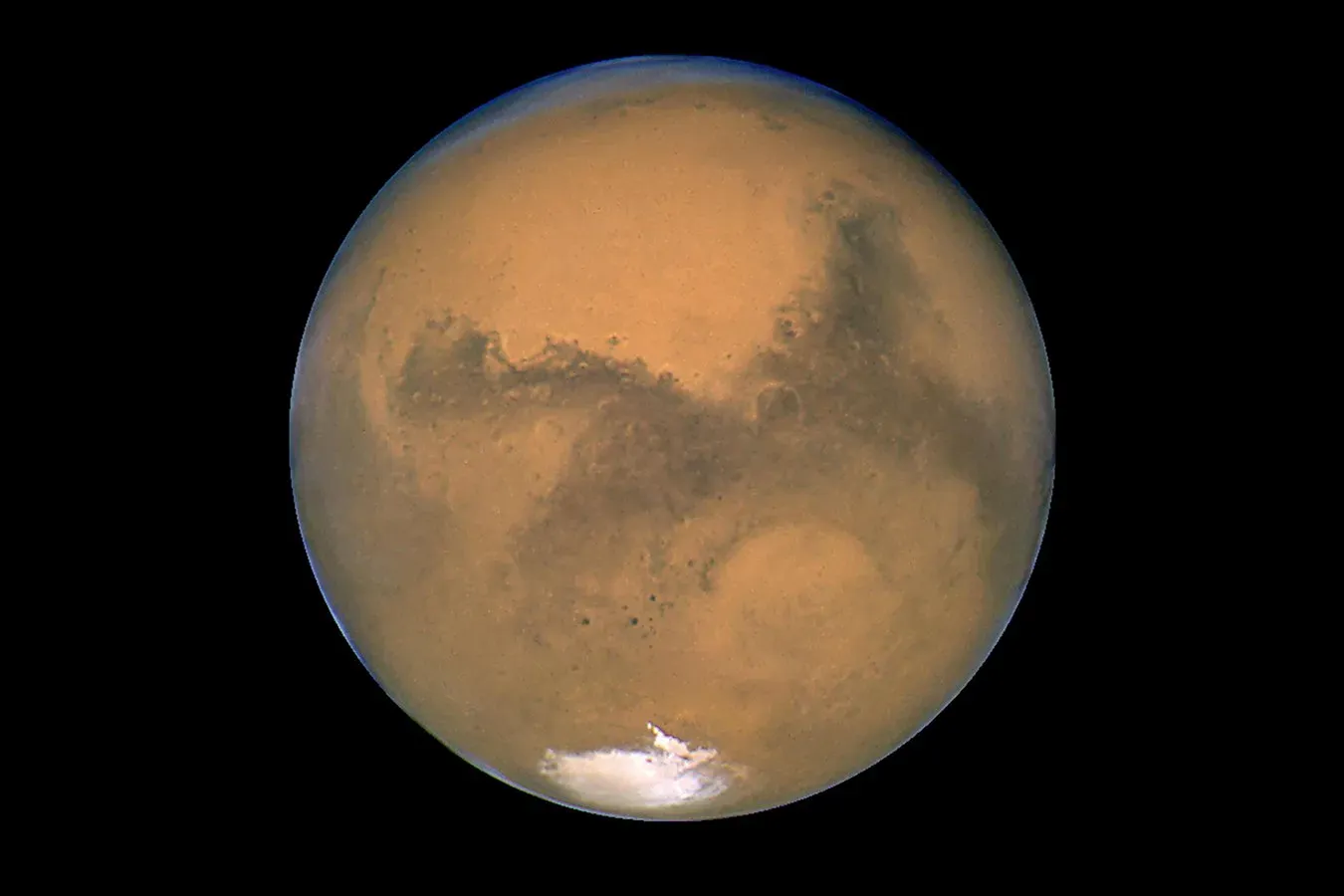
Scientists have been trying to recreate Mars' ancient climate, which was warm enough for water to flow on its surface. However, they haven't been able to agree on an atmospheric recipe that would provide sufficient warming potential. A new proposal has emerged suggesting a different approach. It involves the interaction of hot underground water with iron in the Martian crust.
Water reacting with iron in Mars' crust may have produced a steady supply of hydrogen that was released into the atmosphere for millions of years, according to researchers led by Cin-Ty Lee at Rice University in Texas. While not a greenhouse gas itself, hydrogen can contribute to warming through its interactions with atmospheric carbon dioxide. Specifically, collisions between H2 and CO2 molecules deform both, allowing them to absorb infrared radiation that CO2 alone cannot block.
The presence of even small amounts of hydrogen in the Martian atmosphere could have had a significant impact on the planet's temperature. According to Lee, if there is enough CO2 present, just a few per cent of hydrogen in the atmosphere could be sufficient to bring the average global temperature above freezing. This raises questions about whether Mars' current climate conditions are still conducive to supporting such an atmospheric mixture.
The underground source of hydrogen that Lee proposes is the extremely thick crust beneath Mars' southern highlands, which extends as far as 80 kilometres below ground. The researchers believe that hot water circulating through this crust reacted with iron, producing hydrogen that was released into the atmosphere over millions of years.
As the Martian crust thickens, it contains more radioactive elements like uranium, thorium, and potassium that produce heat as they decay. These elements are scattered throughout the crust, but their concentration increases with depth, meaning thicker crusts harbor a greater total quantity of these heat-generating isotopes.
Despite having the same surface area available for cooling, thicker crusts retain more internal heat due to the increased presence of radioactive elements. This excess heat can have significant effects on the Martian environment, particularly in its upper few kilometres where ice is present.
Ice in the upper levels of the Martian crust would begin to melt as a result of the increased heat, giving rise to aquifers that store water. Once these aquifers are established, the circulating water would start shedding its heat by moving up and down through the porous upper layers of the basalt-rich crust.
The iron content in these basalt layers makes them particularly reactive when exposed to water, leading to rust formation as the water interacts with the metal. This process releases hydrogen molecules into the atmosphere, which would have contributed to a warmer and more humid Martian environment in the past.
Researchers have proposed that hydrogen released from Martian rocks could be responsible for warming up the planet in the past. However, some scientists remain skeptical about this idea until more evidence is presented.
Ramirez of the University of Central Florida has expressed reservations about the theory, stating that it relies on extremely favorable circumstances to explain Mars' warm surface. He also notes that the concept of water releasing hydrogen from rocks was first proposed over a decade ago, but its feasibility remains uncertain.
Lee's research suggests that the process is almost inevitable with a thick enough crust, making it testable by examining the Martian interior. This would not only provide an explanation for Mars' warm climate in the past but also shed light on the red hue of the planet.
As a secondary benefit, studying the Martian crust could reveal how the rusted rocks are exposed to the surface through meteoroid impacts or other processes, leading to dust particles that coat everything in their path.
Facts based on reporting originally published by New Scientist.
You may republish this story, in full or in part, if you credit News Central Site and link to it (licence CC BY 4.0). Photos are not included.