San Francisco Study Highlights Importance of Resident Experiences in Walkability Assessments
A recent study in San Francisco found that physical characteristics such as sidewalks and nearby amenities do not tell the whole story when assessing a neighborhood's walkability.
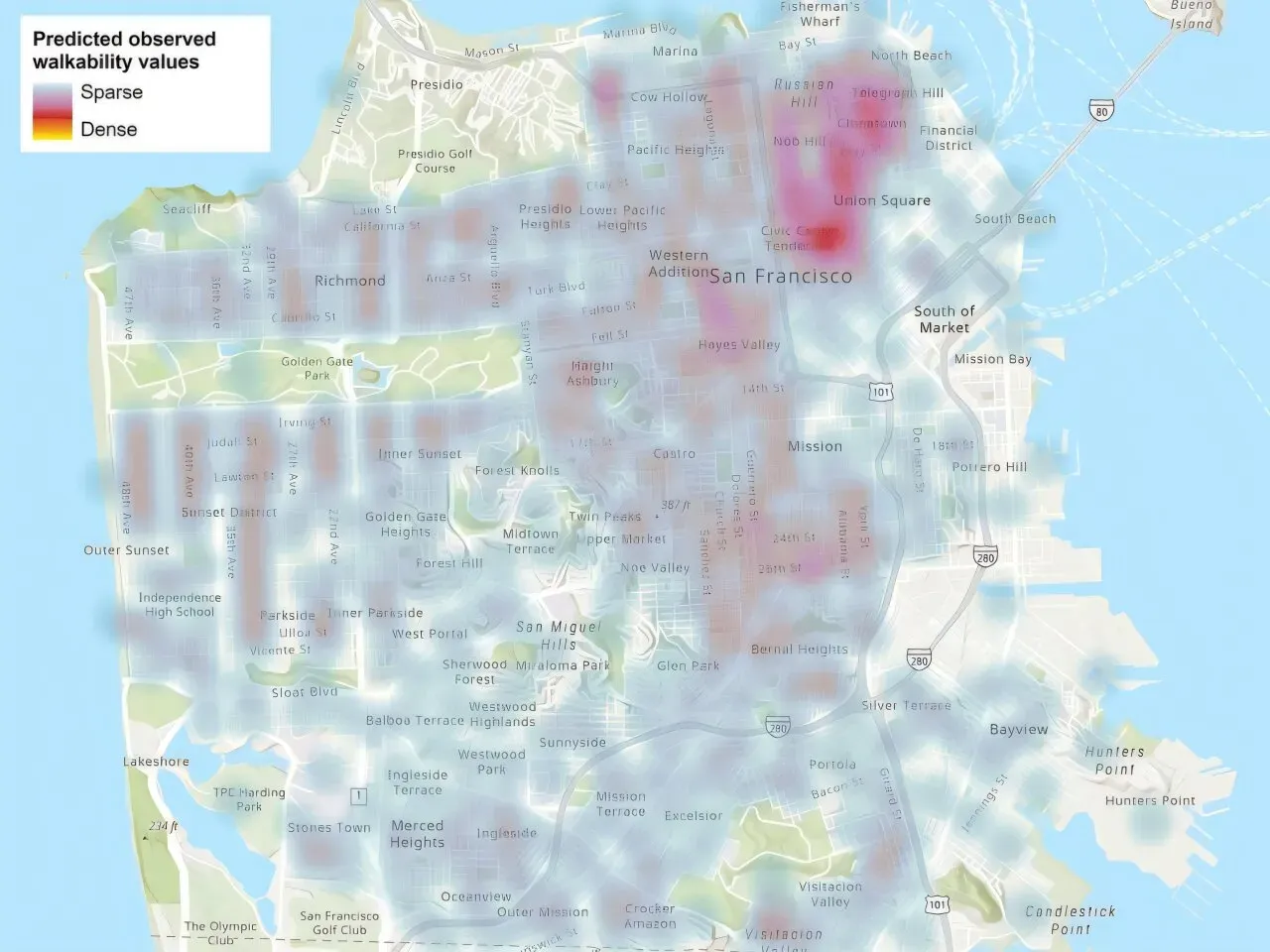
A recent study has highlighted the importance of considering residents' experiences when assessing a neighborhood's walkability. The research, which focused on San Francisco, found that while physical characteristics such as sidewalks and nearby amenities are crucial, they do not tell the whole story.
According to the World Health Organization, walking is essential for maintaining community health, with links to reduced rates of chronic diseases like obesity, diabetes, and cardiovascular disease. To promote healthier communities, city planners often evaluate neighborhoods' walkability scores.
The San Francisco study used data from a 2014-2020 survey of young adults aged 18-32 living in the area. This group is often overlooked in research on walkability, but their perspectives are crucial for understanding how residents experience and perceive their neighborhoods.
Residents' feelings of safety and comfort while walking in their neighborhoods were found to play a significant role in determining walkability scores. This suggests that city planners need to consider more than just physical infrastructure when planning improvements.
The study's focus on an understudied age group, young adults, provided valuable insights into how residents perceive their neighborhoods' walkability.
The researchers conducted a walking survey across 138 census blocks of San Francisco to identify observable characteristics that contribute to a neighborhood's walkability. These characteristics included road quality, access to amenities, sidewalk safety and maintenance, and neighborhood aesthetics.
However, the team found that traditional measures of walkability based on these observations do not necessarily reflect how residents experience their neighborhoods. The study suggests that there is a disconnect between what can be observed and how people perceive their surroundings.
The researchers' findings also indicate that while walkability may not have a significant impact on young adults' self-rated health across San Francisco as a whole, relationships emerge at the neighborhood level. This means that citywide analyses may overlook important differences in how residents experience their neighborhoods.
In some cases, residents' perceptions of walkability were linked to their reported health outcomes, even if physical characteristics suggested otherwise. For instance, in certain neighborhoods where residents tended to report better health, they also perceived their surroundings as more walkable.
In contrast, researchers' assessments of the physical environment sometimes conflicted with residents' views on walkability. This discrepancy highlights the importance of considering resident experience when evaluating neighborhood walkability, rather than relying solely on observable measures.
Researchers have been trying to understand why people living in similar neighborhoods rate their health differently. One possible explanation lies in the way neighborhood walkability is measured. Conventional measures of walkability focus on observable factors such as road infrastructure and land use, but these may not accurately reflect residents' experiences.
In fact, when socioeconomic status was compared with perceived and observed walkability, researchers found a discrepancy between what people thought and what observers saw. In affluent neighborhoods like Nob Hill, the Financial District, or Fisherman's Wharf, residents rated their neighborhood's walkability lower than expected, even though these areas scored high on observable measures of walkability.
In contrast, residents in socioeconomically disadvantaged neighborhoods such as Parkside in San Francisco's southwest portion rated their neighborhood's walkability higher than observers would have predicted. These findings suggest that there are important differences between what people experience and what can be measured objectively.
The study also highlighted racial and ethnic disparities in perceived and observed walkability. In areas with larger proportions of Black residents, researchers found a strong association between lower observed walkability and neighborhood demographics. Conversely, neighborhoods with higher proportions of Latino and Asian residents showed a stronger link between lower perceived walkability and demographic characteristics.
These findings have significant implications for urban planning and public health initiatives aimed at creating healthier communities. By taking into account resident experience and perceptions, policymakers can develop more effective strategies to promote walkability and improve neighborhood environments for all residents.
Historical inequalities in neighborhood development and investment have contributed to the disparity in how residents experience their environments.
These differences are not limited to specific city blocks or neighborhoods within a single urban area, as research suggests that even people living in close proximity may have distinct experiences of walkability.
The study found that observed measures of walkability often fail to capture the nuances of resident experience, highlighting the importance of considering both physical and social aspects of neighborhood environments.
By examining the relationship between perceived and observed walkability, researchers aim to provide a more comprehensive understanding of how residents navigate their urban surroundings.
Researchers have found that residents' perceptions of walkability play a significant role in determining neighborhood characteristics. To measure this relationship, they used satellite imagery to observe street patterns and land use, which was then compared to resident surveys about their walking habits.
The study's findings suggest that perceived walkability is closely tied to observed walkability, with residents accurately assessing the ease of navigating their urban surroundings. By examining the relationship between these two factors, researchers aim to provide a more comprehensive understanding of how residents interact with their environment.
Facts based on reporting originally published by Phys.org.
You may republish this story, in full or in part, if you credit News Central Site and link to it (licence CC BY 4.0). Photos are not included.