Magnitude 7.7 Quake Strikes Myanmar Region
A recent study has analyzed satellite data and video recordings from a 2025 earthquake that devastated Myanmar, providing insights into how similar disasters could unfold in California.
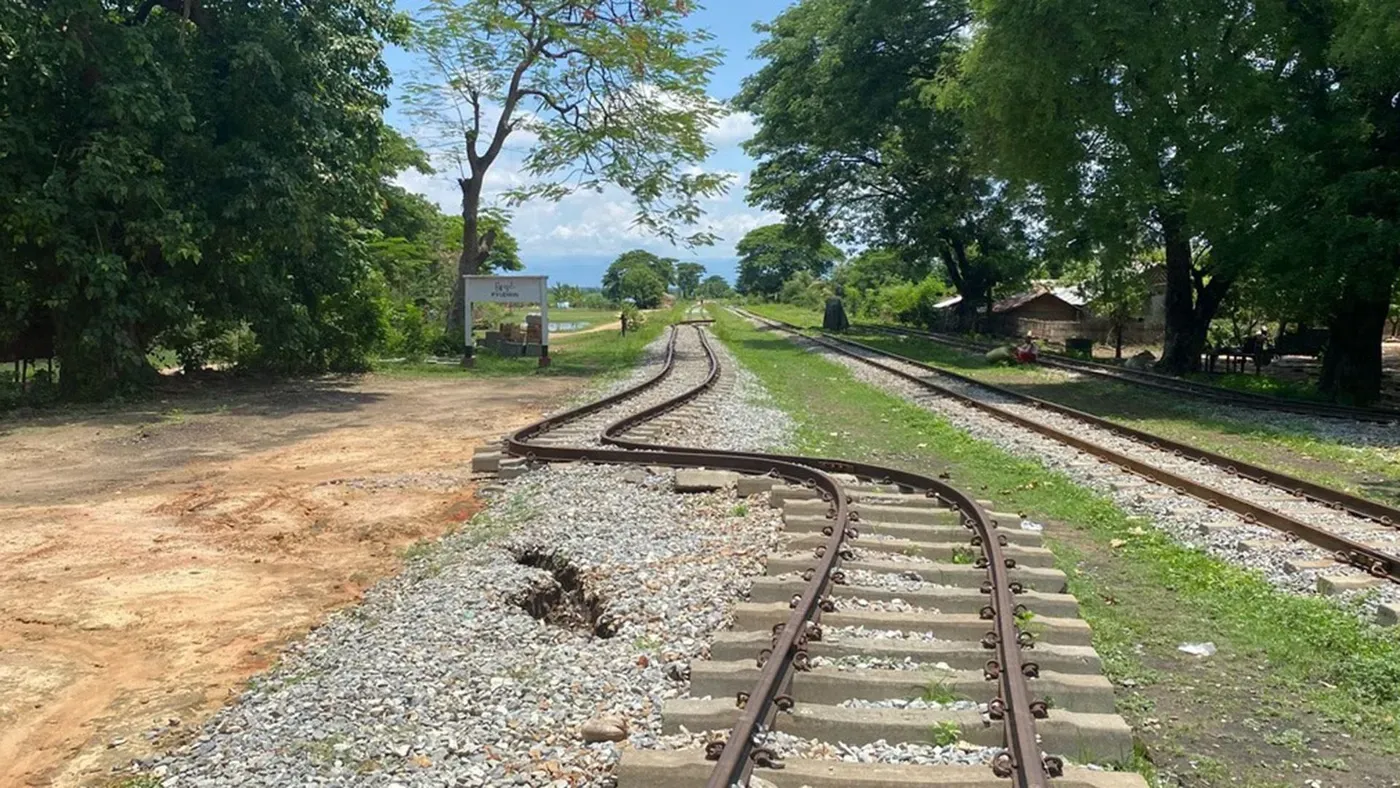
A recent study has revealed new insights into the 2025 Myanmar earthquake that devastated the region and sheds light on how a similar disaster could unfold in California if the "Big One hits the San Andreas Fault.
The magnitude 7.7 quake struck near Mandalay last March, causing widespread destruction as far away as Bangkok, over 1,330 kilometers distant. The death toll from this disaster was estimated to be at least 3,700 people, leaving a trail of devastation in its wake. Researchers have now pored over satellite data and a unique video recording of the ground rupturing during the earthquake.
The Sagaing Fault that triggered the Myanmar quake shares similarities with other strike-slip faults worldwide, posing significant threats to population centers. According to geophysicist Alice-Agnes Gabriel from the Scripps Institution of Oceanography at the University of California, San Diego, this category includes California's San Andreas Fault, which is similarly tilted and capable of generating a 7.8 magnitude earthquake.
The study found that the twisty shape of the Sagaing Fault significantly impacted the shaking caused by the quake. The researchers believe that this finding could have important implications for predicting where the worst shaking will occur in future earthquakes on similar faults.
Gabriel notes that studying the events surrounding the Myanmar earthquake can provide valuable insights into what might happen in future earthquakes on analogous faults, such as California's San Andreas Fault.
The unpredictability of earthquakes is a major challenge for seismologists. They cannot forecast when and where an earthquake will occur on a specific fault line, but they may be able to anticipate certain characteristics of the event.
To model earthquake scenarios, researchers rely on powerful supercomputers and large amounts of data. In the case of the 2025 Myanmar earthquake, scientists had access to a unique piece of information: footage from a security camera that captured the ground cracking as the fault ruptured. This phenomenon had never been recorded before.
The team's computer simulations revealed an unexpected feature of the Sagaing Fault in Myanmar: its surface does not run horizontally under the earth. Instead, it dips westward at the northern end, becomes vertical in the middle section, and then slopes eastward at the southern end.
The direction in which a fault line dips is crucial in determining the intensity of shaking during an earthquake. According to scientists, more intense shaking occurs on the side of the fault where it dips downward. In the case of California's San Andreas Fault, the dip is toward the high desert region, an area with relatively low population density compared to coastal regions.
The researchers believe that the San Andreas Fault has built up significant strain over the past century and may behave similarly to the Sagaing Fault in Myanmar. If this happens, the high desert side of the fault could experience more intense shaking than the coastal side during a major earthquake, often referred to as the Big One.
The researchers' investigation into the Mandalay earthquake has provided valuable insights into the behavior of major faults like the San Andreas Fault in California. According to their findings, small local variations, such as sediment accumulation over bedrock, can significantly impact the severity of ground movement during a large quake.
Los Angeles, situated on a sediment-filled basin, would experience intense shaking if a significant earthquake were to occur there. This is due to the basin's propensity to jiggle like jelly in response to seismic activity. The researchers' analysis highlights the importance of considering local geological conditions when assessing earthquake risks.
The Mandalay quake also offered an opportunity for the researchers to investigate whether they could have predicted certain aspects of the disaster from pre-quake monitoring data. They discovered that segments of the Sagaing Fault had been locked" in place, with rocks jammed against each other as tectonic plates moved past one another.
These locked sections had accumulated strain over a period of 186 years, creating conditions ripe for a significant earthquake. The researchers were able to predict the path, shape and speed of the rupture on the Sagaing Fault using pre-quake data, including detailed fault geometry and locking patterns.
The researchers are now refining their model of what the San Andreas Fault would look like during a massive earthquake, known as the Big One. This updated model will be shared publicly to help inform building codes and emergency management strategies.
The goal is to provide a more accurate picture of how such an event could unfold in California, where the San Andreas Fault poses a significant threat. The researchers' findings have already been applied to a similar fault system in Myanmar, yielding valuable insights into earthquake behavior.
The study's results show that detailed monitoring data can be used to predict not only the path and speed of an earthquake but also its shape. This information could help emergency responders prepare for the aftermath of such an event.
The researchers' work on the Sagaing Fault has provided a roadmap for understanding how similar fault systems might behave in other regions, including California's San Andreas Fault.
The researchers' work on the Sagaing Fault has provided a roadmap for understanding how similar fault systems might behave in other regions, including California's San Andreas Fault. This insight is crucial because it could help scientists and policymakers prepare for the potential consequences of a major earthquake striking the West Coast.
Understanding the dynamics of earthquakes like the one that hit Myanmar in 2025 can also inform strategies for mitigating damage and saving lives. The researchers' findings suggest that similar fault systems might produce catastrophic shaking, landslides, and tsunamis, underscoring the need for proactive measures to reduce vulnerability.
Facts based on reporting originally published by Live Science.
You may republish this story, in full or in part, if you credit News Central Site and link to it (licence CC BY 4.0). Photos are not included.