Interstellar Comet 3I/ATLAS Suffers Significant Material Loss
Researchers estimate that solar heating removed a surface layer approximately 1.7-5.2 meters thick from the interstellar comet, making it difficult to determine its original composition.
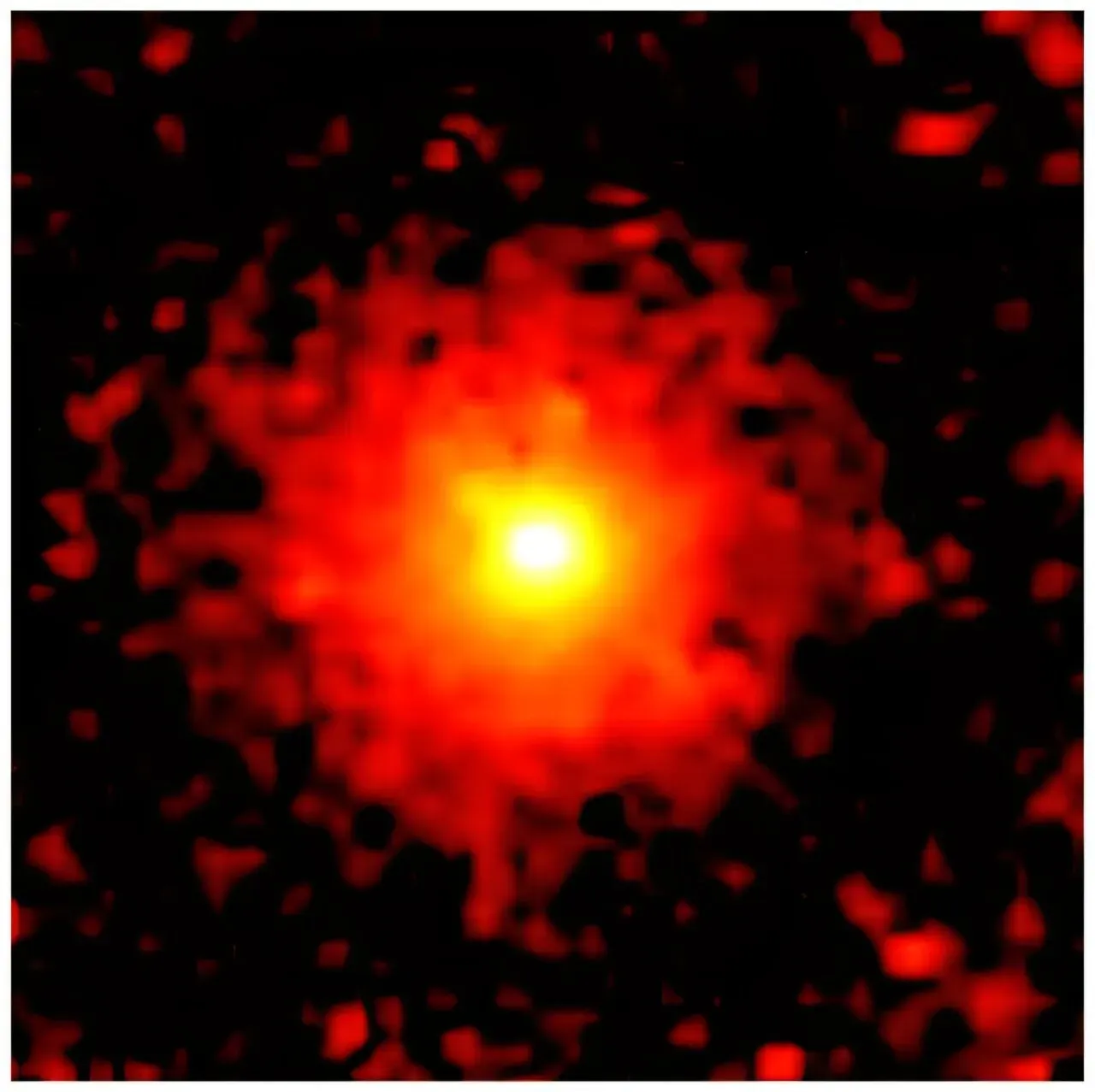
The recent discovery of an interstellar comet has provided scientists with a unique opportunity to study material from another planetary system. However, researchers have encountered a problem in analyzing the comet's chemistry due to potential changes it underwent during its journey through space.
Energetic particles that 3I/ATLAS encountered on its path may have altered its outer layers, making it difficult for astronomers to determine what they are detecting is still representative of the comet's origin. The sun's interaction with the comet could potentially provide a clearer understanding of its composition.
Researchers estimate that solar heating removed a surface layer approximately 1.7-5.2 meters thick from the comet, based on measurements of escaping gas. This estimate can increase to over 10 meters when considering plausible amounts of lost dust.
The calculations were conducted by Tessa Frincke and Darryl Seligman of Michigan State University and have been published in an accepted manuscript for Monthly Notices of the Royal Astronomical Society. The extent to which the comet's material was affected by solar heating depends on how much dust escaped along with the gas.
3I/ATLAS is notable as it is only the third interstellar object detected passing through our solar system, providing a rare opportunity for scientists to study extraterrestrial material up close. As sunlight interacted with the comet, frozen substances turned into gas and formed a cloud surrounding its solid core, further contributing to the complexity of its composition.
The researchers estimated that during its closest approach to the sun, the interstellar comet 3I/ATLAS lost a significant amount of material, primarily in the form of gases such as water, carbon dioxide, and carbon monoxide.
Their calculations put the total gas loss at around 18-58 billion kilograms, which is roughly equivalent to 40-128 billion pounds. This mass loss was substantial enough to have a noticeable impact on the comet's composition and structure.
To better understand the extent of this material loss, Frincke and Seligman modeled the comet as a sphere with an initial radius of 1.3 kilometers and a density typical of comets in our solar system. They then calculated how much the radius would shrink if the estimated amounts of gas escaped.
The results indicated that the erosion was extensive, with estimates ranging from 3.4 to 10.5 meters (11-34 feet) if equal amounts of dust and gas were lost by mass. However, if there were four times as much dust as gas, the modeled erosion would be significantly deeper, reaching approximately 8.6-26.7 meters (28-88 feet).
The ranges in these estimates reflect different assumptions about how long the comet remained active after its closest approach to the sun.
The estimates of how much material was stripped away from comet 3I/ATLAS by the sun's radiation are still uncertain due to assumptions about the comet's size and density.
These factors also affect the amount of dust released per unit of gas, which can change throughout the comet's passage near the sun. This means that the calculations of how much material was lost may not be entirely accurate.
A previous study suggested that radiation converted carbon monoxide into carbon dioxide in the comet's outer layers, potentially explaining the large amount of carbon dioxide detected before its closest approach to the sun. However, this modeling placed a chemically altered zone roughly 15-20 meters deep, which is at odds with the new gas-only estimates.
Some scenarios involving dust do reach comparable depths or go beyond them, suggesting that it's possible for the comet's surface to have been eroded down to layers of unaltered material. However, this conclusion is not definitive and requires further investigation.
The calculations can still provide a way to connect changing chemical signals with possible depths inside the comet. By comparing material released earlier and later in its passage, astronomers may be able to separate what 3I/ATLAS inherited at its birthplace from what happened to it on the way here.
This approach could help shed light on the comet's composition and history, but it also depends on various assumptions about the comet's internal structure and the role of different ices in shaping its chemical signals.
The study suggests that the sun's intense radiation may have stripped away several meters of material from the surface of interstellar comet 3I/ATLAS as it approached perihelion.
This stripping could be responsible for the comet's observed decrease in size and increase in production rates, which are linked to its internal structure. The researchers made these conclusions based on data collected during the comet's passage through the solar system. Further analysis of this phenomenon may provide valuable insights into the composition and history of interstellar comets like 3I/ATLAS.
Facts based on reporting originally published by Phys.org.
You may republish this story, in full or in part, if you credit News Central Site and link to it (licence CC BY 4.0). Photos are not included.