Scientists Make Breakthrough in Electron Manipulation Using Extreme Ultraviolet Light
Researchers have made significant progress in manipulating electrons using extreme ultraviolet (XUV) light by harnessing its power to exert control over electron movement.
Scientists have made significant progress in manipulating electrons using extreme ultraviolet light. This breakthrough has opened up new avenues for researchers to study matter at a fundamental level. By interacting with electrons, light can reveal crucial information about how atoms, molecules, and materials are structured.
High-energy ultraviolet photons are particularly useful because they can access electrons close to atomic nuclei, allowing researchers to identify the unique electronic signature of each chemical element. This ability is essential for understanding the intricate details of matter at the atomic level.
While lasers can control electrons in visible and infrared regions, extending this technique to XUV and X-ray domains has proven to be a significant challenge. Researchers have struggled to replicate these results in more energetic regions of the spectrum.
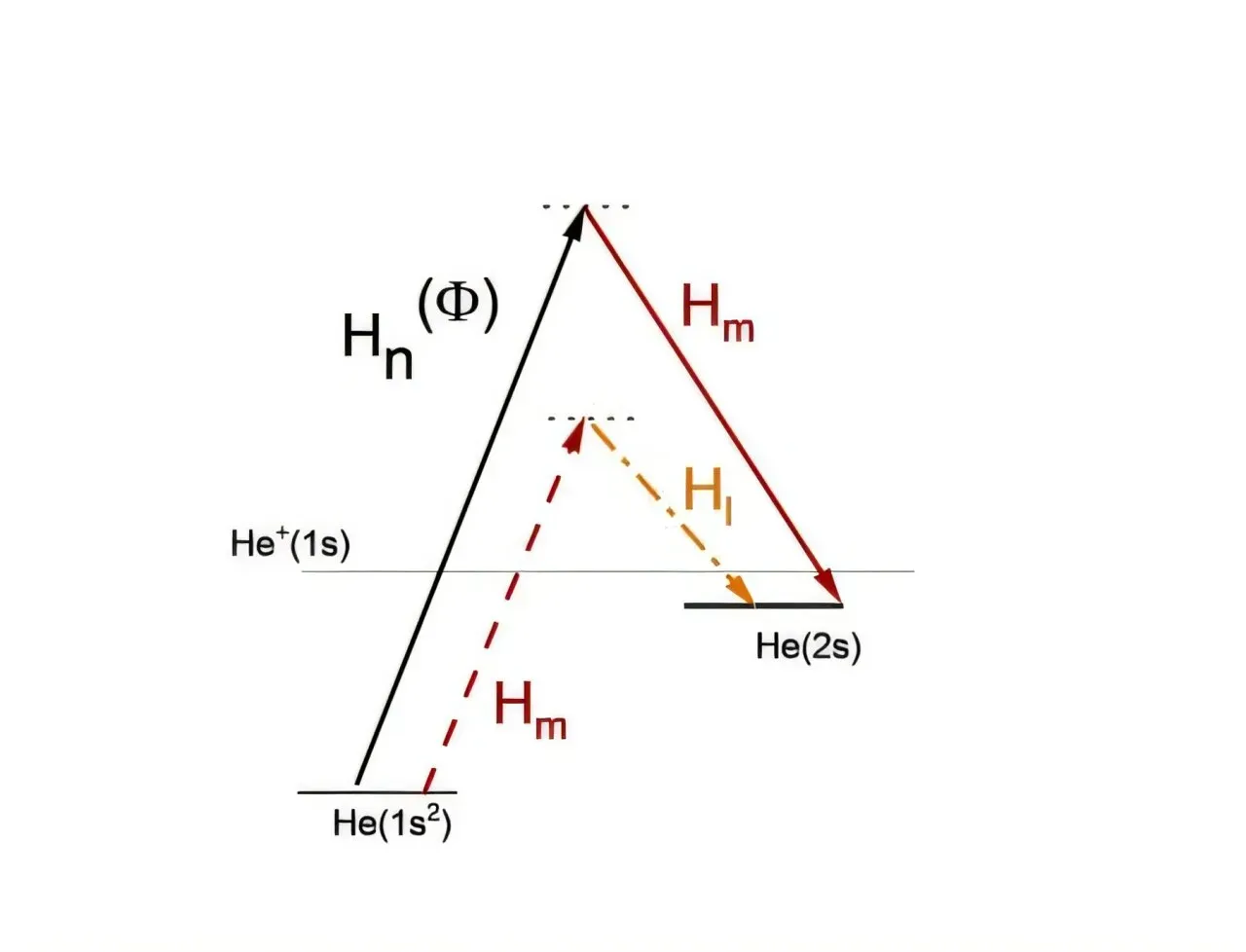
To overcome this hurdle, an international research team has developed a new tool for controlling electrons in the demanding XUV region. By creating two competing quantum routes to excite a bound state, they were able to exploit the phenomenon of overlapping ripples in quantum mechanics.
The researchers used stimulated Raman excitation with XUV pulses to create these competing routes, which can either add up or cancel each other out. This innovative approach has paved the way for further research into quantum coherent control and its potential applications.
Researchers have made significant progress in manipulating electrons using extreme ultraviolet (XUV) light. By harnessing the power of XUV fields, scientists can now exert control over electron movement in a way that was previously not possible.
The technique relies on stimulated Raman excitation, where an electron is "ejected" from its atom and then guided back home with light. This process has been shown to be highly sensitive to the phase of one of the XUV fields used in the experiment.
When two distinct transition pathways are involved, researchers can influence the outcome by introducing small delays in the light pulses. By controlling the phase of these pulses, scientists can manipulate the interaction between the quantum pathways, allowing them to either cooperate or work against each other.
The ability to control electron movement with XUV light has far-reaching implications for various fields of research. For decades, scientists have used stimulated Raman scattering and related techniques to study chemical reactions and electronic motion using visible and infrared lasers.
This breakthrough experiment was conducted at the FERMI free-electron laser in Trieste, Italy, one of a limited number of facilities worldwide capable of producing highly controlled XUV light. The results of this research are expected to pave the way for new applications in imaging and manipulating matter with unprecedented spatial resolution.
The team of researchers has leveraged the capabilities of advanced facilities to produce intense flashes of extreme ultraviolet (XUV) light, allowing them to examine matter in unprecedented detail.
These high-intensity XUV pulses enable the researchers to probe the motion of electrons and atomic nuclei with great precision, providing a snapshot of their dynamics. This level of insight is comparable to the detailed images obtained through X-ray imaging, which can reveal internal structures within the human body. The team's findings have significant implications for the development of advanced imaging tools.
The concepts demonstrated in this research are expected to pave the way for the creation of element-specific imaging and spectroscopy instruments that can track electronic motion and chemical transformations at the smallest scales.
Facts based on reporting originally published by Phys.org.
You may republish this story, in full or in part, if you credit News Central Site and link to it (licence CC BY 4.0). Photos are not included.