King Tutankhamun's Tomb Discovery Inspires Van Cleef & Arpels Designs
Archaeologists Howard Carter and his team made a groundbreaking discovery in 1922 when they uncovered King Tutankhamun's tomb, sparking a new wave of Egyptian Revival in the Art Deco movement.
Archaeologists Howard Carter and his team made a groundbreaking discovery in 1922 when they uncovered King Tutankhamun's tomb. This find sparked a new wave of Egyptian Revival in the Art Deco movement, characterized by regal diadems, golden collars, and bold cuffs.
Van Cleef & Arpels took note of this trend and incorporated elements of ancient Egypt into their designs. Egyptian-inspired calligraphy, hieroglyphs, and semiprecious stones became integral to their lexicon of deco bracelets, sautoirs, and brooches, imbuing them with a sense of history.
The New Kingdom's opulent collars, sculptural rings, and other pieces showcased the era's arts, values, and beliefs. Van Cleef & Arpels drew inspiration from these relics to create designs that honored the past while embracing the glamour of the 1920s.
In doing so, Van Cleef & Arpels uncovered the mystique beneath their history. Necklaces with shape-shifting properties led users into new realms of self-expression, and brooches like Mysterioux reimagined sacred deities in gold and gemstones.
Archaeologist Randall Hixenbaugh explains that ancient Egyptians often used real animals in amulets and small statues, imbuing their owners with desirable traits while also paying homage to the creatures themselves.
These talismans were thought to enhance various aspects of human experience - cats for joy, mongooses for protection against snakes, and frogs for fertility. The value placed on certain stones was deeply rooted in their associations with abundance and immortality.
The Egyptians held bright blue and green materials in high esteem due to their connections with the Nile, the sky, and life itself. Lapis lazuli, a rare and valuable stone, was reserved for pharaohs, underscoring its significance.
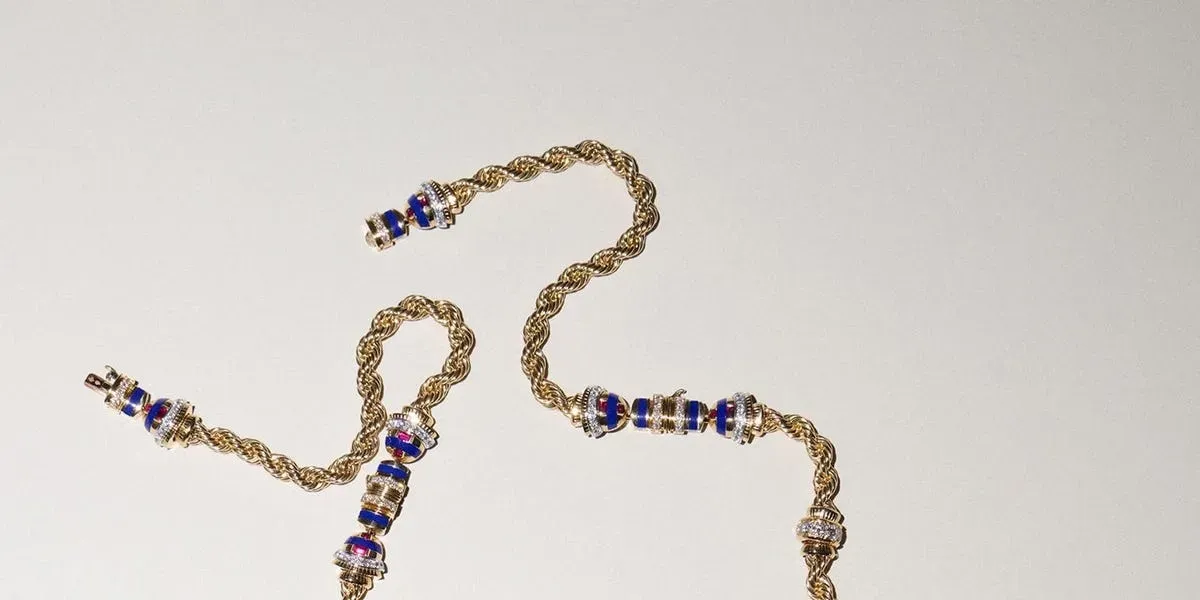
Van Cleef & Arpels' latest creations prominently feature cobalt, an element that appears generously throughout the "Ornement de Saphir necklace.
The Art Deco style has been a defining feature of Van Cleef & Arpels' designs for decades, and nowhere is this more evident than in their exquisite bracelets.
Articulated cuff styles were incredibly popular in the 1920s, providing ample space for intricate motifs to shine, often featuring elaborate scenes and figures.
The house patented its unique method of crafting seamless gemscapes in the 1930s, which has since been used to create a range of Paysage" bracelets that bring ancient landscapes to life with fields of gemstones.
Clad in glittering jewels, these deco-style pieces are truly breathtaking, evoking the grandeur of Egyptian monarchies, starry skies, and majestic monuments.
The Egyptian royal family's fascination with Van Cleef & Arpels' creations is well-documented, and one notable example is Princess Faiza's purchase of a stunning necklace in 1937.
This masterpiece was a true marvel of its time, combining brilliant facets with dome-shaped gems to create a unique visual experience that bridged the transition from traditional to modern design.
By the 1950s, Van Cleef & Arpels had fully immersed itself in the Egyptomania trend, incorporating organic forms and space-age elements into its designs, as seen in pieces featuring semiprecious stones.
The era's use of smooth, matte surfaces for turquoise, malachite, and coral added a layer of realism to biomorphic designs, such as the scarab clip with turquoise wings from 1957.
The intricate designs of Van Cleef & Arpels' creations were so captivating that they even inspired a renowned choreographer to bring their beauty to life on stage. George Balanchine's Jewels for the New York City Ballet in 1931 was a testament to the timeless allure of these exquisite pieces, which had already made their mark with a collection of ballerina clips and brooches just a couple of years prior.
The anatomically detailed figures that adorn the Muse Éternelle brooches are a masterful blend of ancient elegance and modern craftsmanship. Modeled after Cleopatra, these palm-sized icons are lavishly draped in threads of gold, studded with diamonds, sapphires, rubies, and emeralds, their beauty radiating from every angle.
Facts based on reporting originally published by Harper's Bazaar.
You may republish this story, in full or in part, if you credit News Central Site and link to it (licence CC BY 4.0). Photos are not included.