KAIST Researchers Develop Wearable Device for Administering Eyedrops in Space
A team of researchers at KAIST has made significant progress in developing a wearable device that can administer eyedrops to astronauts in space, overcoming a major hurdle for deep space exploration.
A team of researchers at KAIST has made significant progress in developing a wearable device that can administer eyedrops to astronauts in space. The challenge of applying eyedrops in zero-gravity environments had long been acknowledged as a major hurdle for deep space exploration.
The standard method of administering eyedrops relies heavily on gravity, which makes it impractical for use in space. However, the consequences of neglecting eye care during prolonged space missions can be severe, including changes to the structure and function of the eyes due to microgravity's effects on body fluids.
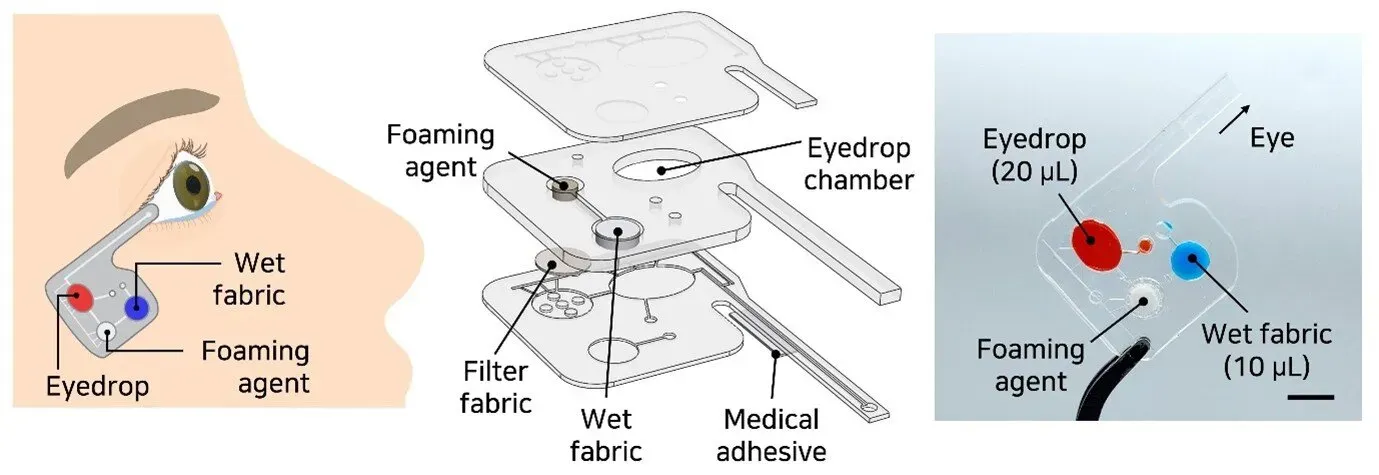
To overcome this limitation, a research team led by Professor Ki-Hun Jeong from KAIST collaborated with another team at Seoul National University Bundang Hospital. Their innovative solution involves combining microchannels that carry liquid with a chemical reaction chamber that generates pressure within a single flexible patch.
When the user presses the actuation area on the wearable device, it triggers a chemical reaction that produces gas and builds up pressure inside the patch. This pressure then delivers the eyedrop to the eye, eliminating the need for gravity-assisted delivery.
The development of this wearable patch is seen as a crucial step towards ensuring astronauts' health during extended space missions. Its ability to administer eyedrops without relying on gravity makes it an essential tool for long-duration space exploration.
The wearable patch's innovative mechanism relies on a chemical reaction between vitamin C and baking soda to generate pressure. This process creates carbon dioxide gas when ascorbic acid and sodium bicarbonate come into contact with water, pushing the eyedrop through the microchannel.
A crucial component of this design is a filter placed between the reaction chamber and the eyedrop chamber. The filter allows gas to pass through while blocking liquid, ensuring that the reactants remain separate from the eyedrops. This separation maintains the patch's efficiency without relying on external power sources or equipment.
The research team conducted experiments to test the patch's performance in varying gravitational conditions. Their results showed consistent release of eyedrops even when gravity was altered. This ability to function independently of gravity is a significant advantage for use in space exploration.
In addition to its performance in different gravitational environments, the patch also demonstrated comparable efficacy to traditional eyedrop delivery methods during an on-body evaluation with human participants. The study's findings suggest that this wearable technology has potential for self-administration of eyedrops in space.
Further verification is needed before the patch can be used in actual space environments. However, its design and functionality make it a promising innovation for personal drug delivery systems, offering a new approach to administering eyedrops without relying on gravity.
The wearable eyedrop patch is not limited to use in space. On Earth, it could provide assistance to individuals who struggle with administering eyedrops due to hand tremors or other physical limitations. This would include patients suffering from conditions like Parkinson's disease.
According to professor Jeong, the flexible patch offers a convenient and straightforward solution for delivering medication without requiring additional equipment. Its potential applications extend beyond space medicine to various settings where ease of use is essential.
This innovative technology has the potential to benefit individuals with physical limitations on Earth while also expanding its reach into space medicine and other areas.
Facts based on reporting originally published by Phys.org.
You may republish this story, in full or in part, if you credit News Central Site and link to it (licence CC BY 4.0). Photos are not included.