Job Cuts Attributed to AI Reach Over 117,000 This Year
A new tracker maintained by the Center for AI Safety estimates that over 117,000 job cuts attributed to AI have taken place across the country this year, resulting in approximately $8.5 billion in estimated annual wage losses.
Rapid advancements in artificial intelligence have led to widespread fears about its impact on the economy and job availability.
In recent years, major companies have been laying off employees at an alarming rate, sparking concerns that AI is taking over human jobs. However, some of these job cuts can be directly attributed to the increasing reliance on automation and AI technology.
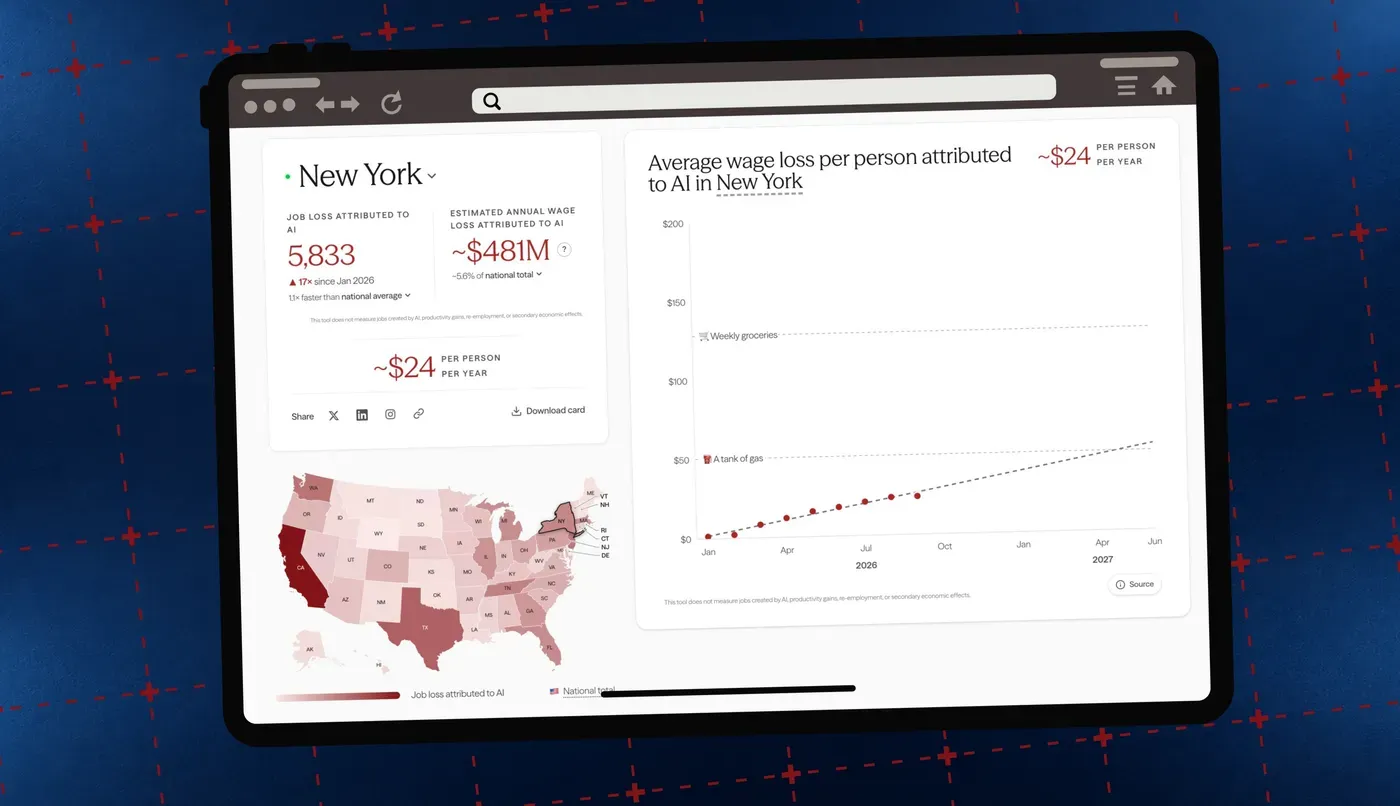
A new tracker maintained by the Center for AI Safety (CAIS) provides a comprehensive overview of the impact of AI on family wages. The Wage Loss Dashboard offers an interactive map showcasing where layoffs have occurred since January 2026, as well as data for individual states.
The dashboard estimates that over 117,000 job cuts attributed to AI have taken place across the country this year, resulting in approximately $8.5 billion in estimated annual wage losses. This staggering figure highlights the significant impact of AI on household incomes and local economies.
To calculate these losses, the dashboard multiplies the number of AI-attributed job cuts by the average annual salary, providing a clear picture of what these layoffs can mean for individuals and communities. The data reveals that these estimated wage losses are not uniform across the country, with some states experiencing significantly higher losses than others.
The dashboard also presents an estimated average wage loss per person based on layoff data, showing how these losses compare to everyday expenses like a tank of gas. For the country as a whole, this figure stands at $25 per person per year, although it varies greatly from state to state.
The estimated average loss per person in a state due to AI-attributed job cuts is calculated using a complex formula that takes into account various data sources.
This calculation method involves converting the number of job cuts attributed to AI in each state into an estimated annual wage loss, and then dividing this figure by the state's population. The result provides a metric that represents the average impact on everyone in a particular state, not just those directly affected by layoffs.
The dashboard relies on data from several sources, including monthly reports from Challenger, Gray, and Christmas, which track job cuts across the US by state and national AI-related layoffs. It also uses information from the Bureau of Labor Statistics on annual mean wages for each state, as well as population estimates from the US Census Bureau.
These diverse data sources are combined to provide a comprehensive picture of the impact of AI on employment in different states, allowing users to compare the effects of automation on their local economy with those in other regions.
The impact of job losses due to automation can be felt far beyond the individual affected. Companies have publicly linked over 54,000 layoffs in 2025 to artificial intelligence, which translates to one in twenty layoffs from last year.
While tracking job losses provides a measure of the scale of the issue, it doesn't convey the full extent of its economic implications for individuals and communities. The monetary costs of AI on American families and communities are difficult to quantify, according to CAIS, the organization behind this project.
The ripple effect of layoffs can be seen in various aspects of local economies, including grocery stores, small businesses, rent, and other expenses. When one person loses their job due to AI, it has a direct impact on the income they contribute to these businesses.
The researchers behind the project highlight that the impact of AI-attributed job cuts is not evenly distributed across states. Those with significant tech and media sectors are experiencing greater losses, underscoring the diverse effects of automation on different regions.
This dashboard does not account for jobs created by AI or productivity gains, as these factors are still being debated among experts. Additionally, there's no consensus on whether AI will stimulate the economy more than it displaces jobs.
The data used in this project only includes job cuts that companies have explicitly linked to AI, but even this information is subject to ambiguity due to varying definitions and a lack of transparency from companies about the causes of layoffs.
The Alliance for Secure AI's methodology in tracking job losses due to AI is focused on capturing a broad pattern of workforce reductions while excluding unrelated cuts. According to the alliance, this means that they don't require explicit statements from executives confirming that AI was used to replace teams.
Other trackers like Jobloss.ai also catalog job loss data by company, date, and how companies cite AI around those layoffs. However, due to the ambiguity in tracking these data, Jobloss.ai only logs layoffs meeting certain criteria: at least 100 jobs lost in one instance accompanied by some mention of AI or proxy terms.
The dashboard aims to make existing data more accessible rather than shaming any particular industry or company for its AI adoption choices. The goal is to provide real information so workers, communities, and policymakers can respond accordingly instead of relying on guesses.
The Wage Loss Dashboard also includes a section on how well AI performs in completing remote freelance tasks. Using data from the Remote Labor Index, which tests agents on real-world freelance tasks like web development and video production, it shows how quickly agents are evolving.
This data is intended to provide insight into the costs of AI adoption, with the alliance stating that companies are adopting this technology for various reasons beyond just job cuts.
The rapid advancement of artificial intelligence (AI) is transforming the job market at an unprecedented rate. According to a recent report, AI agents have made significant strides in completing projects at professional quality, with some models now able to complete up to 15.8% of tasks within this level.
This growth is largely attributed to the development of sophisticated language models such as Claude Fable 5 and OpenAI's GPT-5.5. These models are capable of automating a substantial portion of remote tasks, with the percentage doubling every three months on average.
Despite these advancements, it's essential to note that AI adoption is not solely driven by job cuts. Companies are adopting this technology for various reasons beyond just cost savings. Recent legislation in certain states aims to regulate the use of AI systems in hiring and disciplinary decisions.
The intersection of AI-attributed job cuts and increasingly work-capable agents has raised concerns among experts, who warn that companies may opt for automated systems over human labor in certain cases.
Facts based on reporting originally published by ZDNet.
You may republish this story, in full or in part, if you credit News Central Site and link to it (licence CC BY 4.0). Photos are not included.