Heart Failure Treatment Using Photosynthesis Technique Developed
Researchers have discovered a way to harness photosynthesis to boost energy levels within rat hearts suffering from experimentally induced failure using spinach-derived nanoparticles and red light.
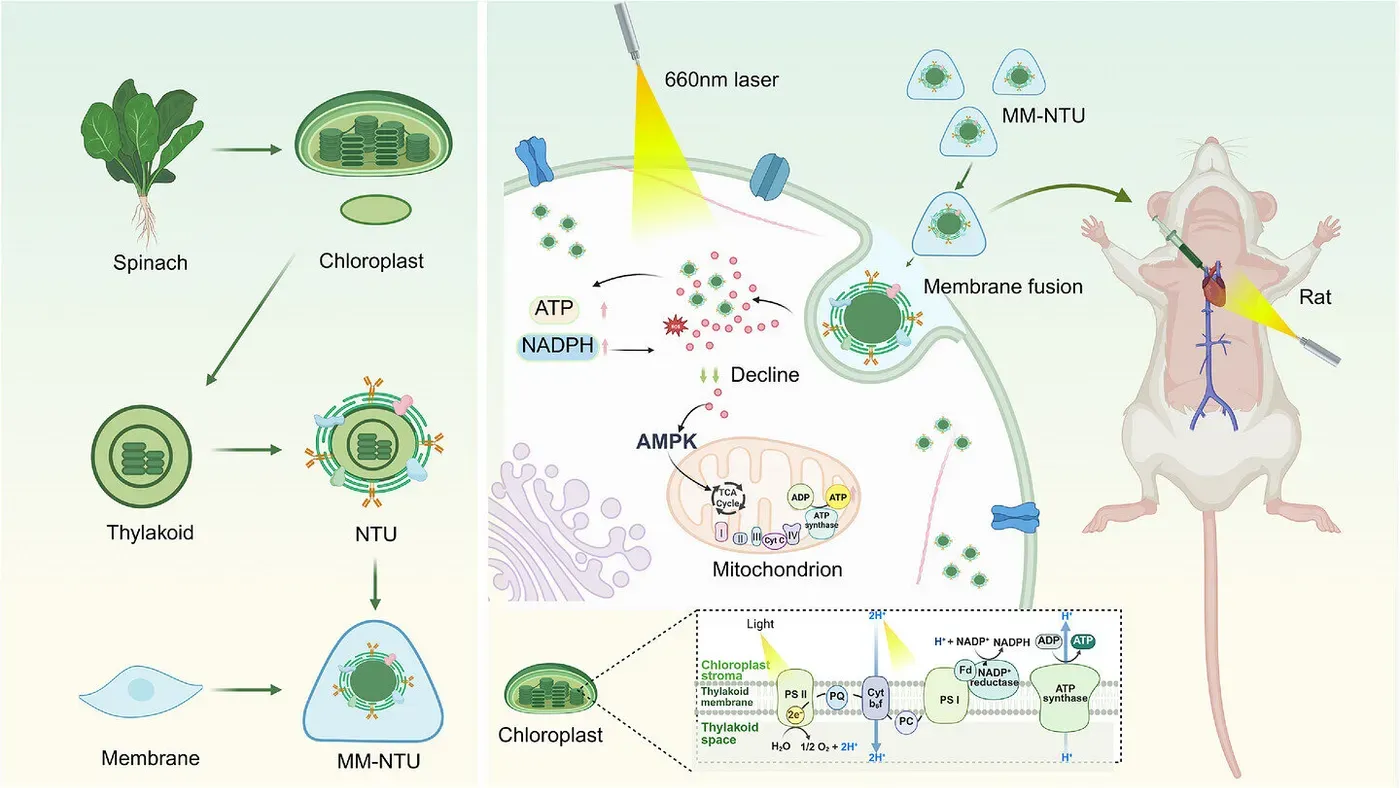
Researchers in China have made an intriguing discovery that could potentially revolutionize the treatment of heart failure by harnessing the power of photosynthesis to boost energy levels within the heart itself.
Using spinach-derived nanoparticles, scientists have found a way to mimic the plant's ability to convert light into chemical energy and apply it to rat hearts suffering from experimentally induced failure. The team's innovative approach involves combining these nanoparticles with red light to stimulate energy production in the heart muscle cells.
The results of their study suggest that this "borrowed photosynthesis technique could provide a new avenue for addressing the underlying energy deficit associated with heart failure. According to the researchers, the nanoparticles and red light combination work together to create a biological battery" capable of controlled energy output.
Heart muscle cells rely on a continuous supply of ATP to function properly, and most of this energy is produced by structures called mitochondria within the cell. When these mitochondria begin to falter during heart failure, it can lead to an energy shortage that exacerbates the muscle's dysfunction.
The scientists' goal is to develop this approach as an experimental treatment aimed at improving heart muscle energy shortages in patients with heart failure. If successful, this innovative therapy could potentially offer a new hope for those struggling with this debilitating condition.
To enhance the effectiveness of plant-based nanoparticles, researchers wrapped them in membranes taken from heart muscle cells to facilitate their entry into heart tissue.
This modification proved successful in laboratory tests, where cultured rat heart cells demonstrated a greater uptake of coated particles compared to uncoated ones.
When exposed to red light, the treated cells showed increased ATP levels. Additionally, the illuminated particles helped protect mitochondrial structure and reduced the accumulation of potentially damaging reactive molecules in stressed cells.
The researchers then sought to determine whether this treatment could improve overall heart function. To achieve this, they surgically narrowed the aortas of rats, forcing their hearts to work against greater resistance over time.
This procedure led to enlargement and impaired heart function, prompting the main experiment to test the efficacy of the nanoparticle treatment under these conditions.
Ultrasound imaging revealed that rats treated with both nanoparticles and light showed improved pumping function compared to untreated animals with heart pressure overload. These rats also exhibited less scarring and abnormal muscle cell enlargement in their hearts. In contrast, rats receiving only the nanoparticles did not experience a statistically significant improvement in heart function.
The success of combining nanoparticles with illumination treatment under these conditions suggests that this approach may be beneficial for failing rat hearts. However, making this treatment practical would require finding a way to deliver both the nanoparticles and light to the heart efficiently. The current method of direct injection into the rats' veins has yet to be proven effective in reaching the heart.
Injections were used in the animal experiment because the membrane coating on the nanoparticles allowed them to enter cultured cells. However, it is unclear whether particles injected into a vein could reach the heart in sufficient quantities for treatment. This uncertainty highlights the need for further research into the delivery of nanoparticles and light to the heart.
Researchers also investigated how light is delivered to the heart tissue. They placed isolated rat chest-wall tissue over cultured cells containing the nanoparticles and found that red light passing through the tissue still increased ATP levels, although less effectively than direct illumination. This raises questions about whether enough light can reach a human heart.
The plant machinery used in this treatment also loses its ability to generate ATP during prolonged illumination, which may limit the effectiveness of each dose over time.
Developing a system to release the nanoparticles at the heart's surface could simplify treatment for patients.
Researchers suggest using gels or patches that can hold particles in place and gradually release them as needed.
This approach might reduce the frequency of injections required to administer the treatment, but light would still be necessary to sustain the photosynthetic activity of the spinach nanoparticles.
A successful treatment system could potentially provide a reliable source of energy for failing hearts.
Facts based on reporting originally published by Phys.org.
You may republish this story, in full or in part, if you credit News Central Site and link to it (licence CC BY 4.0). Photos are not included.