Groundbreaking Discovery Made About Fruit Fly's Ability to Survive Harsh Environments
Researchers at the Francis Crick Institute have identified a specialized lipid barrier in the fruit fly that protects against dehydration.
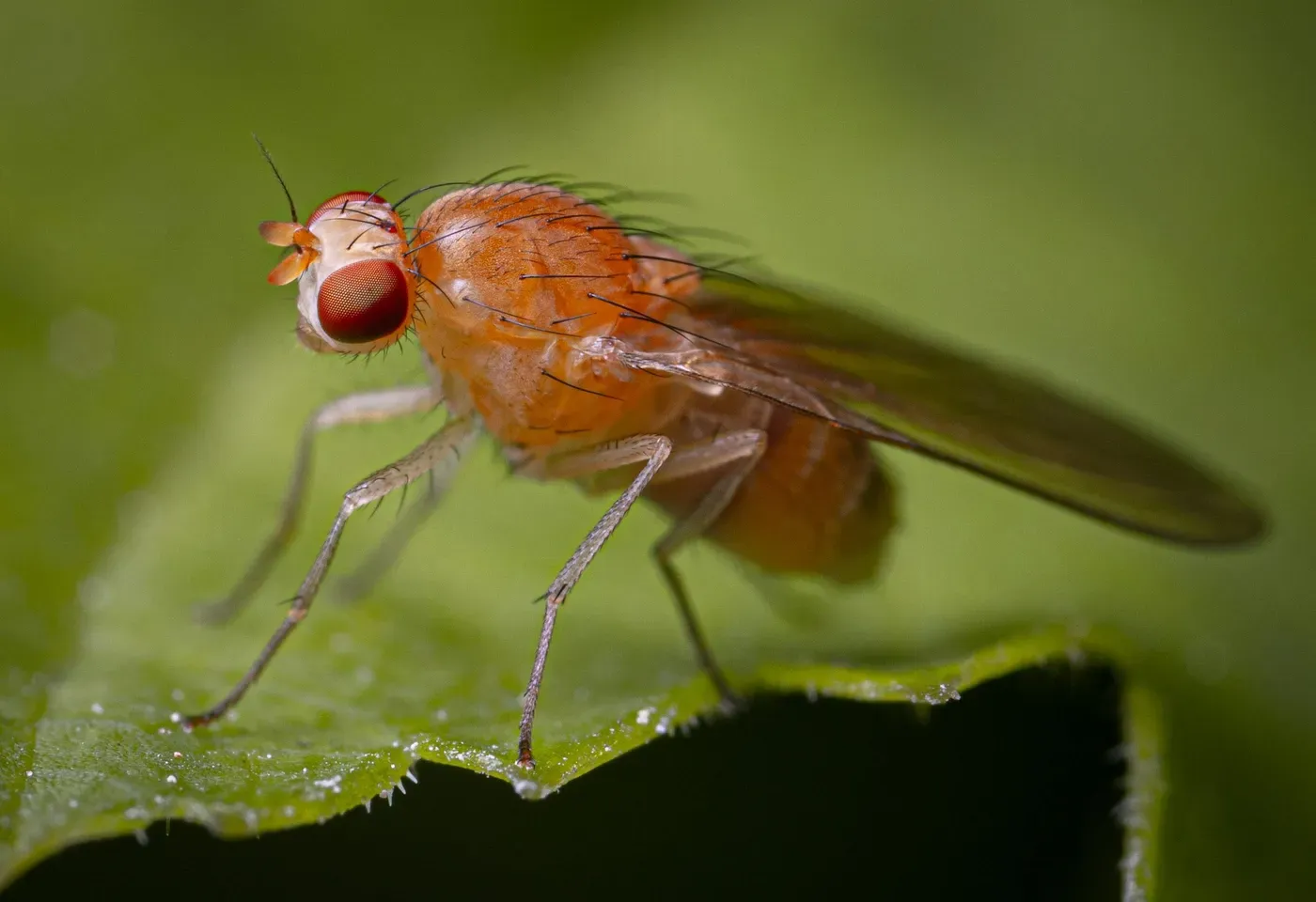
Researchers at the Francis Crick Institute have made a groundbreaking discovery about the fruit fly's ability to survive in harsh environments. A specialized lipid barrier has been identified in the pupa stage of the fruit fly, which protects against dehydration in dry and hot conditions. This finding is significant as it reveals how insects can adapt to environmental stresses.
The study focused on the fruit fly, or Drosophila, a species commonly used in research due to its unique characteristics. During its early development, the fruit fly spends its days as a larva in a humid environment, feeding and burrowing into decomposing fruit. This period is crucial for its growth and preparation for the next stage of its life cycle.
As the fruit fly matures, it undergoes metamorphosis, transforming from an immobile pupa into an adult fly. This complex process involves significant changes to its physical structure and development. The adult stage is particularly vulnerable to dehydration due to its dry-land environment, which poses a significant threat to its survival.
The researchers found that the adult fruit fly has a lipid barrier that prevents water loss through its hydrophobic coating. However, until now, it was unclear how the pupa protects itself from dehydration or what type of hydrocarbon barrier it might have. This knowledge gap has been filled by the recent discovery at the Francis Crick Institute.
The new findings expose the limit of this lipid barrier in extreme environments and suggest that some insect populations may struggle to adapt to climate change. Further research is needed to fully understand how insects like the fruit fly protect themselves from environmental stresses and what implications this has for their survival in a hotter, drier world.
The researchers at the Crick adapted methods from the petroleum industry and used advanced molecular imaging techniques to analyze the hydrocarbons found in fruit flies. Their findings revealed a surprising difference between the adult and pupa stages of the insect's life cycle.
While adults have hydrocarbons present on the surface of their outer body casing, or cuticle, the pupa stage has them internally, coating the underside of the cuticle. These internal hydrocarbons are particularly long in length, far exceeding those found in adult fruit flies.
The team discovered that these hyper-long hydrocarbons are produced by specialized cells within the larval stage and stored in the insect's fat reserve until needed. This anticipatory strategy may enable the rapid deployment of these protective molecules during the transition from larva to pupa.
Further investigation into the production of these long-chain hydrocarbons revealed a specific elongase enzyme responsible for their creation, but its removal did not have a significant impact on the insects in standard laboratory conditions.
The researchers recreated conditions similar to subtropical and Mediterranean climates by exposing fruit fly pupae to high temperatures and low humidity. This environment significantly reduced the water content of the pupa's body but had a much more severe effect on insects lacking the hyper-long elongase enzyme.
Dehydration in these insects almost doubled, making it incompatible with survival. The study highlights the importance of this specific enzyme in maintaining the insect's ability to conserve water in hot and dry environments.
The lipid barrier that surrounds the fruit fly's body has two main functions: protecting against dehydration and serving as sex pheromones. Long hydrocarbons provide better protection against dehydration, but they evaporate more slowly and are less effective as mating signals.
Shorter hydrocarbons, on the other hand, evaporate more easily into the air and are therefore better suited for use as sex pheromones. As a result, fruit fly pupae produce hyper-long hydrocarbons to prevent water loss before reaching adulthood.
However, one desert species of fruit fly, Drosophila mojavensis, retains these long hydrocarbons even after becoming an adult. This suggests that in arid environments, maintaining an effective barrier against dehydration may be more crucial for survival than the ability to produce airborne sex pheromones.
In hot and arid conditions, insects face a daunting challenge: preventing water loss while also developing into adults. Researchers have identified a crucial enzyme responsible for creating a protective lipid barrier around pupae, shielding them from dehydration.
The study highlights the vulnerability of the immobile pupal stage, during which insects are unable to move in search of more favorable environments. This makes it essential for them to prepare for challenging conditions beforehand, as the larva does by building up a reserve of hyper-long hydrocarbons.
These findings were made possible through the application of techniques borrowed from outside biology. By using such methods, researchers were able to uncover one of the many secrets that remain hidden about metamorphosis.
The study's implications extend beyond Drosophila, as it sheds light on the resilience of insects in general. Insects play a vital role in pollinating food crops and maintaining ecosystems worldwide.
The study involved a collaborative effort between researchers from various institutions, including the Metabolomics team at the Crick, the Fly Facility at the same location, Ian Gilmore's team at the National Centre of Excellence in Mass Spectrometry Imaging at the National Physical Laboratory, and Li Zhao's team at The Rockefeller University.
These collaborations led to a significant breakthrough in understanding how fruit flies adapt to extreme temperatures and humidity levels.
Facts based on reporting originally published by Phys.org.
You may republish this story, in full or in part, if you credit News Central Site and link to it (licence CC BY 4.0). Photos are not included.