Exoplanet Atmospheres Found to be Deformed Spheres
A team of scientists has discovered that exoplanet atmospheres are not as perfect and symmetrical as previously thought, with new evidence suggesting they are deformed spheres.
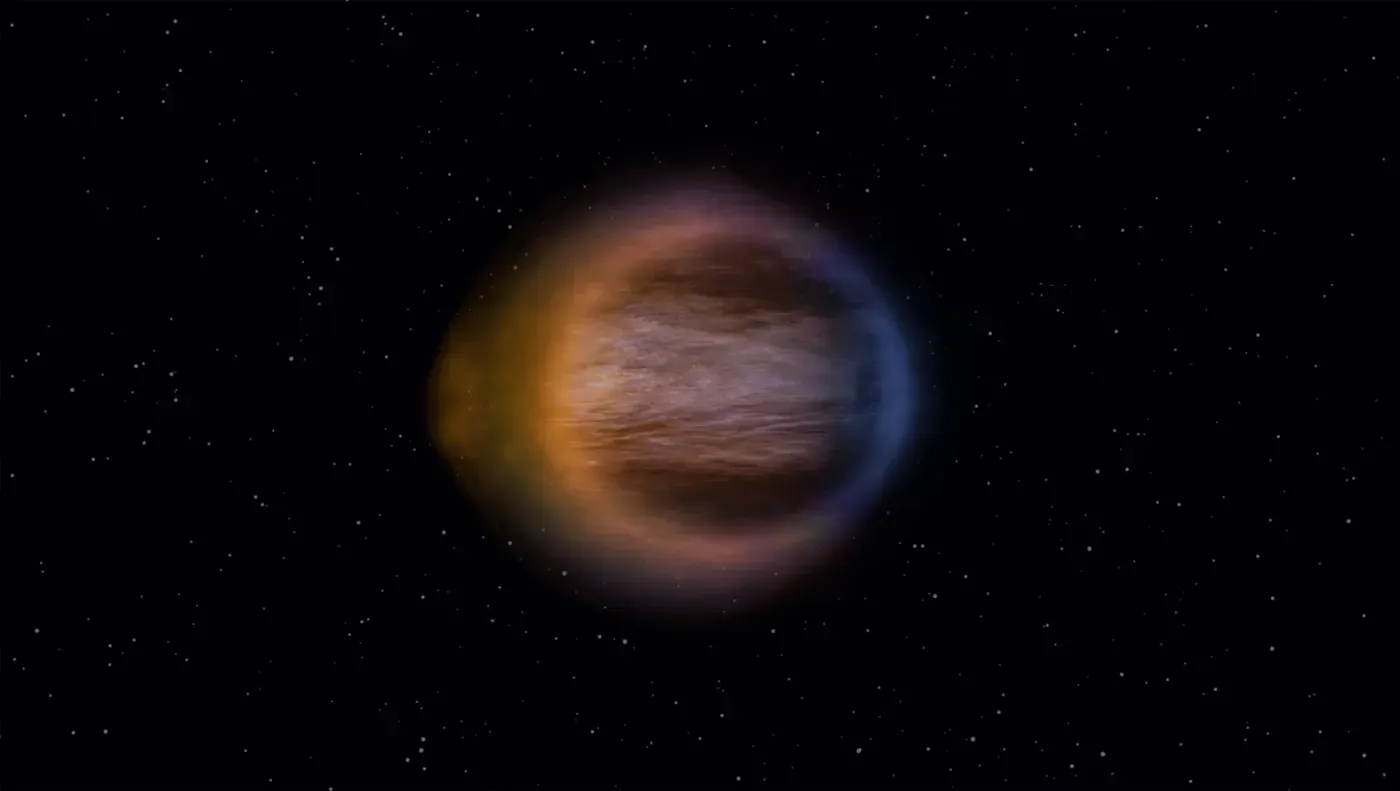
The study of exoplanet atmospheres has taken a significant leap forward with the discovery that their shapes are not as perfect and symmetrical as previously thought. Researchers have long depicted these scorching-hot worlds as circular, but new evidence suggests that their atmospheres are actually deformed spheres.
A team of scientists from Cornell University in the US and the University of Bristol in the UK has made this groundbreaking finding using a novel technique called "transmission strings. Developed by astrophysicists Dr. David Grant and Dr. Hannah Wakeford at Bristol, this method allows researchers to study the uneven contours of exoplanet atmospheres for the first time.
The team's research utilized data from the James Webb Space Telescope (JWST), the largest telescope in space, to analyze the atmosphere of WASP-17b, a hot Jupiter exoplanet orbiting a star 1,300 light-years from Earth. The results revealed that the atmosphere is not only circular but also asymmetrical, with one side more extended than the other.
The study's lead author, Dr. Lili Alderson, a Klarman postdoctoral fellow at Cornell University, conducted her research at the University of Bristol, where she earned her PhD in physics. Her work provides new insights into how intense heat and strong winds shape the atmospheres of these extreme planets.
These findings have significant implications for our understanding of exoplanet formation and evolution. By studying the unique characteristics of WASP-17b's atmosphere, scientists can gain a better understanding of the complex processes that occur in these distant worlds.
The new technique used to study WASP-17b's atmosphere is yielding promising results, providing a comprehensive and detailed view of this scorching-hot exoplanet. The findings on its atmospheric chemical composition and temperature shifts are consistent with theoretical predictions and other modeling techniques.
WASP-17b's unique characteristics make it an ideal candidate for studying the complex processes that occur in distant worlds. As it orbits its star, the planet's atmosphere undergoes significant changes, from equator to poles and between permanent day and night sides. This dynamic behavior is crucial for understanding the atmospheric interactions on exoplanets.
The use of JWST's sensitivity has enabled scientists to pioneer a new technique called eclipse mapping, which measures changes in light as an exoplanet passes behind its host star. However, this method has limitations, and researchers have developed a new approach called transmission strings or transit mapping.
This innovative technique involves tracking the planet as it crosses in front of the star, capturing the composition of light around the edge of the planet's atmosphere from different angles. By doing so, scientists can extract valuable information about the atmospheric chemical composition and temperature shifts on WASP-17b.
The data collected using this new method are providing a more detailed and accurate picture of exoplanet atmospheres than ever before. This breakthrough has significant implications for understanding the complex interactions that occur in these distant worlds, allowing researchers to refine their models and make more informed predictions about exoplanet behavior.
The breakthrough technique developed by researchers has allowed them to map the shape of scorching-hot exoplanet atmospheres in unprecedented detail.
Unlike previous methods that assumed a uniform atmosphere, this new approach enables scientists to measure varying distances from the center to the edge of the planet, effectively creating a 3D model. This allows for a more accurate understanding of atmospheric conditions on these distant worlds.
On WASP-17b, one such exoplanet, the researchers discovered a distinct feature where theory and previous modeling had predicted it should exist - a gem" on the evening side of its equator. Here, powerful jets of wind transport heat from the day side to the night side, causing the atmosphere to expand relative to the cooler morning side.
The findings also confirmed other characteristics of WASP-17b, including its unique temperature differences between the morning and evening sides. As predicted by theory, the planet's temperatures align with expectations, providing further validation for this new mapping technique.
This successful demonstration of transmission strings on WASP-17b has significant implications for understanding exoplanet climates, paving the way for more detailed studies of these distant worlds. The technique is now being applied to other candidates, allowing researchers to differentiate conditions across latitudes and map weather-scale patterns in exoplanet atmospheres.
The technique used to analyze exoplanet atmospheres has been hailed as a breakthrough by researchers.
Researchers have been able to create detailed models of scorching-hot exoplanets' atmospheric conditions thanks to advanced mathematical modeling and data analysis techniques. The models are based on data collected from the James Webb Space Telescope's Guaranteed Time Observations program, which focuses on studying exoplanet atmospheres in unprecedented detail.
The findings represent a significant advancement in understanding the complex dynamics of these distant worlds, allowing scientists to differentiate between various atmospheric conditions across different latitudes and even map weather patterns at an exoplanetary scale.
Facts based on reporting originally published by Phys.org.
You may republish this story, in full or in part, if you credit News Central Site and link to it (licence CC BY 4.0). Photos are not included.