Breakthrough Achieved in Laser Technology
Researchers have developed an erbium-doped fiber laser that meets all requirements for its intended applications.
A breakthrough in laser technology has been achieved by researchers who have developed an erbium-doped fiber laser that meets all the requirements for its intended applications. The new laser produces pulses lasting just quadrillionths of a second, making it ideal for imaging rapid processes and sampling high-frequency signals with great precision. Its ability to provide both short pulses and a broad spectrum is crucial for achieving accurate results in these fields. Moreover, the stable output of the laser ensures that measurements are taken consistently.
The researchers' achievement is all the more impressive given the challenges they faced in designing an all-fiber system that could produce both very broad spectra and short pulses while maintaining low intensity noise and timing fluctuations. Unlike many other broadband ultrafast lasers, this one relies on a straightforward design without free-space components that require careful alignment to function properly. This simplicity reduces the risk of errors due to vibration, temperature changes, or misalignment.
Qianqian Huang, the researcher behind this innovation, is proud of their team's accomplishment in developing a laser that meets all the necessary criteria for its intended applications. According to Huang, the key to achieving record-low noise levels was effective cavity management and pump light stabilization. These strategies allowed the researchers to create a system that could provide both broad spectra and short pulses while maintaining stable output.
The new laser builds on previous research in broadband fiber lasers, which have been able to generate very short pulses but often rely on free-space elements that add complexity to the design. The all-fiber approach used by Huang's team offers greater mechanical stability, but it has typically been limited by its inability to combine broad spectra, short pulses, and well-characterized low-noise performance in a single source.
The significance of this breakthrough lies in its potential applications across various fields where precise measurements are essential. By providing a reliable and stable source of ultrashort pulses with a broad spectrum, the new laser has the potential to revolutionize industries such as medicine, materials science, and telecommunications.
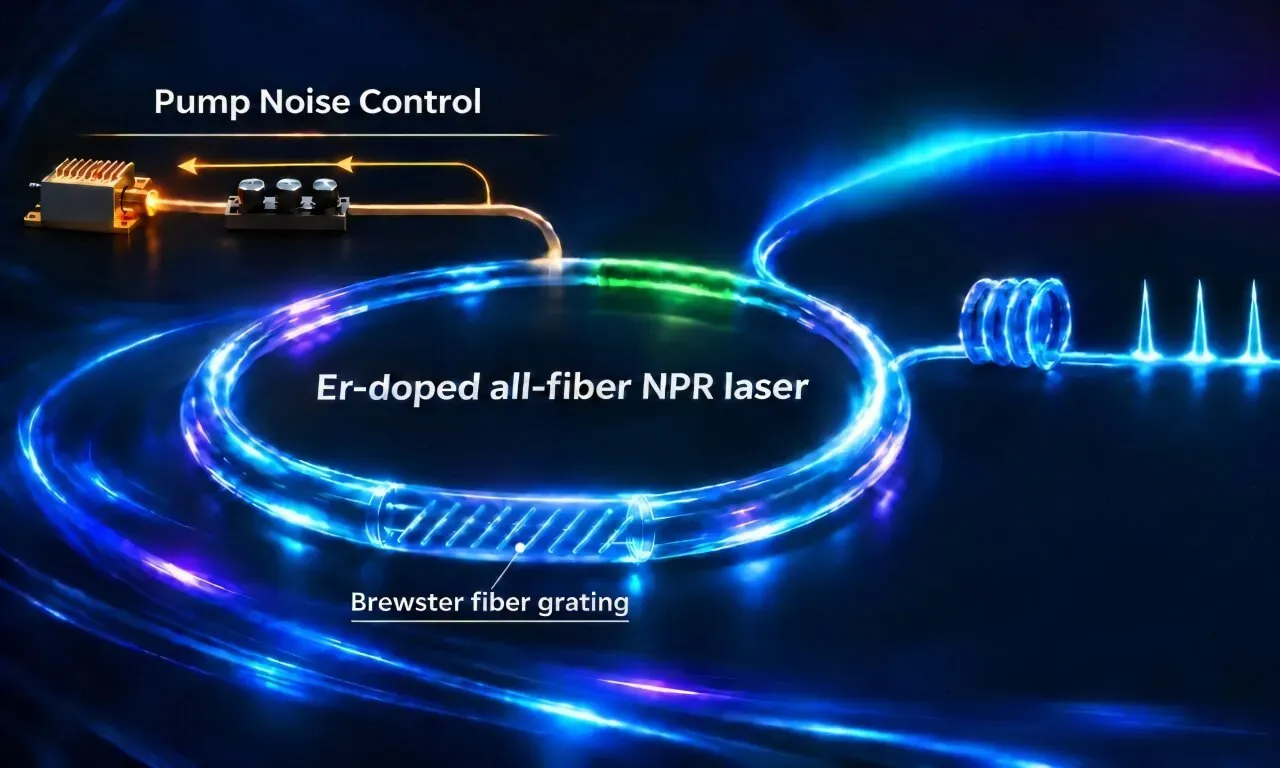
The research team behind the new laser has designed a unique ring-shaped cavity containing two types of fiber: erbium-doped and standard single-mode fiber. This combination provides optical gain near 1550 nanometers, a crucial wavelength for various applications in optical communications and measurement systems. The researchers carefully balanced the dispersion of these fibers to ensure that different spectral components within each pulse remained manageable as it circulated through the cavity.
The laser generates pulses through nonlinear polarization rotation, where the light's polarization changes with its intensity as it passes through the fiber. A key component is a tilted fiber grating and two polarization controllers, which work together to select the most intense part of the circulating light and facilitate the formation of regular trains of short pulses. This innovative setup eliminates the need for a free-space polarizer.
At a pump power of 528 milliwatts, the laser produces a smooth spectrum centered near 1548 nanometers with a bandwidth of 100.1 nanometers at half of its maximum spectral power. The initial pulse duration is approximately 1.6 picoseconds due to the varying emergence times of its spectral components. However, when these pulses pass through an additional 3.5 meters of fiber, their delay is reduced and they are compressed to a shorter duration.
The laser operates at a remarkably high rate of approximately 111.78 million pulses per second. This impressive performance demonstrates the potential of this new technology in various fields that rely on precise pulse control. The ability to generate ultrashort pulses with a broad spectrum and stable output is a significant achievement in itself, but its practical applications are vast.
The design of the laser cavity allows for efficient management of spectral components within each pulse, ensuring that they remain manageable as they circulate through the system. This balance between different fiber types enables the production of high-quality ultrashort pulses with minimal distortion or loss of coherence. As a result, this new laser has the potential to revolutionize various industries.
The research team's numerical simulations successfully replicated the key experimental findings of their all-fiber laser design. These simulations demonstrated that the laser could achieve a bandwidth exceeding 100 nanometers and pulse durations shorter than 100 femtoseconds. A simulated bandwidth of 97 nanometers was matched, along with a compressed pulse duration of 73 femtoseconds. The simulations also predicted how the pulses would repeatedly expand and contract while circulating within the cavity.
The team carefully monitored fluctuations in the pump diode, which supplies energy to the laser, as this can significantly impact the output pulses' intensity. At lower frequencies, technical noise from the pump diode can dominate the output pulses' intensity fluctuations. To mitigate this issue, the researchers utilized reflected light from a fiber Bragg grating to stabilize the pump.
By optimizing the polarization of the reflected light, the team was able to reduce the pump's intensity noise before it entered the laser cavity. This controlled approach significantly reduced the technical noise associated with the pump diode. The resulting stabilization enabled the researchers to achieve consistent and reliable operation of their all-fiber laser design.
The optimized feedback polarization had a profound impact on the laser's performance, particularly in regards to relative intensity noise. When measuring frequencies between 100 hertz and 1 megahertz, the team found that the relative intensity noise remained below approximately −143 decibels relative to carrier per hertz. This impressive result underscores the effectiveness of their stabilization technique.
The authors note that the measured noise levels achieved by this laser are lower than previously reported values for other mode-locked fiber lasers operating within a similar frequency range. This breakthrough has significant implications for various industries, as it opens up new possibilities for high-performance applications.
Researchers measured the timing jitter of the new fiber laser and found an integrated value of 16 femtoseconds between 100 hertz and 1 megahertz.
This measurement indicates that amplified spontaneous emission, a common source of noise in optical amplifiers and lasers, played a significant role over most of the frequency range. The near-zero net dispersion of the cavity helped minimize another important contributor to timing fluctuations.
The team then monitored the free-running laser for an extended period of 5.5 hours to assess its stability over time. During this test, the spectral bandwidth varied by only 0.16% and the center wavelength shifted by a mere 0.0039%.
The researchers believe that these characteristics make the fiber laser suitable for various applications, including high-resolution optical coherence tomography and ultrafast imaging.
The new fiber laser offers a range of benefits, including its ability to produce ultrashort pulses, broad spectrum output, and stable operation. This makes it well-suited for applications that require high precision and accuracy.
Its characteristics are particularly valuable in medical imaging techniques such as optical coherence tomography and ultrafast imaging, where precise visualization of biological tissues is crucial. The researchers believe these features will enable the development of new diagnostic tools and therapies with improved outcomes.
Facts based on reporting originally published by Phys.org.
You may republish this story, in full or in part, if you credit News Central Site and link to it (licence CC BY 4.0). Photos are not included.