RNA Plays Key Role in Cellular Function Beyond Traditional Messenger Molecule
Breaking News: Groundbreaking Research Reveals RNA's New Role in Cellular Function
Breaking News: Groundbreaking Research Reveals RNA's New Role in Cellular Function
Researchers from the Marine Biological Laboratory are leading the charge in understanding cellular compartments known as condensates. These hubs facilitate complex biological reactions within cells, and recent studies have shed new light on their function. A team of scientists, including Amy Gladfelter and Dragomir Milovanovic, has made significant contributions to this field.
Gladfelter's work at Duke University and her role as co-director of the MBL physiology course have been instrumental in advancing our understanding of condensates. Her collaboration with former student Dragomir Milovanovic, now a professor at Charité Berlin University Institute of Biochemistry, has yielded important findings. These researchers, along with Branislava Rankovic and Zachary Geisterfer, have published new evidence in Advanced Science.
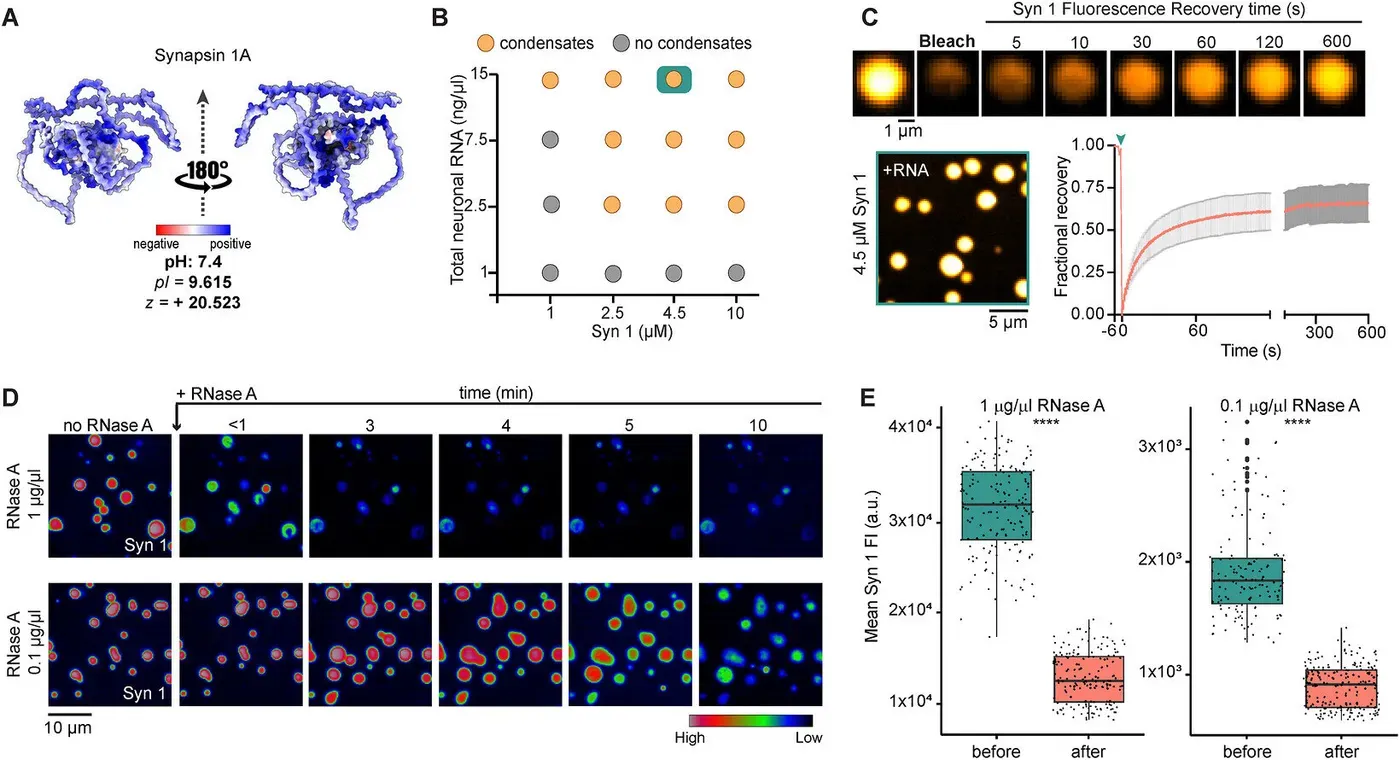
Their study suggests that RNA plays a crucial role in organizing condensates at synapses, where neurons communicate with each other. This is a significant discovery, as it highlights the importance of RNA in cellular function beyond its traditional role as a messenger molecule. The research team's findings have far-reaching implications for our understanding of cellular biology.
The study's publication marks an important milestone in the ongoing investigation into the complex relationships between condensates and RNA. Further research is needed to fully comprehend the mechanisms underlying these interactions, but this breakthrough has already sparked excitement within the scientific community.
The discovery by researchers suggests that RNA's role in the cell extends far beyond its traditional function as a messenger molecule. This new dimension of RNA's capabilities is revealed through its ability to organize specific proteins into condensates.
In neurons, the team found that RNA plays a crucial part in forming these specialized microenvironment hubs, known as condensates. These hubs are essential for various biological processes and chemical reactions to occur within cells. The researchers observed that synapsin-1, a protein involved in neurotransmitter release, is organized by RNA into condensates.
According to the study's findings, condensates are cellular compartments where biomolecules can interact through reversible interactions, creating a unique entity with properties beyond those of its individual components. By gathering within these specialized microenvironments, biomolecules can exhibit new chemical behaviors that facilitate specific biological processes.
The team's research has shed light on how RNA contributes to the structural organization of cells and their functions. This understanding adds complexity to the long-held view of RNA as primarily an information carrier and messenger molecule. The implications of this study are significant, offering a fresh perspective on the multifaceted role of RNA in cellular biology.
The study's findings have significant implications for future research into neurodegenerative diseases, highlighting the importance of understanding the basic principles underlying communication between neurons.
Establishing a baseline understanding of this process is crucial because its disruption is often an early event in neurological or neurodegenerative disorders, making it a vital area of study. The team's work bridges basic and translational biology, offering new insights into both the fundamental role of RNA in cells and its potential implications for human health.
This research has far-reaching consequences, not only shedding light on the multifaceted role of RNA but also paving the way for further investigation into its impact on neurological disorders.
Facts based on reporting originally published by Phys.org.
You may republish this story, in full or in part, if you credit News Central Site and link to it (licence CC BY 4.0). Photos are not included.