Early humans in America endured climate chaos during last ice age
New research on fossilized footprints at White Sands National Park reveals early human lives were marked by extreme cold and harsh conditions due to the last ice age.
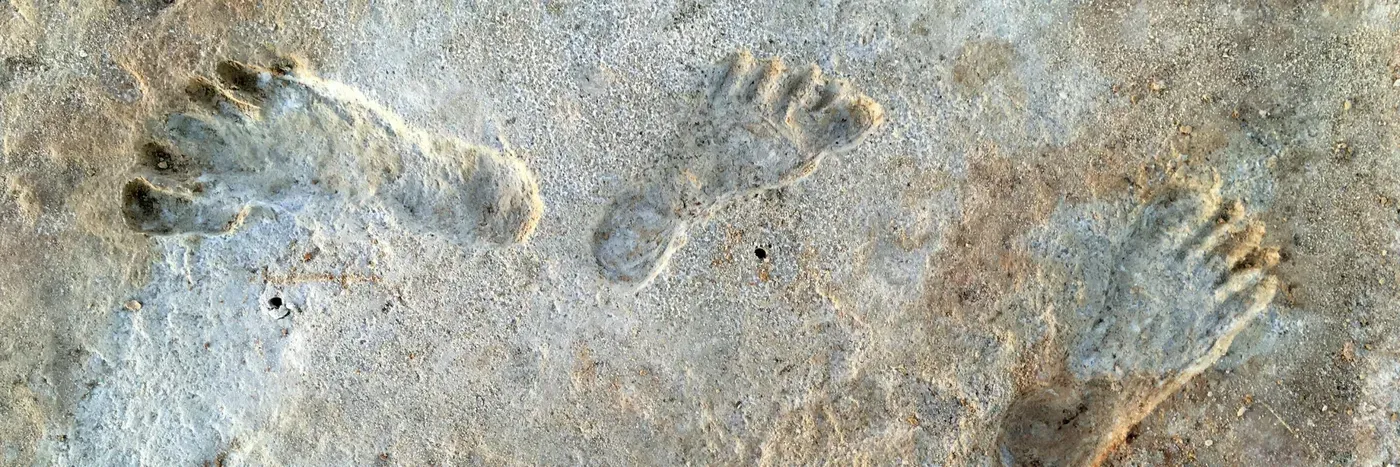
Early humans in America endured climate chaos, new research reveals.
Fossilized footprints left behind by early human migrants in what is now White Sands National Park, New Mexico, have provided a window into their lives over 23,000 years ago. At that time, the region was experiencing extreme cold and harsh conditions due to the last ice age. The discovery of these ancient footprints has been met with significant interest, particularly since they challenge existing theories about when humans first arrived in North America.
The initial findings from 2021 sparked controversy as they suggested that people were present in North America thousands of years earlier than previously believed. However, subsequent research using multiple dating techniques reinforced the original conclusion. The latest study takes this knowledge further by examining not only when but also what conditions these early humans encountered during their time at White Sands.
The excavations have uncovered 20 distinct layers of sediment containing human footprints, spanning almost two millennia from approximately 23,500 to 21,700 years ago. This period falls within the last glacial maximum, marking the peak of the ice age's impact on the region. The data suggests that these early humans lived through a dynamic and rapidly changing climate.
The presence of multiple horizons with human footprints indicates a range of activities and possibly even seasonal migrations by these ancient populations.
The sediments found alongside the ancient footprints contain a rich archive of environmental change, offering valuable insights into the past conditions of White Sands.
Pollen records from these sediments reveal the types of vegetation that grew around the basin over time, while organic molecules preserved in the sediment provide information about temperature and rainfall patterns.
At the beginning of the record, the landscape was vastly different from what exists today. A large body of water, Lake Otero, occupied much of the basin, surrounded by conifer forests. The average annual temperatures were approximately 4°C colder than they are now.
As time progressed, the lake began to shrink around 23,600 years ago due to rising temperatures. This led to a decline in conifer forest and an increase in oak and sagebrush. The basin became progressively drier as evaporation increased, with superimposed climatic swings causing further changes.
Around 23,200 years ago, White Sands experienced a severe drought, characterized by declining rainfall, increased lake salinity, and the expansion of drought-tolerant vegetation. This dry period coincided with a rapid climatic change recorded in Greenland ice cores, and it marked a significant moment in the history of human presence at White Sands.
The repeated visits to White Sands during this period suggest that people were adapting to a rapidly changing environment.
This environmental change was likely significant enough to have been noticed by the individuals living in the area at the time.
However, it's essential to consider what we can infer from the footprints and whether they provide a complete picture of human activity in the region.
The preserved footprints may not be representative of the entire population or their activities, but rather only those that occurred under specific conditions.
The study's findings suggest that human presence around White Sands was not as straightforward as previously thought. The researchers discovered a complex pattern of footprint formation and preservation, influenced by environmental conditions.
Environmental transitions, such as dry periods followed by wetting and sedimentation, played a significant role in the preservation of footprints. This process exposed large areas of footprint-forming mud, which were then buried and preserved when subsequent wetting occurred.
The research team found that footprint surfaces tend to cluster around periods of climatic and hydrological change. This pattern is consistent with the model they developed to explain the formation and preservation of footprints at White Sands.
While the presence of footprints indicates human activity at specific moments, the absence of footprints between these surfaces does not necessarily mean people were absent from the area. The sheer number of tracks left by a small group of individuals can create the illusion of a large population.
The study's findings suggest that there are two intertwined histories at White Sands: one related to climate and the other to human presence. This complex relationship challenges simplistic interpretations of the correlation between footprints and environmental conditions.
The study of human footprints in White Sands, New Mexico, has revealed a complex relationship between early humans and their environment. For almost two millennia, people repeatedly inhabited this landscape as it underwent significant changes. The lake that once existed there shrank, vegetation adapted to new conditions, and the regional climate fluctuated wildly.
Footprints are a unique window into the lives of ancient people, capturing moments in time when human behavior intersected with environmental factors. However, these individual frames do not provide a continuous narrative of daily life. They are snapshots of chance events that occurred when mud, water, and human presence converged.
The researchers analyzed footprints from White Sands during the Last Glacial Maximum, a period marked by extreme climate fluctuations. Their findings suggest that early humans in America were resilient but also vulnerable to abrupt environmental changes. This study highlights the importance of considering both geological and human histories when interpreting fossil evidence.
Ultimately, this research underscores the need for nuanced understanding of the complex relationships between ancient people and their environments. By acknowledging the intricate dance between climate, vegetation, and human presence, scientists can gain a more accurate picture of the past and its relevance to our present.
Facts based on reporting originally published by Phys.org.
You may republish this story, in full or in part, if you credit News Central Site and link to it (licence CC BY 4.0). Photos are not included.