Dwarf Reedsnakes Achieve High Speeds Through Coordinated Body Movement
Researchers have used advanced video analysis techniques to study the unique form of locomotion employed by dwarf reedsnakes.
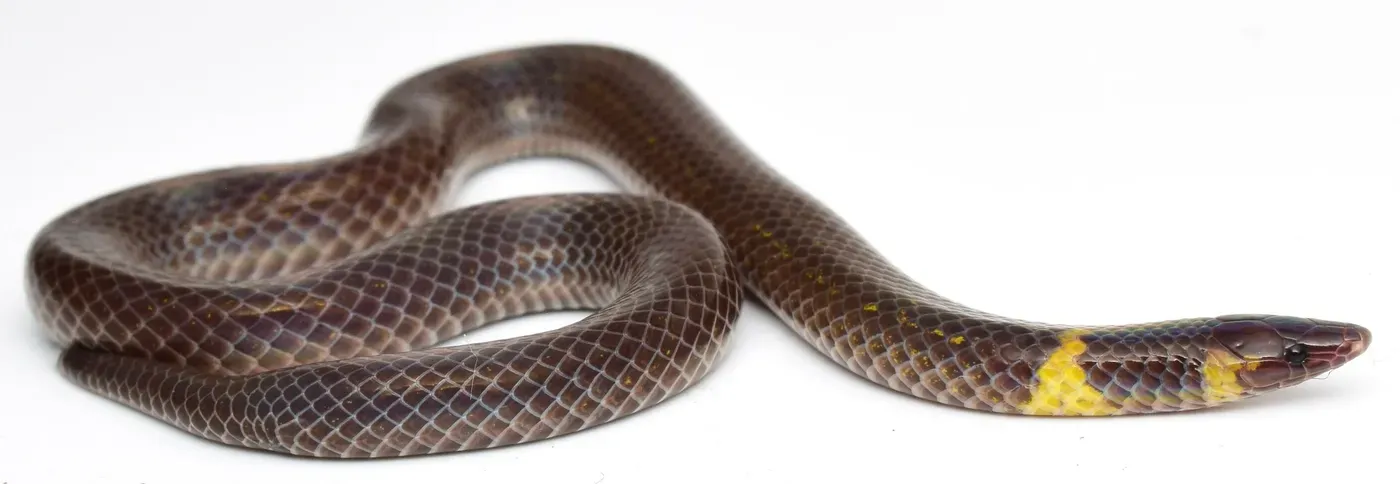
Small snakes called dwarf reedsnakes have a remarkable ability to escape danger by rolling rapidly along the ground. Researchers sought to understand how these snakes achieve this unique form of locomotion using advanced video analysis techniques. The results reveal that the snakes' bodies move in perfectly coordinated sequences, keeping their heads facing forward and at a relatively stable height even as the rest of their body spins.
The findings published in Current Biology highlight the innovative ways animals can adapt to overcome physical limitations. This study shows how behavioral adaptations can enable creatures to achieve remarkable abilities despite their anatomy. The researchers' observations provide valuable insights into the complex interactions between an animal's body and its environment.
Rolling as a form of locomotion presents significant challenges for animals, particularly at high speeds. Unlike inanimate objects like wheels, living bodies cannot freely rotate around a fixed axis without compromising balance and control. When the entire body rotates, it can be difficult to adjust posture and maintain direction, making rapid rolling inherently tricky.
Dwarf reedsnakes of the genus Pseudorabdion are among the few animals that use active rolling as an escape strategy in Southeast Asia. Despite previous observations and field guide descriptions, the underlying mechanics of this behavior remained poorly understood until now. By shedding light on these previously unknown body movements, researchers can better appreciate the remarkable adaptations of these small snakes.
The study's findings offer a fascinating glimpse into the intricate relationships between animal behavior, anatomy, and environment. Further research can build upon this understanding to uncover more secrets about the remarkable abilities of dwarf reedsnakes and other creatures that defy conventional expectations.
The researchers used multi-angle recordings to analyze in detail the movement patterns of dwarf reed snakes as they rolled at high speeds.
These snakes were able to reach remarkable velocities of up to 3.69 meters per second during rolling, a speed that is approximately four times faster than their typical mode of locomotion, lateral undulation.
Notably, despite reaching such high speeds, the snakes were able to navigate a narrow racetrack just 20 centimeters wide with ease.
The videos revealed a complex movement pattern in which each cycle of locomotion consists of a rolling motion where one side of the snake's body is in contact with the ground and then swings down past its head toward the ground.
This alternating cycle, known as a "stroke," allows for continuous rolling locomotion as the snake repeats the sequence from left to right.
The snakes' heads remain aligned with their direction of travel while the rest of their bodies undergo rapid rotational motion.
The study reveals that dwarf reedsnakes have developed a remarkable ability to rotate their bodies at high speeds without any physical separation between their head and tail. This is achieved through a sophisticated division of body control, where specific regions undergo large rotational movements while the rest of the body remains relatively stable.
In particular, the snakes' heads remain aligned with their direction of travel as they twist and turn, allowing them to maintain a sense of balance and orientation even at high speeds. This specialized coordination enables the snakes to cover significant distances without any structural support or external propulsion.
The research highlights the remarkable adaptability of these snakes, demonstrating how behavioral innovation can overcome morphological constraints and unlock new capabilities that might not be predicted based on their physical characteristics alone.
Facts based on reporting originally published by Phys.org.
You may republish this story, in full or in part, if you credit News Central Site and link to it (licence CC BY 4.0). Photos are not included.