Redistricting Efforts by Republicans Backfire
A historic effort by Republicans to redraw Congressional districts mid-decade has left the party on track to lose all of the districts it tried to gerrymander.
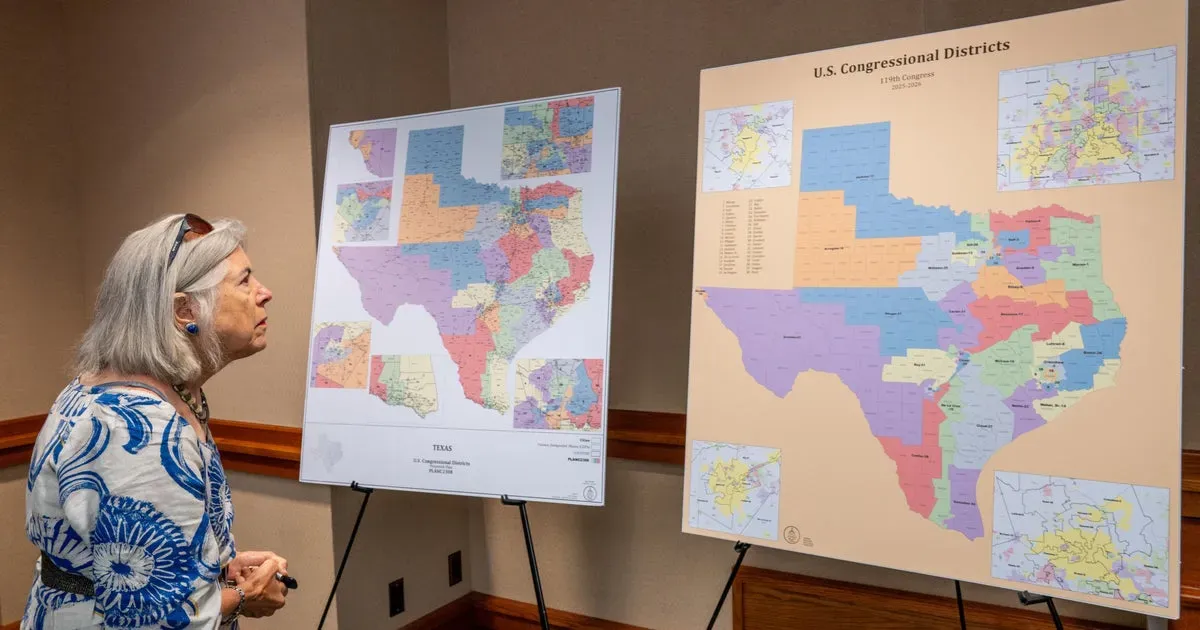
A historic effort by Republicans to redraw Congressional districts mid-decade has backfired, leaving the party on track to lose all of the districts it tried to gerrymander.
The move was initiated when President Trump ordered Texas lawmakers to redraw their map, aiming to net up to five seats for the GOP. However, this aggressive redistricting effort did not yield the desired results. Instead, Democrats are poised to take control of the House, with CBS News estimating they could end up with 251 to 268 seats.
Several states undertook mid-decade redistricting in an attempt to sway the outcome of Congressional elections. Republican efforts were concentrated in key battlegrounds, where they sought to maintain their grip on power. However, these attempts ultimately appear to have been counterproductive.
The consequences of this failed effort are now coming into focus. With Democrats poised to take control of the House and Republicans facing a possible "dummymander situation, the party's leadership is likely to face intense scrutiny over its decision to push for mid-decade redistricting.
In an effort to secure more seats in the House of Representatives, Republicans redrew the electoral map in several key states, including Texas, Ohio, and North Carolina.
Texas was a prime target for Republican efforts, as they aimed to capitalize on President Trump's strong showing in South Texas. By emphasizing these gains, Republicans hoped to win five additional seats in the state.
As of Wednesday, the results were striking: Republicans had secured 24 seats, while Democrats had won only 14. This outcome effectively created a dummymander" situation in Texas, where one party controls a disproportionate number of seats relative to their overall vote share.
In Ohio, Republican lawmakers used their control over the redistricting process to redraw the electoral map in their favor. A commission comprised mainly of Republicans hand-picked by GOP lawmakers was responsible for creating the new map, which was designed to net two more seats for the party.
The impact of gerrymandering efforts by Republicans is being closely watched as election results continue to roll in. In Louisiana, lawmakers redrew their districts after a June Supreme Court decision that ruled against using race as a factor in drawing House district lines.
This move was aimed at eliminating one majority Black district currently held by Democratic representatives. However, with three Republican wins and one Democratic win so far, the new map has failed to achieve its intended goal of netting more seats for the party. The 6th District is still considered a toss-up, while the 5th District will head to a runoff.
In Alabama, Republicans sought to eliminate the state's two majority Black districts, both represented by Democrats. Despite their efforts, both incumbents won reelection on Tuesday, resulting in no net gain for the party and making Alabama a dummymander. This outcome suggests that Republican attempts at gerrymandering may have backfired.
Tennessee lawmakers also redrew their map after the same Supreme Court decision to target the lone Democratic district in Memphis.
The Republican Party had a significant advantage in several key states going into the election, particularly in Florida where Governor Ron DeSantis played a crucial role in redrawing district maps to potentially gain up to four more seats for his party.
As of Wednesday, the latest update showed that Republicans had secured six additional seats, with two races expected to go to a runoff. One of these districts is the newly created 9th District in Memphis, which has yet to be decided.
In Missouri, the state's GOP-led legislature drew new district maps last year, aiming to make one of the Democratic-held districts more favorable to Republicans. However, the map's validity was questioned, and a state court ruled that it could not be used unless approved by voters.
The Supreme Court intervened on multiple occasions, blocking Missouri from using the revised map for Tuesday's election. As a result, the 2022 congressional districts remained in place, with Republicans controlling six districts and Democrats holding two.
The push for Republicans to redraw House districts has been met with resistance in some states, leading to unexpected outcomes. In Indiana, President Trump had advocated for a map that would have effectively eliminated the state's two Democratic lawmakers, resulting in a 9-0 Republican delegation.
However, despite Trump's pressure, the GOP-led state Senate rejected this proposal, opting instead to stick with the same boundaries used in previous cycles. This decision allowed Democrats to hold onto their two seats and even flip a third, ultimately securing six out of nine congressional districts for their party.
In neighboring South Carolina, Republicans also attempted to redraw their map to gain an advantage over powerful Democratic Rep. Jim Clyburn. However, this measure failed in the state Senate, and Clyburn went on to win reelection on Tuesday.
The outcome of these efforts has left some Republican districts vulnerable, with two races still considered toss-ups. Meanwhile, other states have seen significant shifts in their congressional representation, with the party's performance varying widely from district to district.
In California, Democrats held a strong advantage heading into Election Day, with 43 districts under their control compared to nine for Republicans. As of Wednesday, this lead had expanded, with Democrats winning in 42 districts and likely taking another six.
As of Wednesday, the lead had expanded further in favor of Democrats, with a significant gap widening between them and Republicans in several key districts.
In Utah's 1st Congressional District, Democrat Ben McAdams secured a substantial victory, winning by an impressive 47-point margin in Salt Lake City. Meanwhile, in Virginia, voters' efforts to redraw the congressional map through a ballot measure were initially met with success when they decisively approved it in April.
However, their plans were subsequently thwarted when the Virginia Supreme Court intervened and reinstated the original map drawn in 2021, leaving Democrats poised for possible gains on Tuesday.
Facts based on reporting originally published by CBS News Politics.
You may republish this story, in full or in part, if you credit News Central Site and link to it (licence CC BY 4.0). Photos are not included.