Cosmic Dark Age Theory Challenged by New Research Findings
A new study has revealed that the prevailing theory on what ended the Cosmic Dark Age may not be entirely accurate, raising questions about cosmological evolution.
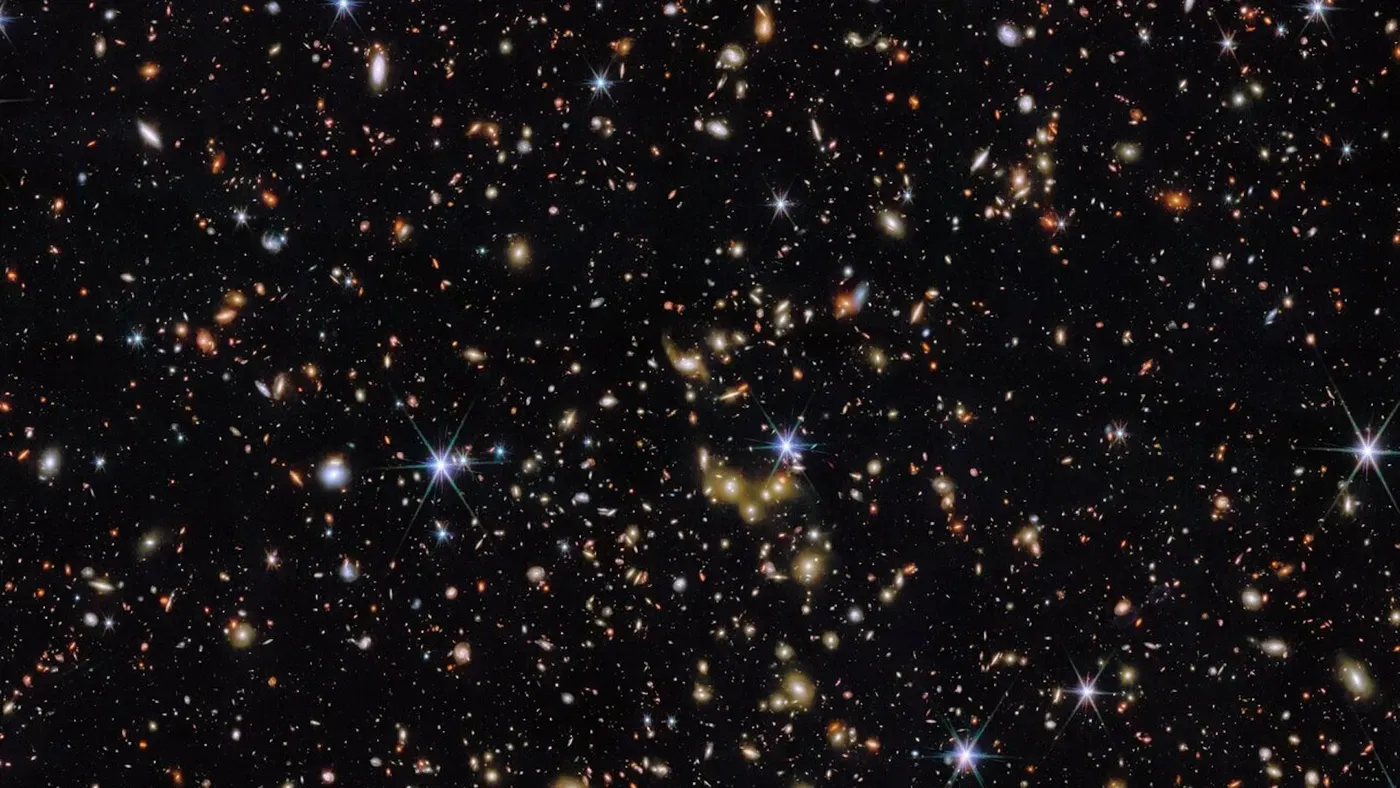
Astronomers have long believed that the universe's "Cosmic Dark Age" came to an end when the first stars formed and emitted bursts of radiation, ionizing neutral hydrogen atoms and clearing away the fog that shrouded the cosmos.
This theory suggests that as these stars flickered to life, they burst forth with ultraviolet light, transforming the impenetrable fog into a sea of electrically charged protons and electrons that allowed light to pass through space unimpeded.
However, a new study has revealed that this explanation may not be entirely accurate, raising questions about what actually ended the Cosmic Dark Age. The researchers' findings hint that astronomers may need to rethink their understanding of cosmological evolution.
Around 400,000 years after the Big Bang, the universe cooled sufficiently for atoms to form, primarily hydrogen. These neutral atoms created a vast fog that rendered the cosmos opaque to ultraviolet light.
This era persisted until the first stars ignited and began to gather into galaxies, emitting radiation that ionized the surrounding hydrogen and cleared the way for light to travel through space.
The prevailing theory on what ended the Cosmic Dark Age has been turned upside down by new research. Astrophysicists had long believed that supernovas were responsible for clearing the fog of ionized gas from the early universe.
However, a recent study suggests that supernovas actually trapped Lyman continuum photons, preventing them from dispelling the celestial fog instead of scattering them. This counterintuitive finding has significant implications for our understanding of the universe's evolution.
The research focused on compact starburst galaxies, which are much smaller than the Milky Way and produce stars at a rate several times higher. These galaxies' spectra revealed that their stellar winds were driven by radiation from newly formed stars rather than being fast galactic winds.
The evolution of massive young stars in these galaxies played a crucial role in shaping their surrounding environment. As these stars aged and eventually died in supernovas, they released enormous amounts of energy that altered the galactic winds.
This change in wind dynamics had a profound impact on the escape of Lyman continuum (LyC) light from the galaxy. In the initial phase of star formation, massive stars' stellar winds cleared a path through the neutral gas and dust at incredible speeds of nearly 2,000 miles per second.
However, as the O-type stars lived out their short lives, they expelled their stellar material into space. This added to the galactic gas and dust, causing it to become opaque and trap LyC light from escaping.
The result was a reversal of the initial process, with LyC light struggling to penetrate the dense, dusty environments. This phase emerged approximately 3 million years after star formation began in these galaxies.
These changes in wind dynamics and radiation escape had significant implications for the surrounding intergalactic space, where neutral gas and dust were ionized by LyC light from nearby galaxies.
New findings suggest that supernovae may not have played a significant role in ending the Cosmic Dark Age, contrary to previous simulations.
The intense radiation from newborn stars now appears to be the most likely source of reionization, which would have had a profound impact on the surrounding intergalactic space and its neutral gas and dust. This realization could lead to further research into understanding the Epoch of Reionization, with scientists potentially collecting more data from various wavelengths in the future.
The intense light of newborn stars now seems like the most viable source of reionization.
This new understanding would mark a significant departure from previous simulations that had pointed to supernovae as the primary drivers of this process.
Facts based on reporting originally published by Live Science.
You may republish this story, in full or in part, if you credit News Central Site and link to it (licence CC BY 4.0). Photos are not included.