Climate change impacts Northwest European seas
New research predicts significant declines in copepod populations across Northwest European Shelf seas due to climate change.
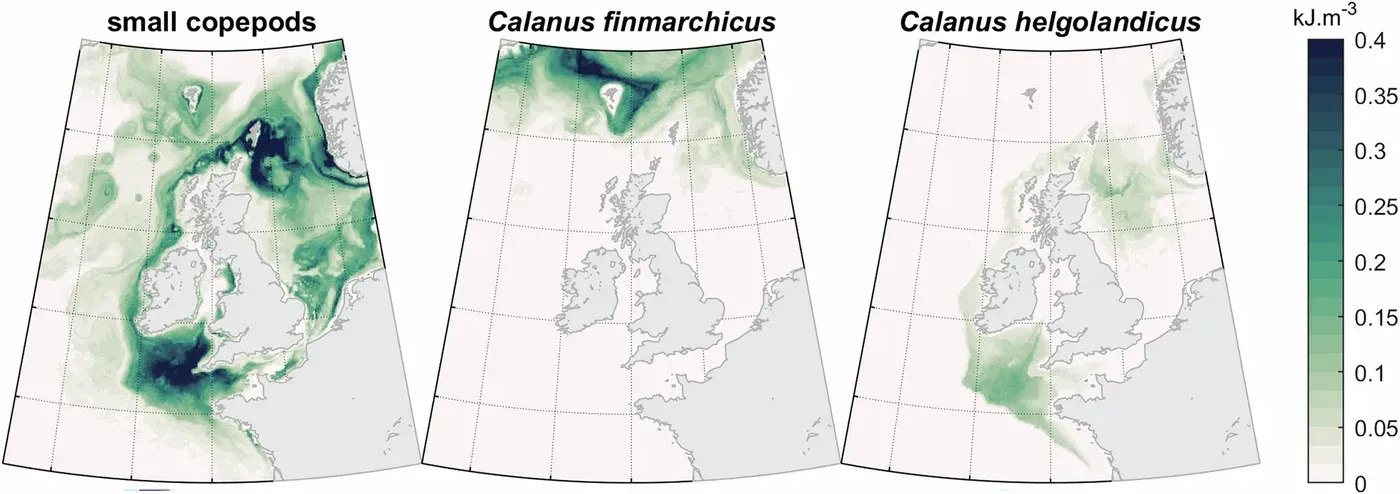
Climate change is expected to have a profound impact on marine ecosystems in Northwest European seas, according to new research that sheds light on the potential effects of rising temperatures and changing ocean conditions.
A team of researchers from the University of Strathclyde has developed a high-resolution modeling tool that uses machine learning to predict how zooplankton - tiny drifting animals that form the base of marine food chains - may respond to these changes over the coming decades.
Zooplankton play a crucial role in maintaining healthy aquatic ecosystems, serving as a vital food source for many fish species and helping to control harmful algal blooms and recycle nutrients.
The researchers' model is notable for its ability to provide detailed regional projections of future ocean conditions, offering insights into potential risks to marine biodiversity, fisheries, and overall ocean health that were previously unavailable.
To develop the model, the team drew on decades of data from the Continuous Plankton Recorder survey, combining this with regional climate projections to simulate future ocean conditions at a finer scale than previous global models had allowed.
The researchers put their model through a rigorous test by simulating a high greenhouse gas emissions scenario. Under these extreme conditions, the model projected alarming declines in copepod abundance across Northwest European Shelf seas.
By 2050, copepod populations were expected to dwindle by between 58% and 72%, while by 2100, this decline would likely worsen to between 84% and 93%. These projections are significantly more severe than those generated by lower-resolution global models, suggesting that Northwest European Shelf seas may be more vulnerable to climate change than previously thought.
The model also highlighted areas within these shelf seas where copepod populations might be less severely affected. Notably, the shallow waters surrounding Great Britain and Ireland, including the North Sea, Celtic Sea, Irish Sea, and English Channel, could potentially serve as regional refuges for marine life.
A combination of factors is driving these projected declines, with rising sea temperatures, reduced nutrient concentrations, and changes in ocean circulation all playing a role. Specifically, a weakening Atlantic meridional overturning circulation (AMOC) is associated with altered ocean circulation patterns that contribute to the decline.
The study's findings are not predictions of what will happen but rather a high-emissions scenario designed to understand how marine ecosystems might respond if greenhouse gas emissions continue at their current rate. The research aims to provide valuable insights for future planning and conservation efforts, helping to mitigate the impacts of climate change on fisheries, wildlife, and ocean health that are essential to coastal communities and marine ecosystems.
The new modeling tool has provided valuable insights into how climate change could reshape marine ecosystems by taking a closer look at zooplankton populations.
These projections have been integrated into broader studies examining the potential impacts of climate change on marine resources and ecosystems as a whole.
The research aims to inform future planning and conservation efforts, helping mitigate the effects of climate change on fisheries, wildlife, and ocean health that are crucial to coastal communities.
Facts based on reporting originally published by Phys.org.
You may republish this story, in full or in part, if you credit News Central Site and link to it (licence CC BY 4.0). Photos are not included.