Carrier-induced photonic resonance alters infrared light transmission in perovskite solar materials
A new phenomenon has been discovered where light reflecting within thin films can mimic molecular signals in perovskite solar materials.
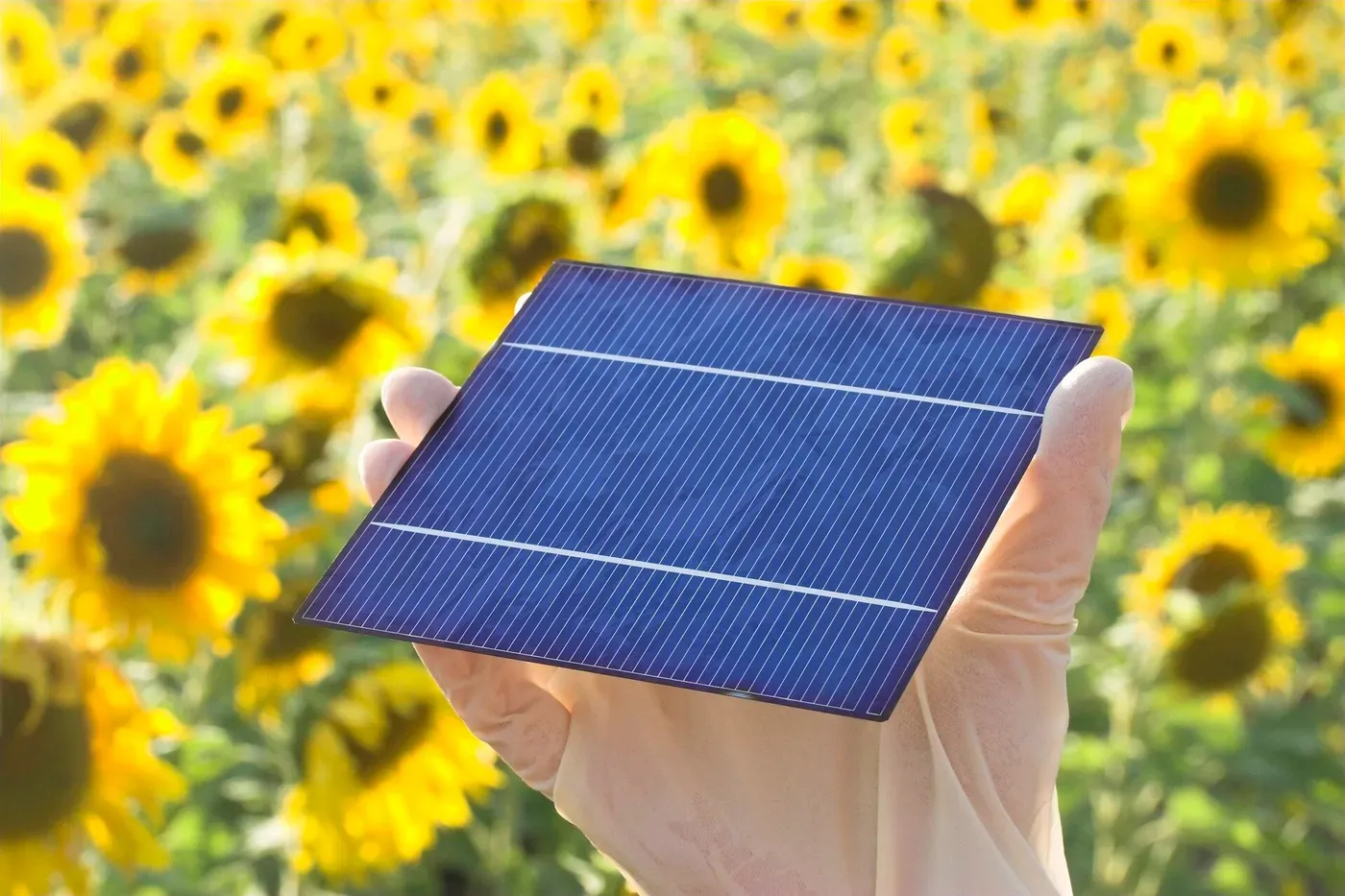
A new phenomenon has been discovered in perovskite solar materials, where light reflecting within thin films can mimic molecular signals, potentially misleading researchers.
The study, published in The Journal of Chemical Physics, reveals that light-generated charges alter the way infrared light is reflected and transmitted through film layers, creating sharp features that resemble changes in molecular vibrations even when these vibrations remain unchanged.
This mechanism, known as carrier-induced photonic resonance (CIPR), can be mistaken for genuine molecular responses when interpreting time-resolved infrared spectroscopy measurements. This technique involves exciting a material with visible light and probing its molecular vibrations with an infrared pulse.
The phenomenon has been observed in lead halide perovskites, where vibrational absorption appears to grow dramatically upon excitation, defying explanation due to the lack of direct bonding between organic cations and the inorganic framework carrying charges.
Researchers have long relied on time-resolved infrared spectroscopy to study how light-generated charges interact with molecules in solar materials, but this new discovery highlights the need for careful distinction between CIPR and genuine molecular responses.
When analyzing earlier measurements on perovskite films using multilayer transmission theory, researchers found that the model could accurately reproduce the observed narrow, blue-shifted signal in the experiment.
The model, which accounts for multiple reflections of infrared light at each interface of the layered sample, assumed no change in the vibrations of organic cations and only included the broad optical response of charges. This suggests that the signal may not be a molecular feature after all, but rather an optical effect.
The analysis also reveals that the phenomenon can masquerade as various molecular events, including increased absorption by excited molecules, shifts in vibrational peaks, or bleaching of existing absorption bands. The spectral character of the charge response determines which type of event is mimicked.
Calculations predict that adjacent layers, even those not directly involved in the process, can generate additional resonances, potentially misleading researchers into thinking they are observing charge trapping or transfer. This underscores the importance of considering the entire stack of film and substrate when interpreting infrared signals.
Researchers have proposed a practical method to distinguish between optical effects and genuine molecular dynamics in perovskite solar materials. This involves measuring perovskite nanocrystals dispersed in a dilute solution rather than a densely packed film.
By reducing the concentration of the solution, the unwanted resonance caused by light reflecting within thin films is weakened. However, the molecular vibrational signal remains strong due to the increased optical path through the sample. This approach offers a clear control experiment for future studies on how charges interact with molecules in perovskite materials.
A re-examination of earlier measurements using ultrafast infrared nanospectroscopy has revealed a more complex picture. The interaction between the metallic tip and the perovskite sample was found to have a significant impact on the predicted CIPR contribution. In models that most closely matched realistic conditions, the optical effect accounted for only a minor part of the observed resonance.
This discrepancy suggests that a genuine shift in molecular vibration may also be contributing to the signal. This could be linked to light-induced expansion of the perovskite lattice, which would have significant implications for understanding the behavior of these materials.
Further work is needed to resolve this discrepancy and clarify the nature of the observed signals. By identifying the optical origin of a previously puzzling signal, researchers can lay a firmer foundation for interpreting infrared measurements of perovskites and other photovoltaic thin films.
The study reveals that optical effects within thin films can mimic molecular signals, potentially leading to incorrect interpretations of data in perovskite solar materials.
This phenomenon occurs when light reflecting off the surface of the film interacts with the material's internal structure, causing a signal that could be mistaken for a genuine molecular response. By identifying this optical origin, researchers can better understand and correct their findings, ultimately providing more accurate insights into the properties of these photovoltaic thin films.
Facts based on reporting originally published by Phys.org.
You may republish this story, in full or in part, if you credit News Central Site and link to it (licence CC BY 4.0). Photos are not included.