BepiColombo Spacecraft Set to Enter Mercury's Orbit on November 21st
The BepiColombo spacecraft is set to enter Mercury's orbit on November 21st after an eight-year journey, marking a major milestone in the mission.
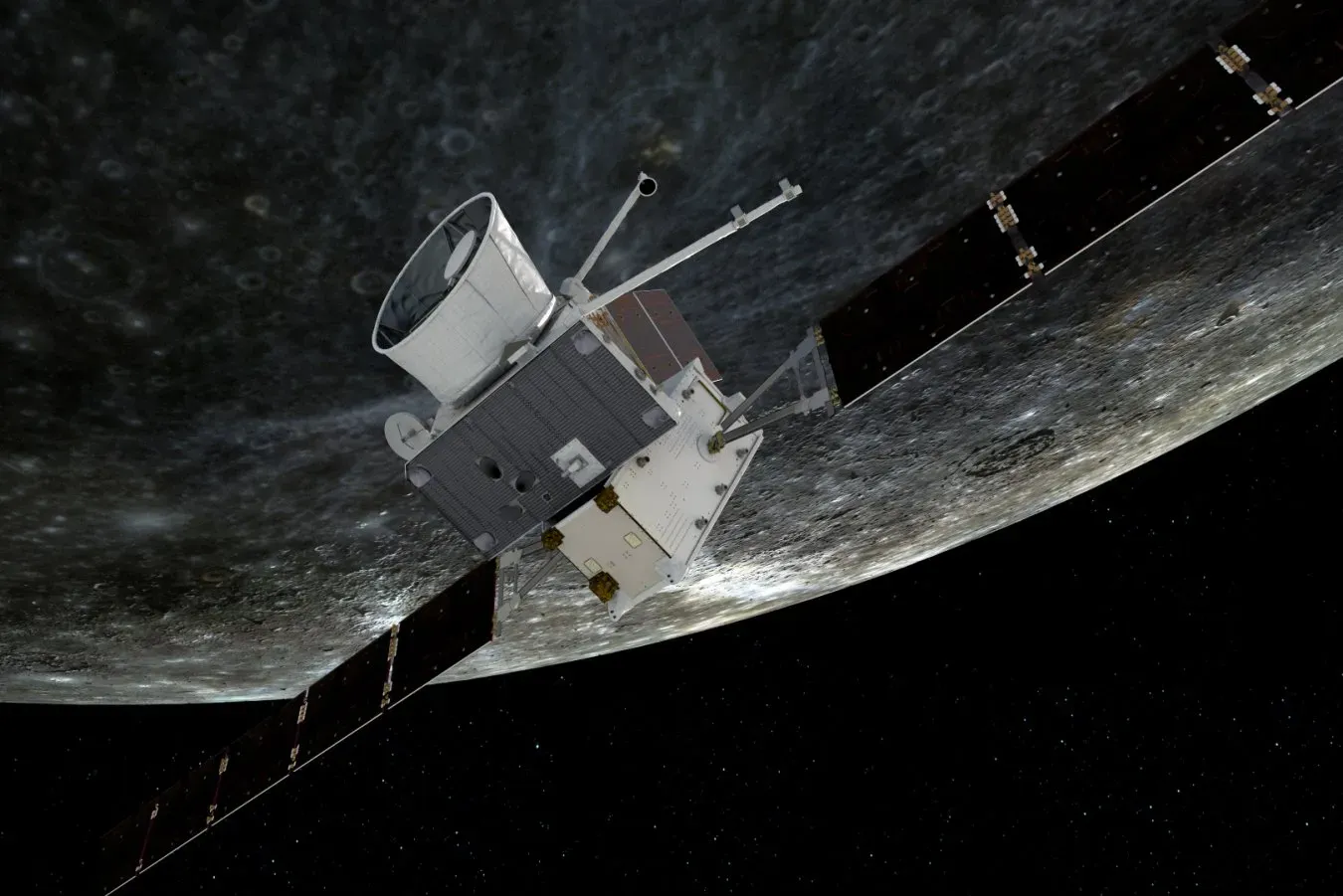
The BepiColombo spacecraft is set to enter Mercury's orbit on November 21st, marking a major milestone in its eight-year journey.
As part of this mission, BepiColombo will conduct an extensive examination of the planet's geological features, its thin atmosphere, and its magnetic field over the course of the next year. This research aims to shed light on Mercury's formation and evolution throughout history. By studying these aspects, scientists hope to gain a deeper understanding of the planet's complex processes.
BepiColombo is a joint venture between the European Space Agency (ESA) and the Japan Aerospace Exploration Agency (JAXA), which was launched in October 2018. Due to Mercury's proximity to the sun, reaching the planet requires a precise trajectory that avoids overshooting its orbit and falling into the solar body. To achieve this, the spacecraft took a circuitous route, utilizing the gravity of Venus and Mercury themselves on multiple occasions to make subtle adjustments to its path.
The dual-orbiting design of the BepiColombo spacecraft allows for a unique approach to studying Mercury's environment and its interactions with the solar wind.
While the two orbiters are distinct entities, they share a common objective: to gather insights into the planet's mysterious exosphere and magnetic field. The Mercury Planetary Orbiter (MPO) is significantly larger than its counterpart, the Mercury Magnetospheric Orbiter (MMO), also known as Mio.
The MPO's extensive suite of instruments focuses on surveying Mercury's surface composition, terrain, and atmospheric properties using a range of spectrometers and a laser altimeter. This information will be crucial in understanding the planet's geological history and evolution over time.
In contrast, MMO's more distant orbit allows it to study the broader magnetic field and atmosphere surrounding Mercury, as well as the solar wind that significantly impacts this region close to the sun.
The prolonged orbit of MMO around Mercury is actually an advantage in studying the planet's magnetic field and atmosphere, as well as the effects of the solar wind on this region near the sun.
Despite its challenges, the mission could be extended for another year if necessary, but eventually the limited fuel and extreme temperatures will make it difficult to continue.
Mercury's enigmatic magnetic field is particularly puzzling because it originates at a height of 400 kilometres above the planet's centre, where one would expect it to have dissipated long ago.
The planet's atmosphere must be constantly replenished with material from the surface, but scientists are still unsure about the exact process by which this occurs.
Mercury's massive iron core is another mystery that BepiColombo will help to unravel, as its size and proportion relative to other planets in the solar system pose significant questions about the planet's formation and evolution.
Facts based on reporting originally published by New Scientist.
You may republish this story, in full or in part, if you credit News Central Site and link to it (licence CC BY 4.0). Photos are not included.