International Space Station Captures Majestic Volcano Peering Above Clouds Over Kuril Islands
A stunning photo taken by an astronaut on board the International Space Station has captured the majestic peak of Alaid volcano peering above a thick layer of clouds over the Kuril Islands.
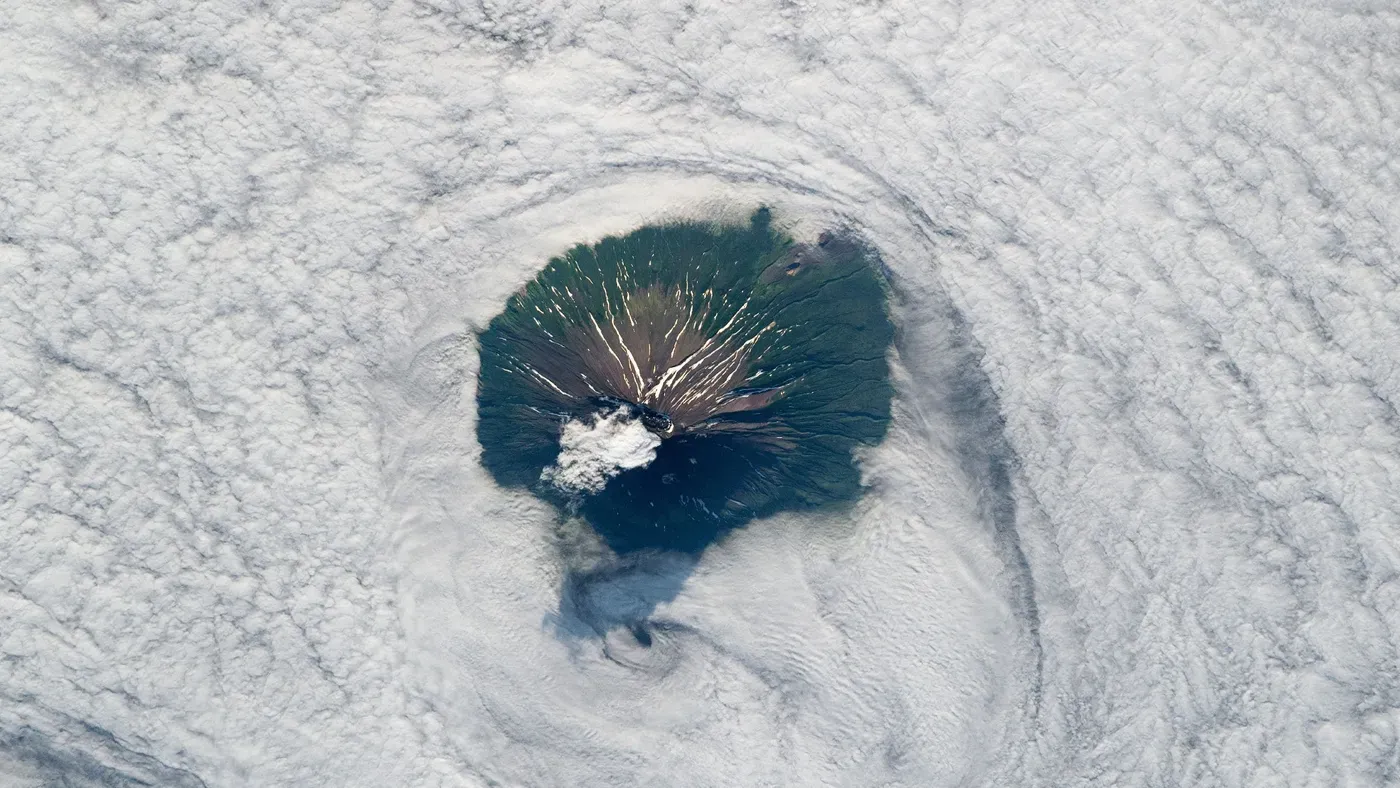
A stunning photo taken by an astronaut on board the International Space Station has captured the majestic peak of Alaid volcano peering above a thick layer of clouds over the Kuril Islands.
The photograph was snapped on August 2, 2019, and shows the towering mountain's near-perfect cone shape. The volcano is located on Atlasov Island, the northernmost of the Kuril Islands, which stretch along a fault line between Russia and Japan in the Sea of Okhotsk.
The island of Atlasov lies approximately 40 miles off the coast of Kamchatka Peninsula, another region known for its volcanic activity. This chain of islands is comprised of around 50 largely uninhabited volcanic landmasses, with Alaid being the tallest peak at an impressive 7,497 feet above sea level.
Alaid's unique shape and towering height make it a striking sight from space, but the volcano's significance extends beyond its visual appeal. It has erupted numerous times in recent history, including a major outburst in April 1981 that sent a massive plume of smoke and ash into the atmosphere.
The Smithsonian Institution's Global Volcanism Program has documented Alaid's eruptions over the past 50 years, noting at least nine instances of volcanic activity.
The Russian volcano Alaid has been experiencing frequent eruptions over the past few decades. Its most recent outburst occurred between September and November 2022, during which a river of lava flowed down its flank.
A closer look at the eruption reveals that it also produced smoke and ash, which was visible from space alongside another plume coming from the nearby island Paramushir. This indicates that Alaid's eruptions are not isolated events but can be seen in conjunction with other volcanic activity in the region.
The November 2022 eruption brought a scorching lava flow down its snow-covered slopes, highlighting the volcano's potential for destructive power. This event also underscores the importance of monitoring volcanoes like Alaid to predict and prepare for future eruptions.
When viewed from space, the island of Atlasov appears shrouded in clouds, with only half of it visible above a deep layer of swirling vapor. The cloud cover also obscures the volcano's caldera, which is approximately 6 km in diameter.
Farther down Alaid's flanks are series of snow-filled gullies carved out by lava flows from previous eruptions. Additionally, parasitic cones, small openings where lava burst through in the past, can be seen around the edge of the cloud layer on the volcano's northwest flank.
The Russian volcano Alaid has been showing off its impressive summit to astronauts and satellites alike, but beneath its majestic peak lies a much larger underwater volcanic structure.
Alaid is situated atop this massive submerged volcano, which stretches deep into the Sea of Okhotsk. The island's growth around the exposed cone is a result of lava flows that have reached sea level and solidified over time.
The history of Alaid reveals a complex geological past, with evidence suggesting that it was once connected to the Kamchatka Peninsula via a land bridge that has since been submerged by rising seas.
A major eruption in 1981 sent a massive plume of smoke and ash soaring up to 2,000 kilometers long, casting a shadow over the surrounding area.
A 2024 astronaut photo has captured the moment when Pangong Lake's icy surface began to break apart in the Tibetan Plateau. The lake's shoreline now reveals a point where ice meets water, mirroring the disputed border between China and India.
The explosive peak of a Russian volcano produces a unique type of lava that is surprisingly cool but moves at an unusually fast pace. In contrast, the massive 1981 eruption sent a colossal plume of smoke and ash soaring up to 2,000 kilometers long, casting a shadow over the surrounding area.
Facts based on reporting originally published by Live Science.
You may republish this story, in full or in part, if you credit News Central Site and link to it (licence CC BY 4.0). Photos are not included.