Astronomers Discover Mysterious Object in Early Universe Using James Webb Space Telescope
Astronomers have made an extraordinary discovery using the James Webb Space Telescope - a mysterious object that existed just 450 million years after the Big Bang has been spotted.

Astronomers have made an extraordinary discovery using the James Webb Space Telescope - a mysterious object that existed just 450 million years after the Big Bang has been spotted.
The object, dubbed CW-LRD-z10, is believed to be a "little red dot, a type of enigmatic entity thought by many researchers to be black holes forming within dense gas cocoons. The existence of these objects is still shrouded in mystery, but this new find could shed light on their origins.
According to experts, if confirmed, CW-LRD-z10 would be the earliest known example of its kind, potentially offering a glimpse into how such objects come into being. This could have significant implications for our understanding of supermassive black hole formation.
Professor Roberto Maiolino, an expert in experimental astrophysics at the University of Cambridge, has weighed in on the discovery, suggesting that CW-LRD-z10 may provide further evidence that little red dots are indeed linked to the earliest stages of supermassive black hole development.
The universe's light stretches and changes as it travels through space, a phenomenon known as redshift that occurs when objects are farther away from us. This effect is crucial for astronomers studying distant sources, like little red dots (LRDs), which were only recently discovered thanks to the James Webb Space Telescope (JWST). The JWST's advanced instruments allow scientists to observe these faint objects in unprecedented detail.
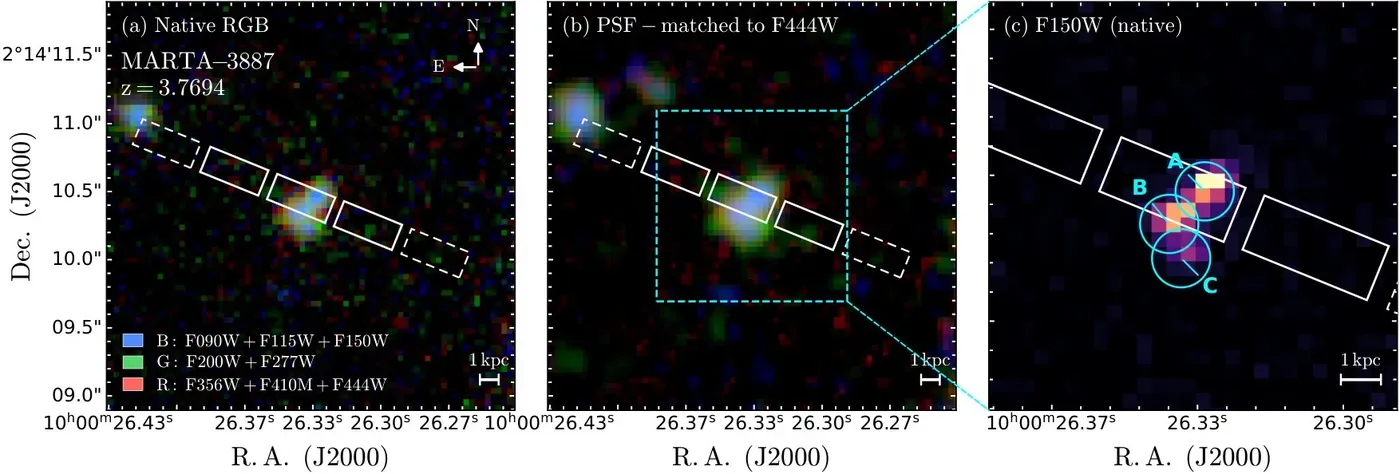
The recent study utilized the JWST's mid-infrared instrument (MIRI) to search for distant sources, and after scouring a vast area of space, the team found one potential candidate. CW-LRD-z10 was identified as the only possible match from their extensive search, according to Takumi Tanaka, the lead author of the study. This object's characteristics sparked significant interest among astronomers.
The researchers measured the redshift of this compact, red object and determined that it emitted its light around 450 million years after the Big Bang. The measurement's reliability was confirmed by a key indicator, the continuum drop attributed to a Lyman-alpha break appears convincing. Professor Maiolino praised the result for its robustness.
The color of CW-LRD-z10 is another significant clue, as it exhibits a distinctively redder hue in the mid-infrared band compared to the near-infrared range. This peculiarity strengthens the notion that this object could be a little red dot, adding weight to the theory that these enigmatic objects might be baby black holes.
The analysis of the spectrum from the mysterious red object has revealed several characteristics that could be indicative of a little red dot. The signature of emitted light shows a V-shaped dip typical of these objects, as well as possible iron emission and tentative detection of emission lines similar to those found in other little red dots and active black holes.
While none of these factors is conclusive on its own, the cumulative evidence supports the notion that this object could be a little red dot. However, one key feature that would typically confirm this identification - wide hydrogen lines - is not present in the spectrum.
This absence is due to the limited range of wavelengths covered in the study, which doesn't extend far enough into the region where these lines are usually found. As a result, the object's classification as a little red dot candidate remains provisional, with further investigation needed to confirm its nature.
Despite this ambiguity, other possibilities have been proposed, including that the object's spectrum might be indicative of a Balmer break - a sharp drop in light produced by older stars at closer distances. However, Tanaka has expressed skepticism about this interpretation due to inconsistencies in the data.
The discovery of a mysterious red object by the James Webb telescope has sparked debate among scientists about its nature and potential connection to a baby black hole.
A key aspect of CW-LRD-z10's light is the presence of an unusually strong spectral line that could be indicative of a specific element, but its position falls outside the current spectrum observed by the telescope.
This means that future observations will be crucial in confirming or ruling out the presence of this element, which would provide valuable insights into the object's composition and potential connection to black holes.
Emission features from iron have also been detected in CW-LRD-z10's light, a characteristic typically associated with actively feeding black holes rather than ordinary star-forming galaxies.
Further analysis of CW-LRD-z10's properties could provide valuable insights into the formation of the first supermassive black holes in the universe.
The James Webb Space Telescope is scheduled to take a spectrum of the mysterious object in 2027 using its mid-infrared instrument, which will help scientists separate the red glow from strong emission lines. This observation will allow the team to detect hydrogen and oxygen emission lines as well as the underlying continuum of the object's light.
We're really looking forward to seeing the data," said Tanaka, highlighting the anticipation surrounding the 2027 observations that could shed more light on CW-LRD-z10's nature.
Facts based on reporting originally published by Live Science.
You may republish this story, in full or in part, if you credit News Central Site and link to it (licence CC BY 4.0). Photos are not included.