US midterm elections control of Congress hangs in balance
The outcome of eight critical Senate races will determine which party controls the chamber after the election.

The 2024 US midterm elections have sparked intense debate over control of Congress, with Republicans fighting to hold onto slim majorities in both chambers as Democrats aim to seize power for the final two years of Donald Trump's term.
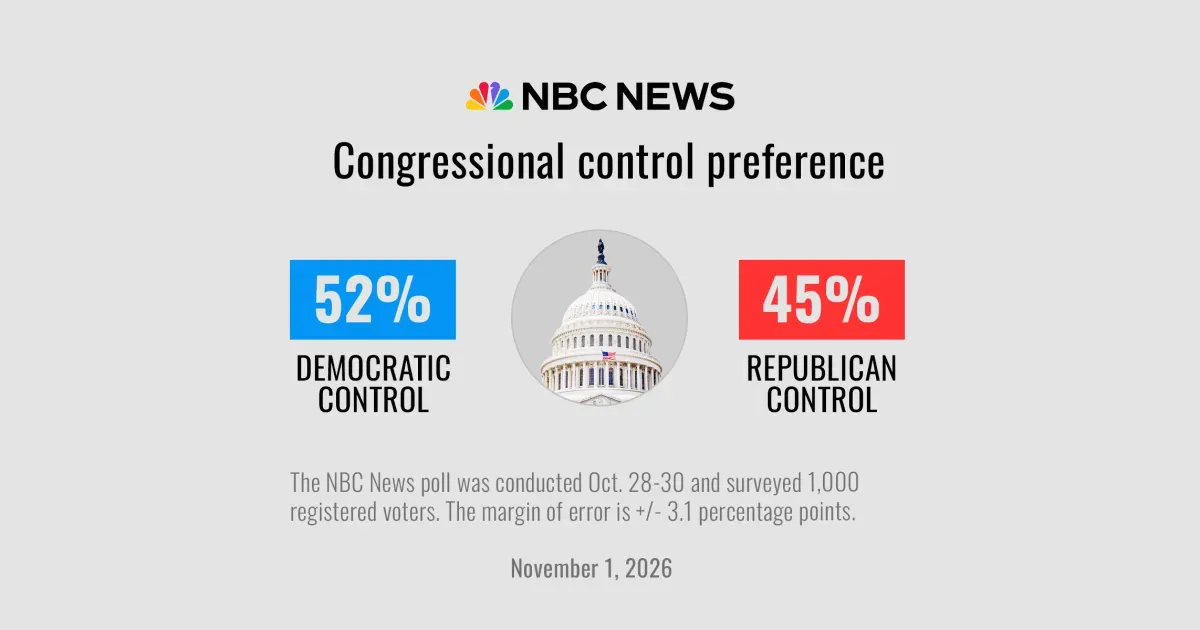
Public polling indicates a significant advantage for Democrats in key Senate contests and the House, suggesting that NBC News may be able to project control of both chambers on election night. However, the complexity of vote counting and close races will likely prolong the process of determining winners.
The Decision Desk at NBC News will closely monitor the outcome of eight critical Senate races, classified as toss-ups or lean Democratic, including contests in Alaska, Iowa, Kansas, Ohio, Texas, Maine, Michigan, and New Hampshire. These states vary significantly in their vote-counting efficiency, with some quick to tally ballots and others notoriously slow.
To reclaim Senate control, Democrats would need to win five out of these eight crucial contests, assuming they secure all "Likely" Democratic seats currently projected for them. Flipping North Carolina's Senate seat from red to blue and retaining Georgia in their column would be essential components of this strategy.
The outcome of these closely contested races will ultimately determine when NBC News can project control of the Senate. While some states may declare winners early, others may require a more prolonged count, complicating the decision-making process for the Decision Desk.
The fate of Congress hangs in the balance as voters head to the polls, and the wait for definitive results is likely to be long and arduous. As vote counting commences, NBC News will closely track developments, providing updates on the status of these pivotal Senate contests.
In closely contested Senate races, the margin between winning and losing can be razor-thin, making it challenging to declare a winner on election night.
As vote counting commences, the timing of when we will know control of the Senate is uncertain, with some contests potentially taking until early morning hours to resolve.
If individual Senate races are as close as predicted, determining overall Senate control may not be possible even if one party appears likely to win.
In such scenarios, Americans might wake up on Wednesday without a clear majority decided, despite having a good sense of who will ultimately prevail.
The outcome in Alaska is another factor that could prolong the uncertainty, due to its ranked choice voting system which can take several weeks to determine a winner.
Past elections provide valuable insights into how quickly votes are counted in each state, even if the exact timing on election night may vary.
Looking at historical patterns, some states stand out as fast counters and slow-but-steady counters, with Alaska being a wild card due to its unique voting system.
Elections in Michigan are administered at the local level, resulting in a decentralized counting process that can drag on until early morning or even midday Wednesday.
The margin of victory plays a significant role in determining how quickly Senate and House races are called, as close contests require more time to tabulate votes.
Recent polls have suggested that both Senate races in Michigan would be closely contested, with some favoring the Democratic candidates.
However, the early vote appears to be trending in favor of Democrats, which could lead to a wider range of timing possibilities for these races.
If the nationwide momentum translates to results, New Hampshire might see its Senate race called before midnight ET on election night.
In Michigan, Wayne County is a critical source of ballots, and statewide races often cannot be called without its results being tabulated.
The likelihood of calls coming before early morning hours depends on how close the two candidates are in each state, a fact that won't become clear until tonight.
The ranked choice voting system used in Alaska's Senate race will determine the winner through a complex process called tabulation. This involves eliminating candidates one by one until a majority is reached, with votes being reallocated based on voters' next-preferred choices.
Alaska's ranked choice tabulation typically occurs 15 days after Election Day, providing some clarity on the outcome of this critical Senate seat. However, in Maine, which also uses ranked choice voting for its Senate race, there are no official guidelines for when tabulation will occur. Historically, Maine has released ranked choice results 10 days after its primary election.
The uncertainty surrounding Maine's ranked choice tabulation is significant because it may not be known until the next day or even several weeks whether one or both of these seats are needed to win a majority in the Senate. This could lead to a prolonged period of uncertainty regarding control of the upper chamber.
In contrast, Democrats only need a net gain of three seats to flip control of the House, making them heavy favorites to succeed. However, the size of their potential majority is still up for grabs and will depend on how much voters shift their support towards the Democratic Party.
Recent analysis by our Decision Desk suggests that this nationwide shift could be substantial enough to produce a historically large majority for Democrats or conversely small enough to leave either party with a razor-thin majority. The size of the House majority matters significantly in determining control of the chamber.
The smaller the final size of the majority, the longer it will take for our Decision Desk to be certain about who will control the House. If current polls are overestimating Democratic support and the House majority is small, historical data from previous elections can provide some insight into timing.
While the 2022 and 2024 elections may offer some clues on how long it will take for us to determine House control, this information alone cannot guarantee a precise timeline. The interplay between current polls, voter sentiment, and election outcomes will ultimately dictate when we can confidently project which party will control the House.
The NBC News Decision Desk is currently analyzing data from various sources to determine when control of the House will be projected.
Several factors are at play in this process, including current polls, voter sentiment, and election outcomes.
One key consideration is the size of the majority that each party achieves - if it's a single-digit number of seats, it may take days or weeks for either party to reach 218 seats.
The Decision Desk uses a statistical model to estimate the total number of seats won by both parties, relying solely on past and current vote counts without incorporating any polling data.
This model is applied throughout the night after Election Day, providing an indication of which party is likely to control the House.
Some states, such as Maine and Alaska, use ranked choice voting in their House elections, potentially delaying projections until 10-15 days after Election Day if control hinges on these districts.
Current polls suggest that Democrats are poised to win at least 230 seats, according to recent analysis by the Decision Desk.
The outcome of key congressional districts will play a crucial role in determining control of the House and Senate come election day.
Kentucky's 6th District is being closely watched as an early bellwether for the midterms. The district saw Trump win by a margin of 15 points, but Democrats can still secure a majority without winning this seat.
A narrow victory for Republican Ralph Alvarado in Kentucky's 6th would be seen as a positive sign for Democrats, while a comfortable win would suggest they are poised to take control of the House. Conversely, if Alvarado wins by a wide margin, it could indicate that neither party will have a significant majority.
Florida is another state with several districts worth monitoring early in the night, particularly its 25th district where Democrat Jared Moskowitz is seeking re-election. The district was redrawn to favor Trump by 9 points but Moskowitz's win would signal a strong Democratic wave.
The outcome of Florida's 25th and Kentucky's 6th districts could potentially determine which party ends up with control of the House, as these early results may give insight into the broader trend of the election.
Facts based on reporting originally published by NBC News Politics.
You may republish this story, in full or in part, if you credit News Central Site and link to it (licence CC BY 4.0). Photos are not included.