Uganda's Entebbe International Airport linked to three recent Ebola cases in Kenya and Nigeria
Investigations are underway into possible links between three Ebola cases in Kenya and Nigeria, all of which may be connected to Uganda's Entebbe International Airport.
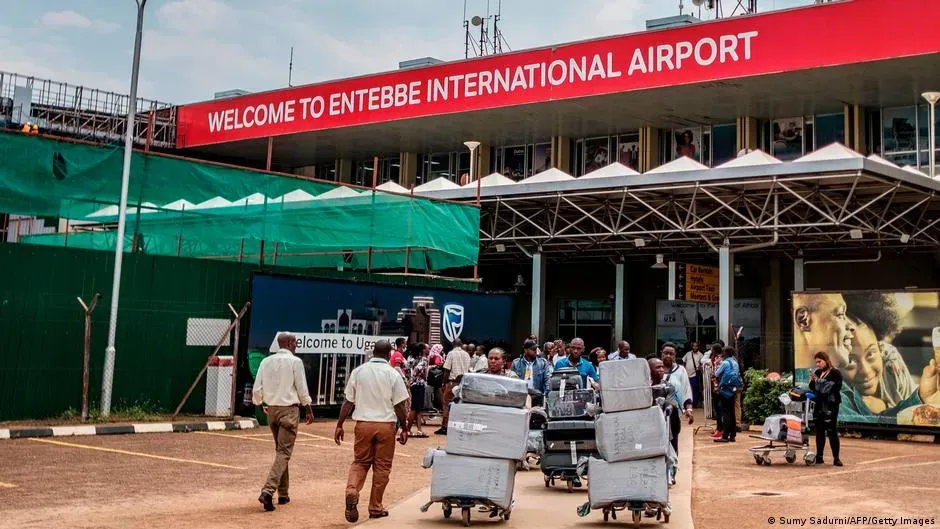
African health officials have raised concerns about a possible link between three recent Ebola cases in Kenya and Nigeria, all of which may be connected to Uganda's Entebbe International Airport.
The airport has become a focal point for investigations into the cases, with the head of emergency preparedness at the Africa Centers for Disease Control and Prevention (Africa CDC) confirming that both patients passed through the airport on October 3.
According to Wessam Mankoula, it is possible that the two patients may have crossed paths at the airport, although it has not been established whether they encountered each other or if any transmission occurred during their time there.
Health authorities in Kenya and Nigeria are now investigating Ebola infections involving individuals whose travel histories or contacts are linked to Uganda, sparking questions about the East African nation's role in the spread of the virus.
The new developments have also highlighted discrepancies in the accounts given by different countries, with Switzerland disputing claims that one of the Nigerian patients had visited the Democratic Republic of Congo, where an ongoing Ebola outbreak is a major concern.
A woman who traveled to East Africa, including Uganda, has been confirmed to have contracted Ebola in Nigeria's capital city, Abuja.
The Nigerian Health Minister Muhammad Ali Pate announced that a private health facility had diagnosed an imported case of Ebola virus disease on October 11, after the patient developed symptoms on October 7.
Health officials in Nigeria have identified 44 contacts of the infected woman, including healthcare workers and individuals who may have encountered her during her travels. The patient is reportedly stable and has been isolated for treatment.
Investigations are underway to determine whether the Nigerian patient's movements overlapped with those of another confirmed Ebola case, which was reported in Kenya.
The Swiss government has issued a statement contradicting earlier reports that a woman contracted Ebola while traveling in Uganda with her husband, who is a Swiss diplomat based in Abuja.
According to the Swiss Federal Department of Foreign Affairs, the couple did not visit the Democratic Republic of Congo as previously suggested. The department's statement to Reuters news agency directly disputes this account and provides new information about the woman's movements.
The woman, identified by Swiss authorities as a Swiss national with Ugandan origins, is married to a diplomat stationed in Abuja. This development adds another layer of complexity to the investigation into her possible exposure to Ebola.
Swiss officials initially told Reuters that they believed she contracted Ebola while traveling with her husband in Uganda, but this assessment has not been independently confirmed by other organizations.
Health officials have confirmed that a patient who passed through Entebbe International Airport on October 3 was likely exposed to the virus before traveling to other countries.
This revelation has led Kenyan authorities to report additional infections linked to the initial case, sparking concerns about the spread of Ebola in the region.
A Ugandan national is currently being sought as a contact of the deceased patient, with health officials in Kenya struggling to establish his whereabouts.
According to reports, the individual in question is known by name and passport number, but efforts to reach him are hindered by his use of a South Sudanese telephone number.
The complexities of tracking potential Ebola exposures across multiple countries have been laid bare by recent discoveries in Kenya and Nigeria.
Both patients who tested positive for the disease had passed through Entebbe International Airport on the same day, highlighting the difficulties of reconstructing travel histories and identifying close contacts.
This challenge is further compounded by the need for authorities to exchange accurate information quickly enough to identify potential exposures.
In Abuja, residents are voicing concerns about the consequences of another outbreak, with some expressing fears that Nigeria's health care system may struggle to respond amidst economic hardship.
The confirmed infection has revived memories of previous Ebola outbreaks in the city, with residents such as Peace Kolawole calling for increased vigilance and precautions.
Uganda's claim of having no active Ebola cases is being met with skepticism due to conflicting reports from Switzerland and other countries involved in the outbreak investigation.
The World Health Organization (WHO) and Africa CDC are yet to verify the travel history of a Nigerian patient who tested positive for Ebola, which has added complexity to the ongoing probe. This discrepancy highlights the challenges faced by investigators as they attempt to track the source of the infection.
As the outbreak continues to spread in Kenya and Nigeria, health officials are focusing on containing confirmed cases, while Uganda must demonstrate the effectiveness of its surveillance systems to reassure both its citizens and neighboring countries, ultimately bringing stability to the region.
Facts based on reporting originally published by DW English.
You may republish this story, in full or in part, if you credit News Central Site and link to it (licence CC BY 4.0). Photos are not included.