Star Moving at Over 8% of Speed of Light Discovered
Astronomers have discovered a star moving at an incredible speed through space, traveling over 8% the speed of light and providing new insights into the Milky Way.
Astronomers have discovered a star that is defying all expectations by moving at an incredible speed through space.
The star, designated S301, has been found to be traveling at more than 8% of the speed of light, making it one of the fastest-moving stars ever recorded.
This remarkable discovery sheds new light on the mysterious heart of our galaxy, the Milky Way, and provides a unique opportunity for scientists to study this region up close.
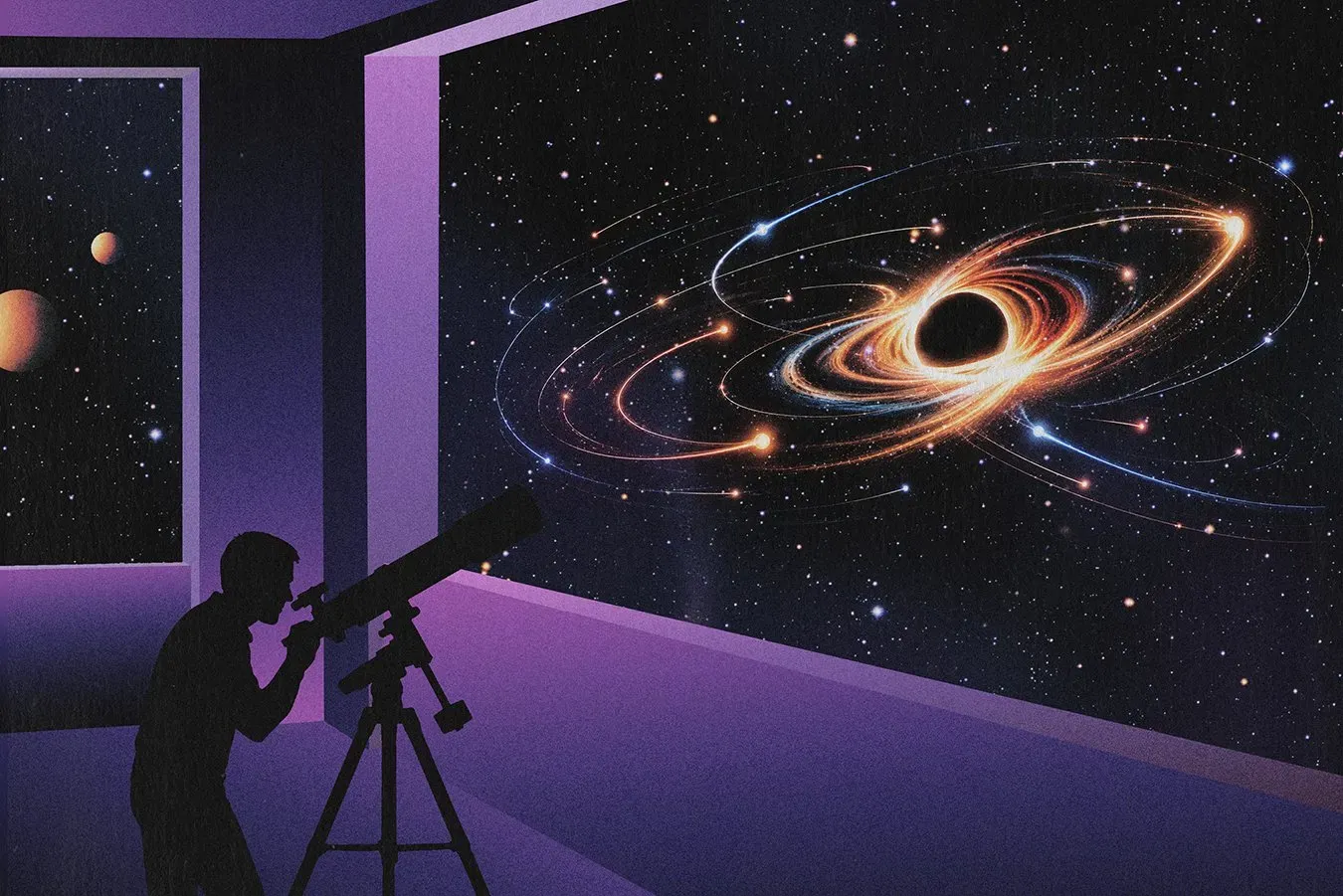
The extreme velocity of S301 is not an isolated phenomenon, but rather part of a larger pattern of high-speed stars circling around the black hole at the center of our galaxy.
This superhighway of stars is likely due to the intense gravity in the vicinity of the black hole, which would normally rip apart the clouds of gas and dust that give birth to new stars.
The existence of these stars is a surprise because they should not be able to form under normal conditions, given the extreme environment surrounding the black hole.
Astronomers are eager to learn more about this remarkable system, as it could reveal hidden properties of the black hole at the center of our galaxy and test gravity in one of the universe's most extreme environments.
The region surrounding the Milky Way's central black hole is notoriously difficult to observe due to the Earth's atmosphere distorting our view and massive clouds of dust and gas obscuring visibility.
Astronomers have struggled to resolve individual stars in this area, but recent advances have allowed them to peer through the veil and pick out stars near the galactic centre for the first time.
Gillessen notes that even with very good eyesight, tiny objects like these stars can be easily overlooked, much like a glow worm next to the headlight of a car.
The problem is further compounded by the need for an extremely large telescope to resolve such distant and faint objects, with some estimates suggesting a mirror diameter of 30-40 meters would be required.
However, astronomers are impatient and unwilling to wait for the construction of such massive telescopes, which could take years or even decades to complete.
To overcome this challenge, researchers have turned to adaptive optics technology, which involves using a deformable mirror that can adjust its shape hundreds or thousands of times per second to compensate for atmospheric distortions.
The European Southern Observatory in Germany is home to an adaptive optics mirror that has revolutionized our understanding of the Milky Way's mysterious heart.
This cutting-edge technology uses a deformable mirror just 2 millimeters thick, which can be shaped by magnetic forces to create tiny surface deformations hundreds or thousands of times per second. This allows for incredibly precise adjustments to compensate for atmospheric distortions.
The mirror has enabled researchers to capture images that were previously unimaginable, with resolutions that seem almost magical. However, the real breakthrough came in 2002 when a star called S0-2 was discovered, which would go on to dominate the field for years to come.
S0-2 is an incredibly fast-moving star that comes within just 17 light hours of Sagittarius A*, the supermassive black hole at the center of the galaxy. At its closest point, it reaches speeds of around 7,650 kilometers per second, which is almost 3% of the speed of light.
By tracking S0-2's orbit, researchers could begin to weigh whatever was sitting at the heart of the galaxy. The data suggested that Sagittarius A* had to be an enormously massive and compact object, compelling evidence that it was indeed a black hole.
The next major leap forward came in 2018 when S0-2 made another close pass by Sagittarius A*. This time, researchers used interferometry, a technique that combines light from multiple telescopes to create the effect of one much larger observatory. The result was unprecedented precision in tracking the star's orbit and pinning down the mass of the black hole.
The work has been instrumental in earning its lead researchers a Nobel prize in 2020, but it's just the beginning of unraveling the mysteries of our galaxy's behemoth black hole.
The S stars' unusually short lifetimes suggest they cannot have migrated into the galactic centre gradually over millions of years.
According to lead researcher Gillessen, these stars are incredibly young, with a lifespan shorter than the time between the dinosaurs' extinction and the present day.
This raises questions about how such young stars ended up in the vicinity of Sagittarius A*, the supermassive black hole at the Milky Way's centre.
One theory proposes that these S stars began as binary systems in more distant orbits, which then drifted too close to the black hole.
If they were torn apart by the intense gravitational forces near the event horizon, one star would be flung out of the galaxy at high speed while the other was drawn into a perilously tight orbit around Sagittarius A*.
This process could have accelerated their journey to the galactic centre, allowing them to reach their current locations within the relatively short time frame of their lifespan.
A cluster of stars called IRS-13E has caught the attention of astronomers studying the Milky Way's mysterious heart. Located near the galactic centre, this star cluster may harbour a black hole at its core, potentially capable of accelerating nearby stars to their extreme velocities.
While the presence of a black hole in IRS-13E remains unconfirmed, scientists are intrigued by the possibility that it could be responsible for the rapid movement of these stars. Further investigation is needed to determine if this theory holds up, as the region surrounding the galactic centre is notoriously difficult to study.
The process of studying a black hole like Sagittarius A*, located at the heart of the Milky Way, is akin to trying to understand the inner workings of the sun without getting too close. While we can observe the matter swirling around it and even capture images of its shadow using advanced telescopes, the black hole itself remains invisible.
Black holes are relatively simple entities, with only two key properties: mass and spin. Fortunately, scientists have already determined the mass of Sagittarius A*, thanks to the work of researchers Genzel and Ghez. However, determining the spin of this massive black hole is a more complex task.
Astrophysicist Ziri Younsi notes that measuring the spin of a black hole is an extremely challenging task. While it's possible to estimate the spin of distant black holes through various methods, these approaches are not applicable for Sagittarius A*. The event horizon of this black hole remains elusive, much like trying to pin down its spin.
The Event Horizon Telescope captured a stunning image of Sagittarius A* in 2022, revealing the swirling patterns of magnetic fields surrounding the black hole. However, the picture is more of an artistic representation than a precise measurement, as it relies on indirect observations and complex algorithms.
Measuring the spin of Sagittarius A* directly remains one of the biggest challenges in astrophysics today. One possible solution lies in observing stars that orbit close to the black hole, allowing scientists to gauge its influence and ultimately determine its spin.
The gravitational pull of the Milky Way's central black hole has been found to have an unusual effect on nearby stars, causing them to move in a way that can reveal information about the black hole's spin.
When the black hole rotates, it creates an "imprint" on the surrounding space-time fabric, affecting the orbits of nearby stars. This phenomenon is known as precession, and by measuring its effects precisely, scientists can infer the black hole's spin rate.
Researchers are particularly interested in studying stars that orbit close to the black hole, such as S2, which has a highly elliptical path around the galaxy's center. By monitoring this star's motion over time, they hope to gain insights into the black hole's behavior and its impact on the surrounding environment.
Recently, scientists have spotted another nearby star, S301, using the Very Large Telescope in Chile. This star is notable for being only 8 billion kilometers from the black hole at its closest approach, making it an ideal candidate for studying the black hole's effects. With a orbital period of just 7 years, S301 offers a more sensitive probe of the black hole's gravity and spin.
While measuring the black hole's spin may seem straightforward, it requires precise calculations and long-term observations to account for any errors or uncertainties. According to researchers, combining data from over 30 years is necessary to accurately measure these effects, which can be easily distorted by minor discrepancies in measurement.
Ultimately, determining the spin of Sagittarius A*, the Milky Way's central black hole, will provide a unique window into the galaxy's behavior and help resolve long-standing mysteries about its dynamics.
Facts based on reporting originally published by New Scientist.
You may republish this story, in full or in part, if you credit News Central Site and link to it (licence CC BY 4.0). Photos are not included.