Cosmic surroundings are relatively peaceful despite turbulent events elsewhere in space and time
A study published in Monthly Notices of the Royal Astronomical Society analyzed simulated universes to identify safe havens for life to thrive across the universe.
A study of simulated universes has revealed that our cosmic surroundings are relatively peaceful, despite some turbulent events occurring elsewhere in space and time.
The research, published in Monthly Notices of the Royal Astronomical Society, aimed to identify safe havens for life to thrive across the universe. The team used supercomputers to generate a vast number of simulated universes, allowing them to analyze various cosmic environments and their potential effects on life.
Our solar system is situated in one of these habitable zones, often referred to as Goldilocks zones. These regions are characterized by conditions that are neither too extreme nor too mild, making them suitable for life to emerge and sustain itself.
The existence of such zones highlights the significance of our location within the Milky Way galaxy. While other areas may pose dangers or be inhospitable to life, our cosmic surroundings appear relatively tranquil compared to these regions.
The concept of habitable zones takes on a new meaning when considering the immediate surroundings of stars. For liquid water to exist, temperatures must be just right, not too hot or too cold. This delicate balance is achieved in what's known as the circumstellar habitable zone.
As we expand our search for life-supporting regions, we look within our own galaxy, the Milky Way. Young stars that are too close to the galactic center face intense competition from nearby stars, while those farther away may lack essential chemicals necessary for life. This balance of proximity and isolation is crucial for a star's habitability.
The sun itself finds itself in a favorable position within the Milky Way, situated in what's referred to as the galactic habitable zone. This suggests that our planet's location is not unique, but rather part of a broader pattern that may be repeated elsewhere in the galaxy.
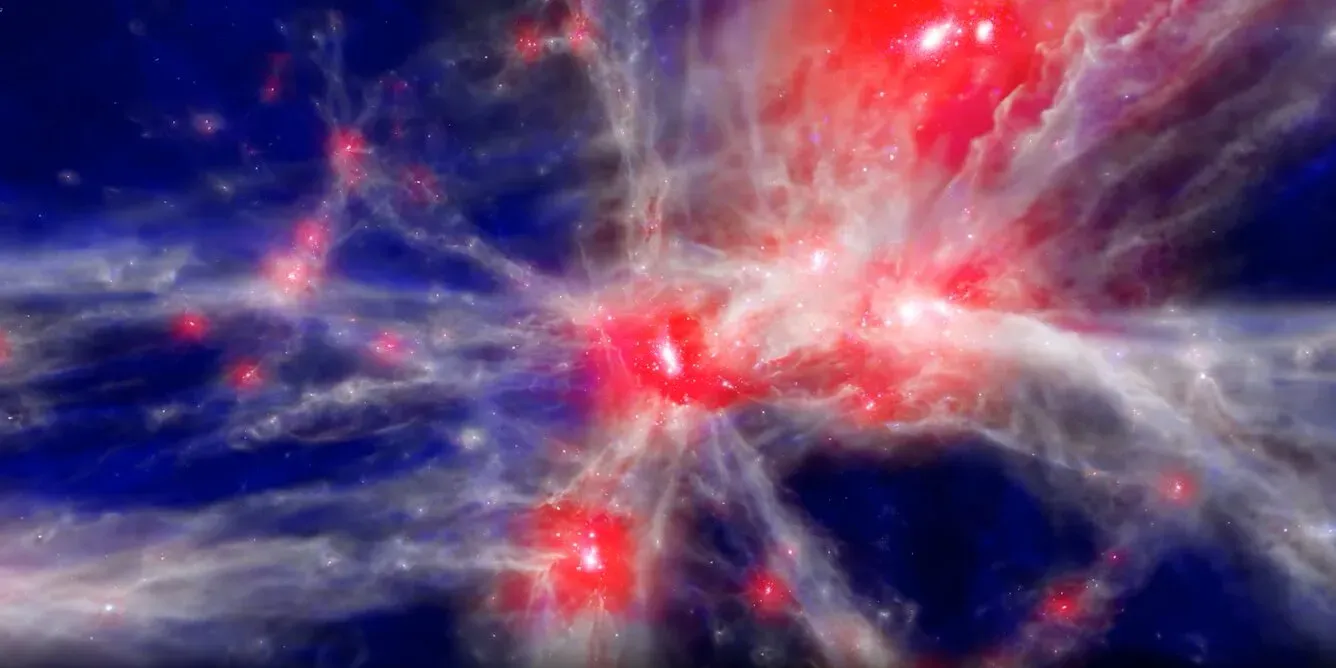
By zooming out even further, we can explore other galaxies and their potential for supporting life. To achieve this, researchers utilized the EAGLE project, a comprehensive simulation of the universe that models the expansion of space, gravity's influence, and the behavior of gas, stars, and black holes across vast distances.
The ingredients necessary for life are complex and multifaceted. While hydrogen and helium produced during the Big Bang are fundamental elements, they alone do not provide the building blocks for life as we know it. Instead, researchers focus on stars that have seeded the universe with heavier elements essential for life.
Studies of exoplanets suggest that Earth-like rocky planets require a specific concentration of these heavier elements to support life. However, an overabundance of them can lead to the formation of hot Jupiters, gas giants that roam through planetary systems and devour smaller rocky planets in their path. This is a scenario best avoided.
Researchers have turned their attention to modeling the factors that are detrimental to life. Supernovae, massive explosions triggered by the collapse of big stars, can sterilize their surroundings, making them inhospitable to life. Even more catastrophic events, such as gamma-ray bursts, can have a devastating impact on a much larger scale.
Some scientists believe that one such event may have been responsible for the Ordovician mass extinction 450 million years ago. This theory suggests that a nearby explosion triggered by a supernova or other cataclysmic event may have had far-reaching consequences for life on Earth.
A galaxy's neighborhood can also pose risks to life, particularly if it is overcrowded and prone to close encounters between stars. This could disrupt the stability of planetary orbits, making it difficult for life to thrive.
The simulation has revealed that certain regions of the universe are more conducive to supporting life. While it's uncertain whether life would actually emerge in these areas, they do offer the most favorable conditions for its development. These locations have been identified through a thorough analysis of various factors, including cosmic radiation and planetary stability.
The results also suggest that our own galaxy, the Milky Way, is relatively well-suited to support life. This finding isn't solely a reflection of our fondness for our home neighborhood; rather, it's an indication that the conditions in the Milky Way are indeed favorable. The simulation has taken into account various types of galaxies and their potential for supporting life.
The universe appears to have created numerous opportunities for life to thrive. However, there is evidence to suggest that this process may be slowing down as the rate of catastrophic events, such as supernovae explosions, increases. These destructive occurrences can have a devastating impact on planetary development.
In contrast to younger galaxies, which are still going through energetic and tumultuous periods, our Milky Way and similar galaxies seem to have entered a more stable phase. Even after billions of years of existence, the likelihood of an extreme extinction event in our galaxy remains relatively low, with fewer than one star in a thousand experiencing such a catastrophic occurrence.
The likelihood of life existing in smaller galaxies is significantly lower due to their crowded and energetic environments.
These galaxies are vastly more numerous than large ones like the Milky Way, making them a dominant feature of the universe.
In essence, buying property in the Milky Way can be considered a secure investment from an astronomical perspective.
Facts based on reporting originally published by Phys.org.
You may republish this story, in full or in part, if you credit News Central Site and link to it (licence CC BY 4.0). Photos are not included.