China's Humanoid Robot Project Entertains Visitors with Dance Moves
A child-size yellow robot in Wuhan, China has been entertaining visitors with its dance moves, showcasing the capabilities of China's humanoid robot project.
A child-size yellow robot in Wuhan, China's lobby has been entertaining visitors with its dance moves. The miniature humanoid robot twirls to traditional Chinese music while larger robots on either side of the stage pound out a lively rhythm on drums. Its agility is so impressive that it appears almost lifelike as it bobs along to upbeat pop tunes.
As visitors watch, other smaller robots in the lobby demonstrate their capabilities by performing everyday tasks such as pouring water into a jug and arranging cutlery. Meanwhile, nearby, a student disassembles a flashlight and swaps out its battery, showcasing the robots' potential for assisting humans with various chores.
Mei, a 22-year-old intern, was initially enthusiastic about her work on China's humanoid robot project. However, she soon found it monotonous, which is not uncommon for engineering graduates in China. The country's universities produce nearly 1 million engineers every year, far outnumbering their counterparts in the US, where about 140,000 young engineers enter the job market annually.
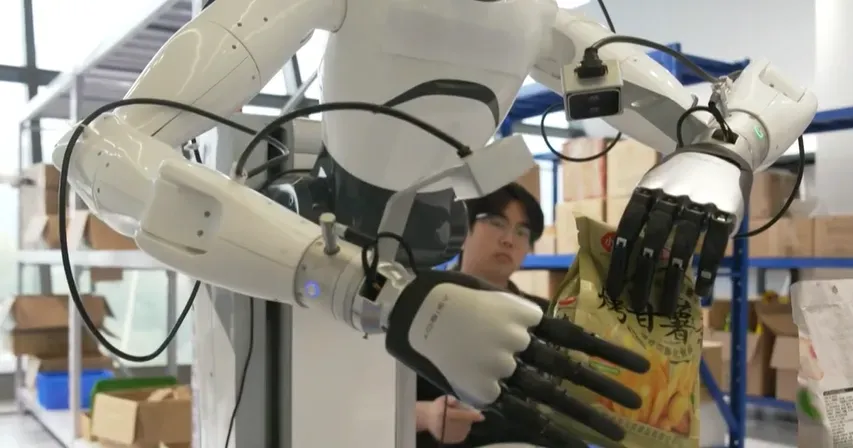
Another graduate sat nearby with a remote control and a humanoid robot beside him, as he worked on training it to perform various tasks. He explained that they were capturing specific actions, such as pouring water into a cup, and gathering data for the model. The robot's movements are controlled by a hand controller, mimicking the exact motion of human hands.
China's robotics industry is focused on developing humanoid robots that can assist humans in various settings, according to Prof. Jiyin Cao, director of the Hubei robotics center. Cao emphasizes that these robots are designed to augment human productivity, not replace it.
The country's aging and shrinking population puts immense pressure on China to innovate and deploy robots quickly. Cao believes that future robots will be versatile and widely used across various industries, including manufacturing, healthcare, and nuclear energy sectors. They will also serve as personal assistants and provide elderly care services.
Cao is confident about the potential of humanoid robots in improving productivity and quality of life. He envisions a future where these robots are deployed not only in industrial settings but also in households, making tasks easier for people and freeing up time for more important activities.
Robots designed to assist humans in their daily lives are still in the early stages of development, requiring extensive training and learning before they can be deployed effectively. Home environments are particularly challenging for robots due to their inherent complexity and variability.
The unique characteristics of every household make it difficult to create robots that can adapt seamlessly to these settings. China's industrial manufacturing system and supply chain for robotics products give the country a significant advantage in developing and producing such robots, with experts predicting that it could be three to five years before humanoid robot helpers become a common sight in homes.
Facts based on reporting originally published by CBS News World.
You may republish this story, in full or in part, if you credit News Central Site and link to it (licence CC BY 4.0). Photos are not included.