Supernova Observed in Distant Universe
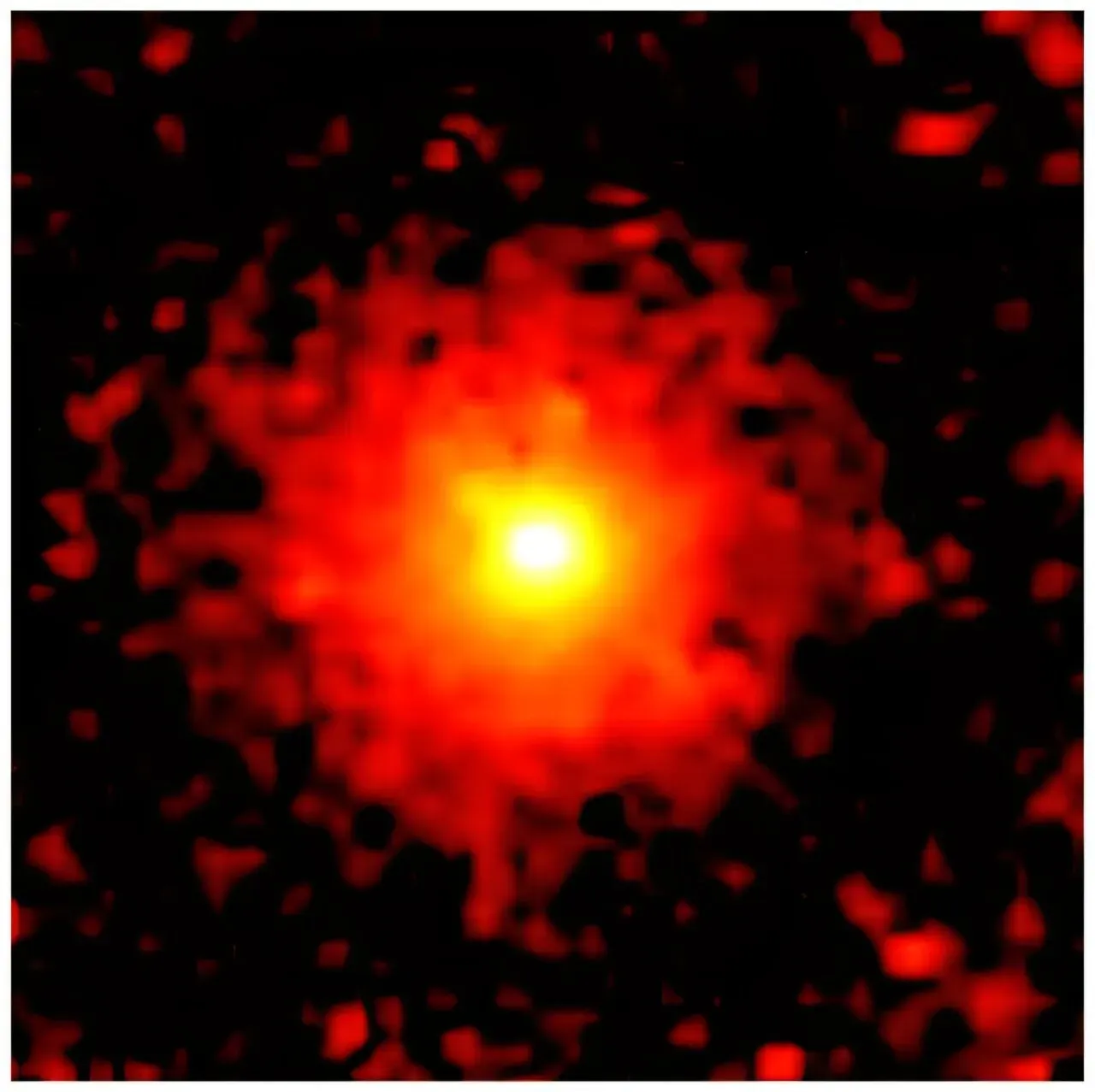
Astronomers using the James Webb Space Telescope have identified one of the most distant supernovas ever observed.
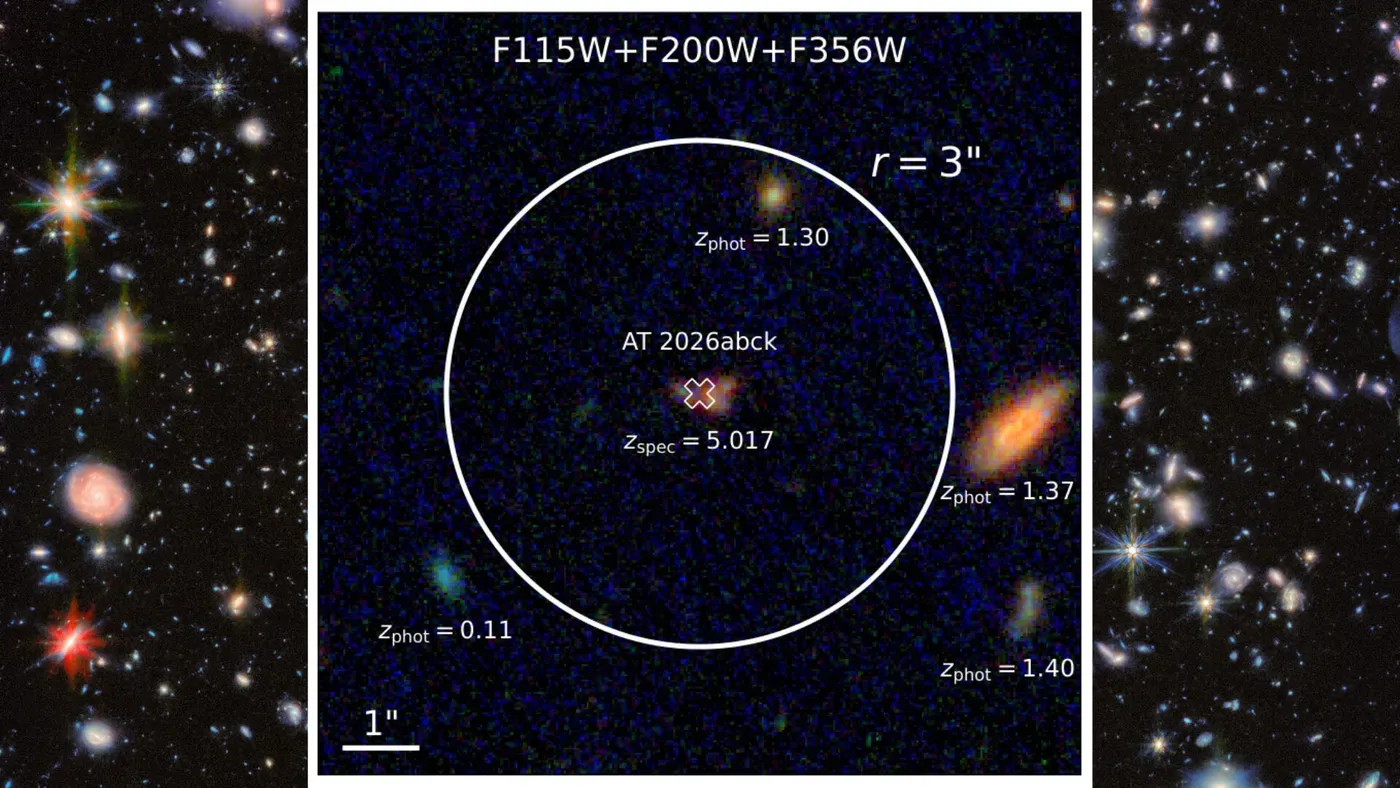
Astronomers using the James Webb Space Telescope (JWST) have identified what may be one of the most distant supernovas ever observed in the universe.
The ancient explosion is thought to date back around 1.15 billion years after the Big Bang, when the universe was still in its early stages and bursting with massive stars. At this time, the universe was less than one-tenth of its current age, and it's believed that the distance between us has expanded significantly since then.
The supernova is estimated to have occurred around 12.5 billion years ago, releasing a massive amount of light into space as it violently exploded. According to researchers, this ancient speck of light has been traveling through the universe for an enormous period of time, with its brightness amplified by the expansion of the cosmos.
Despite being incredibly distant, the supernova is remarkably bright, with its peak intensity reaching levels that are almost as high as the entire Milky Way Galaxy. This is due to the immense energy released during the explosion, which would be equivalent to the sun's output over a period of approximately 2 billion years.
The discovery was announced in a paper uploaded to the preprint server arXiv on September 29, although it has yet to undergo peer review by other experts in the field. The findings suggest that this ancient supernova offers a unique opportunity for scientists to study the early universe and its evolution over billions of years.
The newly discovered supernova is radiating intense heat, reaching temperatures of over 30,000 degrees Fahrenheit (16,000 degrees Celsius). This extreme temperature is causing its ejected material to expand into a massive shell that has reached a radius of approximately 46 astronomical units.
This measurement corresponds to about 46 times the distance between Earth and the sun or roughly the distance Pluto travels from the sun at its farthest point. The sheer scale of this expansion underscores the enormous energy released by the supernova explosion.
The host galaxy of this supernova, designated ID101411, is a massive celestial body with approximately 6.3 billion solar masses. Notably, it is an actively star-forming galaxy that produces new stars at a rate significantly higher than our Milky Way.
This galaxy's high rate of star formation is likely due to its rapid conversion of gas into stars, which is facilitated by the presence of massive amounts of fuel. The galaxy's ability to form new stars rapidly suggests that it is in an early stage of evolution, with ample opportunities for stellar growth and development.
The observed supernova is thought to have exploded within a relatively short time frame, between four to 10 days before observation.
The discovery of a distant supernova is even more remarkable due to a stroke of luck: it was observed without the aid of gravitational lensing, a phenomenon predicted by Einstein that bends and magnifies light emitted by objects behind massive space objects.
Normally, most supernovas this far away are found with the help of a foreground galaxy cluster acting as a natural magnifying glass. However, this particular supernova stands out as it is the most distant one we've actually seen appear without such assistance.
The supernova was discovered as part of the NEXUS Treasury program, where the James Webb telescope intermittently scans patches of the sky for ancient explosions. Interestingly, the host galaxy of the explosion had been observed by JWST over several years before the actual event occurred on Aug. 7 this year.
A notable aspect of this observation is that the star had not yet exploded in JWST's previous viewing on May 28, 2026, indicating that 71 days passed on Earth while only about 12 days had elapsed in the supernova's own time frame.
This phenomenon highlights a fundamental property of the universe: its expansion doesn't just stretch space but also slows down time from our perspective. This means that changes occurring at the supernova unfold at a rate six times slower than they actually happened, taking one week to appear as about six weeks in our view.
The explosion's energy output is a key factor in determining its classification and understanding what triggered it.
Further investigation is needed to confirm whether this supernova is indeed a superluminous one, which would release significantly more energy than conventional core collapse supernovas. These rare events are thought to occur when a star undergoes an intense burst of activity, potentially leading to the explosion of nearby matter. The team's observations suggest that this process may be taking place in the vicinity of the supernova.
Preliminary interpretations of the data have led researchers to speculate about what might be happening inside the explosion itself. It is unclear whether it will continue to heat up or begin to cool, which could provide valuable insights into its environment and any potential triggers for the event.
Follow-up observations are crucial in confirming the team's findings and gaining a deeper understanding of this enigmatic explosion.
The James Webb Space Telescope has been observing one of the earliest supernovas in the universe, providing scientists with a unique opportunity to study this rare and enigmatic event. The explosion is thought to have occurred about 12 billion years ago, during the early stages of the universe's formation.
Follow-up observations are crucial in confirming the team's findings and gaining a deeper understanding of this phenomenon. By continuing to monitor the supernova, researchers can gather more data on its properties and behavior, shedding light on the mysteries surrounding these ancient cosmic events.
Facts based on reporting originally published by Live Science.
You may republish this story, in full or in part, if you credit News Central Site and link to it (licence CC BY 4.0). Photos are not included.