Quantum Pathway Discovered in Energy Harvesting Research
A team of researchers has discovered a novel approach to harnessing energy from various sources while minimizing entropy transfer.
A team of researchers has stumbled upon an unexpected solution while trying to prove a theoretical limitation in physics. Led by Oscar Dahlsten, an associate professor at City University of Hong Kong's Department of Physics, they aimed to verify a long-held assumption but instead discovered a quantum pathway.
Their investigation focused on harnessing energy from fluctuating sources, such as those found in nature. However, conventional methods for converting this energy often come with a catch: entropy, or randomness, which makes it challenging to transform into usable power needed for devices and batteries.
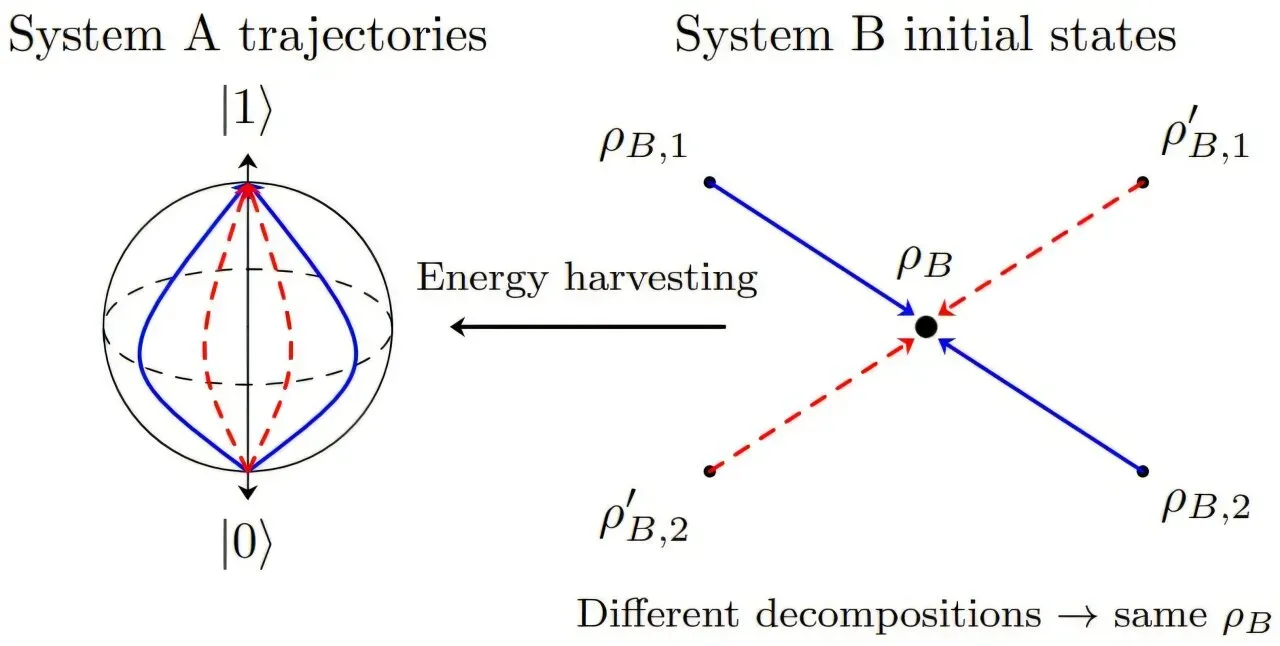
The researchers' breakthrough hinges on a fundamental aspect of quantum theory known as the non-unique decomposition of mixed states. This concept enables them to bypass traditional physical constraints and explore an innovative strategy for energy harvesting.
Their findings have been published in Physical Review Letters under the title "Nonunique Decompositions of Mixed States and Deterministic Energy Transfers."
The team's research has revealed a novel approach to harnessing energy from various sources while minimizing entropy transfer. A key aspect of this method is that it can be charged in multiple ways, corresponding to different intermediate superposition states. As long as the source induces one of these state transitions in the harvester, the final state will be the charged state with certainty.
This finding suggests a possible mechanism for transferring energy from different sources while avoiding the transfer of entropy. According to Dahlsten, the team initially set out to prove that such a protocol might be impossible, but their efforts led them to discover a viable solution instead. The shift from trying to disprove a concept to uncovering a practical application was a significant turning point in the project.
The theoretical framework developed by the researchers has far-reaching implications for future low-power technologies. By providing a foundation for converting ambient energy into usable power with minimal loss, it points toward the development of more efficient devices and systems. This could include reducing the fundamental losses of conventional AC-to-DC rectifiers and powering internet of things devices, wearables, smart-city sensors, and 6G devices from ambient sources.
The team's discovery has significant potential for a wide range of applications, including powering small devices that require minimal energy to operate. The framework offers a prospective route to reduce the fundamental losses associated with conventional power conversion methods, enabling more efficient use of ambient energy.
The framework developed by researchers offers a promising solution to reduce energy losses associated with conventional power conversion methods. This is achieved through the use of nonunique decompositions of mixed states, which enables deterministic energy transfers.
By harnessing this approach, it becomes possible to efficiently utilize ambient energy without incurring fundamental losses.
Facts based on reporting originally published by Phys.org.
You may republish this story, in full or in part, if you credit News Central Site and link to it (licence CC BY 4.0). Photos are not included.