Raphael Glucksmann Wins French Socialist Presidential Primary
French politician Raphael Glucksmann has won 66% of votes in the first round of the party's presidential primary.
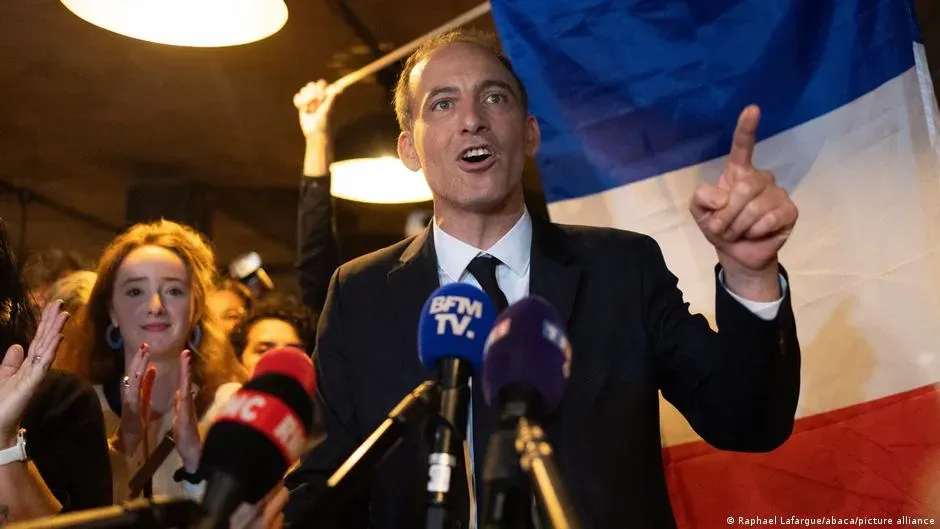
In a significant development, Raphael Glucksmann has emerged victorious in the French Socialists' presidential primary, securing 66% of the votes cast in the first round. This decisive win sets him up as the party's candidate for the 2027 presidential election. The victory was celebrated by Glucksmann supporters at the Cantine de Belleville restaurant in the gentrified Parisian neighborhood of Belleville.
However, the festivities were marred by an incident that has raised questions about the tone and direction of Glucksmann's campaign. As he left the restaurant, Glucksmann was attacked with flour bombs by an unidentified individual. The perpetrator's motives are still unclear, but the act has sparked debate about the level of animosity and aggression within the party.
Glucksmann has responded to the incident by calling on his rival, Jean-Luc Melenchon, to condemn attacks carried out by his supporters. However, it remains uncertain whether the attacker was indeed a supporter of Melenchon's La France Insoumise (LFI) party. The incident highlights the challenges that Glucksmann faces in winning over Melenchon's supporters without compromising on his own stance.
The issue of cooperation with the LFI has been a contentious one throughout the primary campaign, with some Socialists advocating for a more open approach and others pushing for a clear break. Glucksmann's decisive victory is seen by many as a vote in favor of a distinct demarcation between the two parties.
Glucksmann's campaign will now face intense scrutiny as he prepares to take on Melenchon and other candidates in the presidential election. The question of how he can win over Melenchon's supporters while maintaining his own stance is set to dominate the coming weeks, with many wondering whether Glucksmann's victory will ultimately prove a blessing or a curse for the Socialist party.
Glucksmann's victory in the primary has sparked concerns about his ability to lead the Socialists due to his lack of experience in government or local politics.
His opponents have questioned whether he is ready for the top job, with some comparing him unfavorably to a rookie trying to take charge of a company. This criticism comes from within the party itself, with several members expressing doubts about Glucksmann's suitability as leader.
A recent poll has highlighted the challenges facing Glucksmann and the Socialists. Conducted by Toluna Harris Interactive just after his win, it projected that he would secure only 10-11% of the vote in a presidential election. This is a significant improvement on the party's performance in 2022, when their candidate won just 1.75% of the national vote.
However, the same poll also suggested that far-left candidate Melenchon was still in a strong position to reach the runoff stage. With 18% of the projected vote, he would be more likely than Glucksmann to make it through to the next round.
Glucksmann's own party affiliation adds another layer of complexity to his situation. Although he is leading the Socialists, he is actually a member of a smaller center-left party called Place Publique.
Young people in France seem unimpressed by Jean-Luc Mélenchon's leadership of the Socialists, despite his efforts to rally them behind his party's banner. In a recent survey, Ipsos found that 41% of voters under the age of 25 would back Mélenchon if he were the social-democratic candidate in an election.
This is significantly higher than the proportion who support Marine Le Pen, the far-right nationalist leader. However, it also highlights the deep divisions within France's young electorate. While Mélenchon dominates on the left, his party's appeal seems limited to a core group of committed supporters.
Mélenchon has been seeking to connect with younger voters by aligning himself with the student protests that have drawn international attention. He recently spoke at a rally near Clermont-Ferrand in central France, where he expressed solidarity with the students and reiterated his calls for lowering the voting age to 16 and abolishing Parcoursup.
Political scientist Antoine Bristielle has analyzed the dynamics of Mélenchon's support base. According to Bristielle, many of Mélenchon's most loyal supporters are young, educated city-dwellers who are struggling financially. Four in ten households in this group live on a net monthly income of less than €2,000.
Bristielle's research also suggests that a significant proportion of the left-wing electorate is open to voting for different parties. Almost half of these voters are under 35 and would consider backing either the Socialists, the Greens, or Mélenchon's own party, La France Insoumise.
These voters prioritize redistribution and an active government, but they also want politicians who are willing to compromise and work together. As a result, Mélenchon faces significant challenges in building a broad coalition of support behind his party.
In contrast to Germany, where young women tend to vote for the left and men for the right, a similar pattern is not evident in France. Research by political scientists has found that among young French voters, there is little difference between the likelihood of women voting for the left or far right compared to their male counterparts.
Jean Glucksmann's Socialist party is attempting to differentiate itself from its competitor, Mélenchon's LFI, on several key issues. One such area is social policy, where Glucksmann proposes reducing France's CSG tax on earned income while increasing taxes on large inheritances worth more than €2 million.
Glucksmann's stance on European integration also sets him apart from his competitor. While Mélenchon views the EU as a neoliberal institution, Glucksmann presents himself as a committed supporter of further European integration. This could potentially appeal to voters who are sympathetic to President Emmanuel Macron's camp.
France's Ukraine policy is another area where the two parties diverge significantly. Jean Glucksmann advocates for robust support for Kyiv, whereas Mélenchon's LFI has expressed reservations about providing military assistance. Instead, they propose that any aid be subject to democratic debate and must not compromise France's own defense capabilities.
Mélenchon's party has already demonstrated its opposition to the French-Ukrainian security agreement in 2024, with LFI MPs voting against it. Manon Aubry, an MEP for LFI, has outlined specific conditions under which her party would support military assistance, including that aid must not enable attacks deep within Russian territory.
The aftermath of the flour attack on a Belleville taxi driver has highlighted the ongoing divisions within France's left-wing parties. LFI MP Sebastien Delogu took to social media platform X to express his support for the driver who would have to clean up the mess.
Glucksmann faces a significant challenge in winning over voters from Melenchon's camp, which is likely to be a more daunting task than simply distancing himself from the LFI leader.
Facts based on reporting originally published by DW English.
You may republish this story, in full or in part, if you credit News Central Site and link to it (licence CC BY 4.0). Photos are not included.