Lara Saget Transforms Brooklyn Studio into Quarry for Artistic Inspiration
The sculptor has been collecting and working with Tuckahoe marble, a rare stone previously used in the construction of the Washington Square arch.
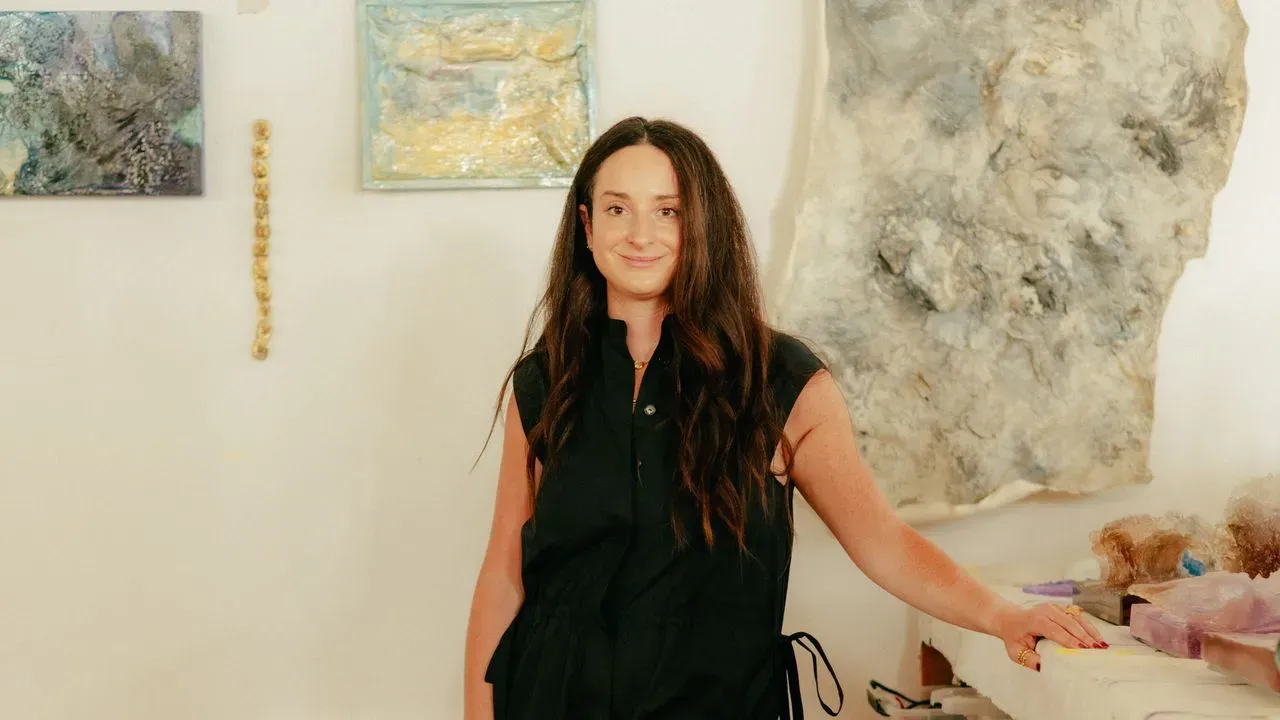
Lara Saget's studio is a treasure trove of raw materials, a space that blurs the lines between art and industry. As you approach her Brooklyn studio, two neighboring businesses catch the eye - a headstone shop with grave markers on display in its window, and a warehouse with stacks of granite and marble slabs visible through its open garage doors.
Inside Saget's studio, it's clear that she has transformed part of it into her own quarry. A corner of the space resembles a construction site, with piles of stone scattered about. The sculptor points to one pile, explaining that it is rare Tuckahoe marble, previously used in the construction of the iconic Washington Square arch.
Saget's fascination with raw materials and their potential is evident in her work. When she learned that a hotel was planned for a former Tuckahoe marble quarry site in Westchester County, she contacted the owner to ask if she could collect some of the stone. This gesture reflects the artist's practice of finding beauty in nature.
Saget's upcoming exhibition, "and the world came apart," curated by Sarah Darro, is set to open on November 7 at Trotter&Sholer. The show promises to showcase Saget's unique perspective and artistic vision, one that explores themes of creation and destruction.
Lara Saget's artistic vision is deeply rooted in spirituality, which she has recently studied at the Center for Religion and Advanced Spiritual Studies, where she earned her master's degree in divinity and was ordained as a minister.
This spiritual foundation is evident in her work, which explores themes of regeneration, the ancient, and the alchemical. Her use of materials such as copper alloy, granite, and black marble creates a sense of timelessness, evoking the early cave drawings that inspired many ancient cultures.
The show features two distinct components: wall works that depict volcanic maps and tectonic plates in a style reminiscent of those early cave drawings, and glass sculptures centered on the Judean date palm and the Joshua Tree. The latter is particularly significant, as scientists were able to regenerate this once-extinct tree from nearly 2,000-year-old seeds.
Saget's interest in legacy and inheritance extends beyond her own family history, which includes being the daughter of late actor Bob Saget. She has inherited not only his famous last name but also a strong example of what it means to be an artist.
Lara Saget has spoken about the enduring influence of her father, a renowned artist known for his innovative approach to creativity.
Saget describes her father as someone who embodied artistic freedom and experimentation, much like jazz music that constantly evolves and adapts.
In 2019, she traveled to India for the first time, where she spent a month at Art Ichol, an artists' residency focused on bronze and stone work, located in a small village.
She worked alongside a team to create intricate carvings in stone, using wax to capture the surface details before building a mold around it.
Saget's wall works take on a unique perspective by adopting a bird's-eye view approach, employing a tiled-grid modularity that resembles excavation sites and areas of discovery.
This modular design is evident in her piece The Last One Million Years (2026), which maps volcanoes and tectonic plates using a celestial map provided by NASA. The raised rock sections within the map are comprised of heat-trapping granite, formed through a spontaneous interaction between metal and rock.
The use of these materials creates an effect that can be described as spiritual archaeology, where Saget taps into the earth's fundamental nature to reveal its profound secrets. By employing the earth's most ancient and essential materials, she uncovers hidden truths about the planet's history.
Saget's focus shifts from her wall works to tree sculptures, which represent the present and future. Her glass tree sculptures began in 2016, focusing on trees that have demonstrated remarkable resilience against adversity.
Lara Saget's sculptures have continued to evolve, as evident in her piece Rebirth of an Ancient Palm, which brings back to life the Judean date palm from extinction through meticulous recreation.
Both glass tree sculptures utilize kiln-cast glass and the lost-wax process to achieve intricate textures, adding depth to the artwork. To further immerse viewers, Saget enlisted two children to narrate an audio piece, each playing a tree that encourages caretaking of these remarkable plants.
The narrative highlights the trees' resilience against adversity, with Saget reflecting on the parallels between this phenomenon and her own experience with grief.
Facts based on reporting originally published by Vogue.
You may republish this story, in full or in part, if you credit News Central Site and link to it (licence CC BY 4.0). Photos are not included.