Metal-Organic Frameworks Preserved with Ionic Liquids
Researchers have developed a method to reduce damage when manipulating MOFs for electronic devices by filling their pores with an ionic liquid.
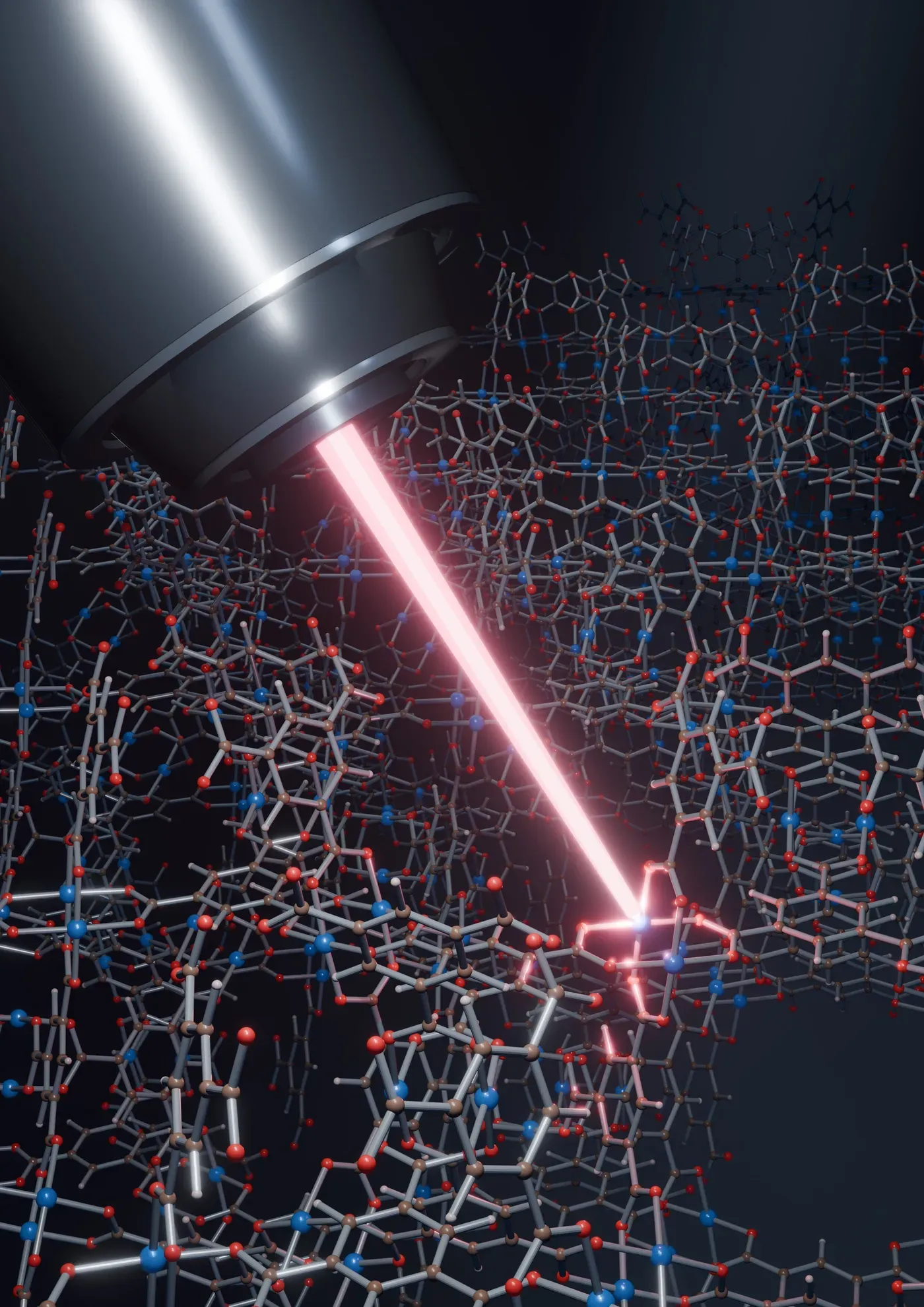
Researchers have been working on developing metal-organic frameworks (MOFs) for various applications, including gas storage and pollutant capture. MOFs are a class of porous materials that consist of metal ions linked by organic molecules, forming structures with cavities.
The unique properties of MOFs arise from their porous nature, which is difficult to achieve with conventional materials. As a result, MOFs have shown great promise for use in functional devices such as chemical sensors and electronic components.
Despite their potential, the fragile structure of MOFs can be easily damaged during dry etching, a process that involves using high-energy particles to remove material and create patterns on the surface.
The challenge lies in preserving the delicate structures of MOFs while still being able to manipulate them into specific shapes and forms for practical applications.
Researchers have developed a method to reduce damage when manipulating metal-organic frameworks (MOFs) for electronic devices. To achieve this, they filled MOF pores with an ionic liquid that increases the material's hardness and preserves its structure during etching.
The study, led by Assistant Professor Yumeng Zheng and Professor Kentaro Kinoshita from Tokyo University of Science, built on earlier work demonstrating the strengthening effect of ionic liquids on MOFs. By exploring this approach further, the researchers aimed to enable precise microfabrication of these delicate materials.
In their experiment, the researchers used four imidazolium-based ionic liquids that occupied 50%–60% of the pore volume in a copper-based MOF called Cu₃BTC₂. The ionic liquid-filled material was then etched with a focused gallium ion beam at room temperature.
The use of ionic liquids greatly improved the mechanical stability of the MOFs, reducing damage from electron and ion beams during etching. This development has significant potential for the creation of precise patterns in MOFs at the nanoscale.
The researchers discovered that using an ionic liquid in conjunction with ion beam etching resulted in significantly less damage to the metal-organic framework's (MOF) crystal structure compared to untreated samples.
This was attributed to the ionic liquid's ability to absorb heat and dissipate electrical charge during the etching process, thereby protecting the delicate MOF structure. The thermal properties of the ionic liquid may also help buffer temperature changes, while its redistribution of ions can screen local electric fields.
Thermal analysis revealed that the treated MOFs had higher decomposition temperatures than their untreated counterparts, indicating improved thermal stability. Hardness tests further showed that all four ionic liquid-treated samples were harder than the untreated material, with stiffness remaining largely unchanged in the process.
The use of an ionic liquid during ion beam etching has opened up new possibilities for patterning MOFs at room temperature without requiring specialized equipment such as cryogenic cooling systems. This approach could be extended to other types of MOFs, potentially making them easier to incorporate into practical devices.
The successful creation of various patterns using this method is a significant step forward in the development of precise MOF structures. These include intricate designs like a square measuring 5 × 5 µm² and even a Chinese character with etched lines as narrow as 130–300 nm, demonstrating the potential for high-resolution patterning at the nanoscale.
Researchers are optimistic about the potential of metal-organic frameworks (MOFs) to be used in various electronic devices, including high-sensitivity sensors, separation and analysis devices, and catalytic devices.
The method developed for shaping MOFs into precise structures could unlock new applications for these materials, which have been limited by their difficulty to shape. With over 100,000 known MOFs today, this technique has the potential to greatly expand their use in practical devices.
This breakthrough is expected to bridge the gap between MOFs' exceptional material properties and their usability in real-world applications. As a result, MOFs could become a foundational technology for various industries.
Facts based on reporting originally published by Phys.org.
You may republish this story, in full or in part, if you credit News Central Site and link to it (licence CC BY 4.0). Photos are not included.