Quantum Fields and Vacuum Decay in the Universe
Scientists suggest that the universe could be residing in a "false vacuum" state, potentially leading to catastrophic consequences.
Reports are emerging of a mysterious phenomenon known as "The Nothing that could potentially signal the end of the universe as we know it.
This concept may seem like science fiction, but it's actually rooted in our understanding of quantum mechanics and the nature of space itself.
According to scientists, every point in the universe is permeated by various quantum fields, which are accompanied by energy and virtual" particles that pop in and out of existence at random.
In this context, a vacuum is not an area with no energy at all, but rather one with the minimum possible energy - a distinction that may seem subtle but has significant implications for our understanding of the cosmos.
The universe's vast expanses are thought to be filled with these quantum fields, which could potentially create pockets of lower energy than what we currently observe.
The concept of a false vacuum suggests that our universe is currently residing in an energy state that's not the lowest possible one.
This idea is illustrated by comparing the universe to an egg in a bowl, where the bottom of the bowl represents the global minimum energy and the current state of the universe is akin to being at the local minimum, nestled within the bowl's sides.
In this scenario, if a sufficient amount of energy is added, much like shaking the bowl, the universe would transition from its current false vacuum to a true vacuum, a process known as vacuum decay. This shift would have significant consequences for our cosmos.
The emergence of such a bubble could be triggered by quantum fluctuations in the fields that permeate space-time, which occasionally exhibit unpredictable and seemingly inexplicable behavior governed by the principles of quantum mechanics.
The behavior of quantum fields in space-time can lead to unpredictable events, one of which is known as quantum tunnelling. This phenomenon allows a particle to pass through a barrier instead of over it, much like an egg passing straight through a bowl without any visible reason.
The likelihood of such an event occurring with individual particles is extremely low, but the universe contains a vast number of particles, making these events occasional occurrences. When a particle does tunnel into a true vacuum, it creates a tiny bubble of space-time that is significantly emptier than the surrounding cosmos or potentially even devoid of any matter and energy.
The properties of this bubble depend on various factors that are not yet fully understood, including the energy difference between the true and false vacuums. This disparity can result in a bubble that differs subtly from the rest of the universe or one that is fundamentally incompatible with its laws and particles.
The surface tension of the membrane separating the bubble from regular space-time also plays a crucial role in determining what happens next within the bubble. If this energy difference is significant, it could potentially lead to the emergence of a new reality or even the end of our current universe as we know it.
The scenario of a universe-ending event unfolding suddenly from nothing is a complex one, where even small variations in energy differences can have drastic consequences.
Depending on the size and surface tension of the bubble that forms, its fate can be vastly different - it may shrink away to nothingness or expand at the speed of light, engulfing everything in its path.
Simulations suggest that within this expanding bubble universe, a collapse would ultimately occur, with no clear indication of what might trigger such an event. The very notion of a catastrophic outcome is unsettling, especially when considering the uncertainty surrounding this possibility.
Determining whether a universe-ending bubble can form and spread through the cosmos proves to be a daunting task - experts struggle to assess the likelihood of such an event due to its elusive nature, making it difficult to predict or even detect until it's too late.
The search for signs of impending doom in our universe is a daunting task. Experts are on high alert for any indication that the fabric of space-time might be about to unravel.
One crucial factor in determining the stability of our universe lies in the precise values of fundamental constants such as the mass of the Higgs boson and the strength of the strong force. These measurements require an almost unimaginable level of precision, and so far, we have not yet reached that threshold.
The numbers are still fuzzy, but they do suggest that our universe is precariously balanced on the edge of stability. Any slight variation could push us over into instability, with potentially catastrophic consequences.
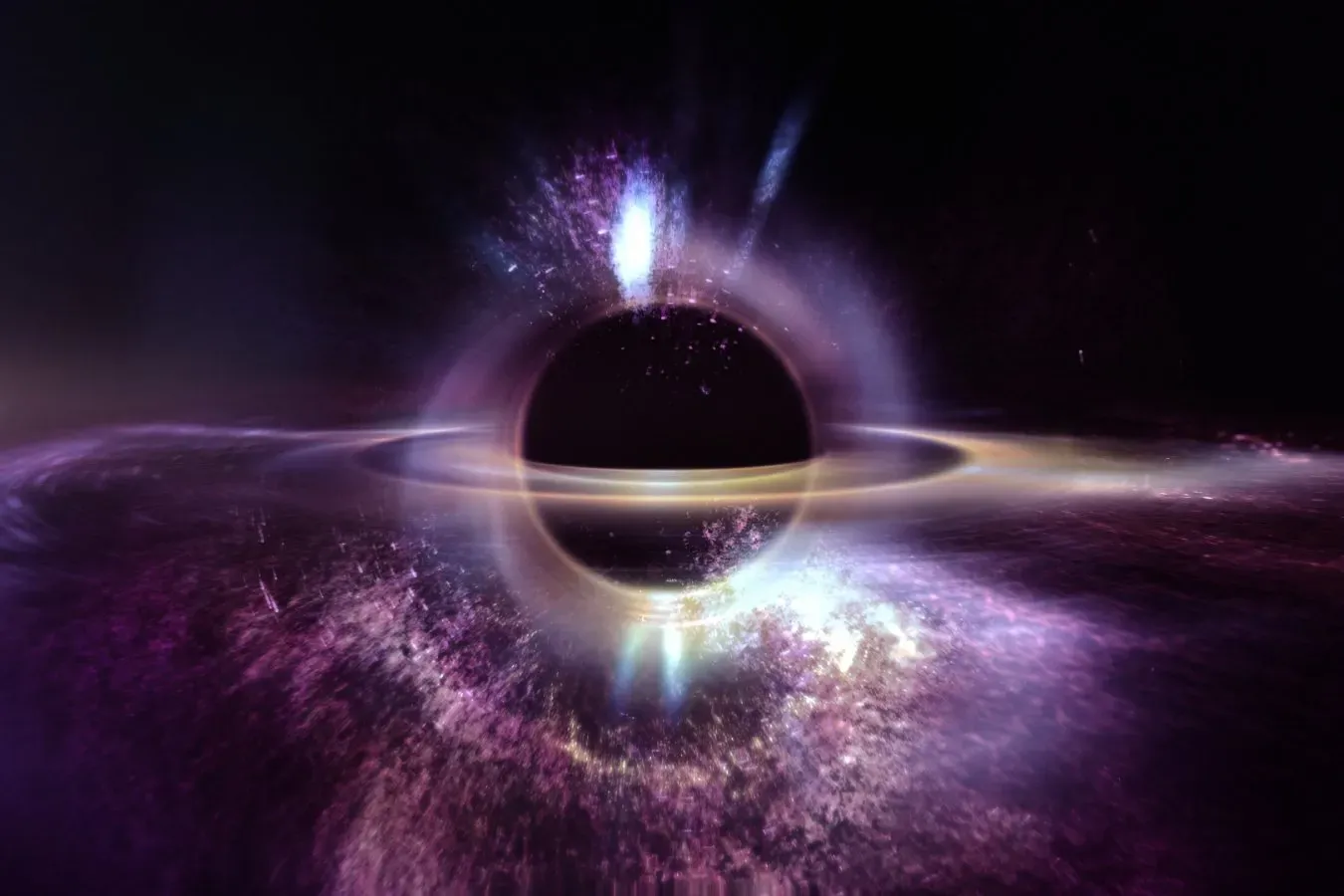
Researchers believe that tiny bubbles of true vacuum might be lurking in the cosmos, waiting to pop up and wreak havoc. One possible location for these bubbles is the region between colliding black holes, where the intense gravitational forces might just create the perfect conditions for their emergence.
Tiny black holes could be created when multiple true vacuum bubbles merge, potentially allowing scientists to detect them as they rapidly evaporate away. This process would occur if there's a sufficient time gap between the emergence of true vacuum and its eventual consumption by a black hole.
The thought of such an event is so daunting that it may be more comforting to focus on other matters, like enjoying a favorite film - perhaps one with a reassuring narrative, like The NeverEnding Story.
Facts based on reporting originally published by New Scientist.
You may republish this story, in full or in part, if you credit News Central Site and link to it (licence CC BY 4.0). Photos are not included.