Particle Physics Puzzle May Be Solved
Physicists have found a new calculation that resolves the discrepancy in electron neutrinos captured by gallium nuclei.
A decades-old puzzle in particle physics may be on the verge of being solved. The "gallium anomaly" first emerged in the mid-1990s but was not clearly identified until 2007 by Italian physicist Carlo Giunti.
The issue revolves around a discrepancy in the number of electron neutrinos captured by gallium nuclei, with about 20% fewer observed than expected. This shortfall has significant implications for our understanding of particle interactions and the behavior of neutrinos.
Physicists at various Italian universities and research institutions have been working to explain the anomaly through a new calculation. Their work, recently published in Physical Review Letters, appears to resolve the issue by matching the observed number of electron neutrinos with theoretical expectations.
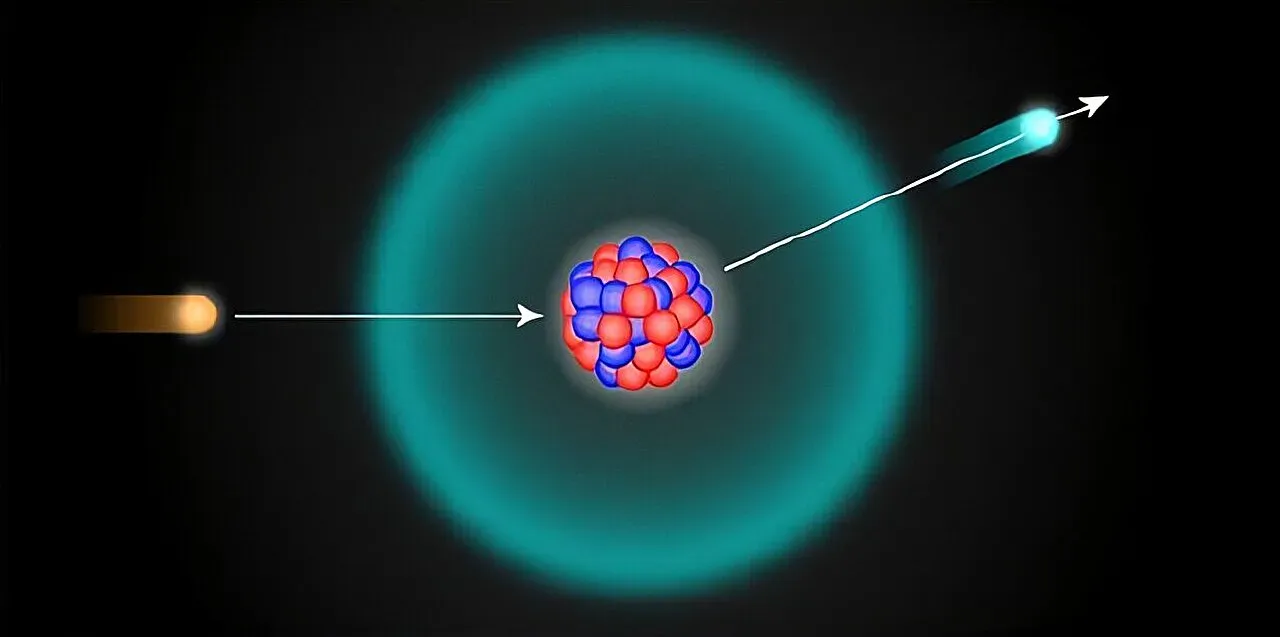
When an electron neutrino collides with a gallium-71 nucleus, it can trigger a chain reaction involving the transformation of a neutron into a proton. This process is mediated by a W+ particle exchange and falls under the category of weak force interactions.
The search for a solution to the gallium anomaly has been ongoing for years, with one interpretation suggesting the presence of sterile neutrinos.
Sterile neutrinos are hypothetical particles that interact with normal matter solely through gravity, not through any other fundamental forces in the Standard Model of particle physics.
However, this explanation is at odds with various other neutrino results, including reactor antineutrino experiments and measurements of solar neutrinos.
The lead author of a new study on the gallium anomaly, Matteo Cadeddu, has been fascinated by the problem for a long time and has now returned to it after a hiatus of several years.
Cadeddu's team is exploring alternative explanations for the anomaly that do not involve sterile neutrinos.
The investigation into the gallium anomaly has been a collaborative effort involving current and former master's students, many of whom are now pursuing their Ph.D.s or working as postdoctoral physicists under Cadeddu's guidance.
Working on this complex problem can be a solitary experience, with theoretical physics often requiring long periods of mental exploration. According to Cadeddu, his team had to question some fundamental assumptions that were previously taken for granted in order to make progress.
A key simplification that had been made in previous calculations was the separation of the gallium nucleus's behavior from that of the neutrino and electron. To address this issue, Cadeddu's team incorporated earlier work as an intermediate step, separating the wave functions of the electron and neutrino from the nuclear part of the calculation.
This more detailed approach enabled the incorporation of special relativity into the calculation, which involved starting with the Dirac equation rather than the nonrelativistic Schrödinger equation. The Dirac equation is a more complex formulation that takes into account four-dimensional spinors consistent with special relativity's demands.
The inclusion of special relativity in the calculation allowed for more accurate electron wave functions to be determined, but unfortunately, it did not resolve the gallium anomaly.
The team's previous work on electron behavior inside the nucleus laid the groundwork for their next move. They began to question whether the electron and nuclear transition could be treated independently in calculations.
This shift in perspective had significant implications, revealing details of the nuclear transformation that were previously overlooked. The new approach allowed them to consider information typically compressed into a single matrix element as potentially relevant.
Using their own software package, Cadeddu and his co-authors were able to solve the problem numerically. Their findings indicated an increased production of electron neutrinos from the reaction, which could account for the gallium anomaly.
The solution was not achieved alone; the team credits each other's input and discussions in tackling the complex problem. Cadeddu specifically acknowledges the contributions of his wife, Francesca Dordei, a physicist and co-author who shared countless hours of debate on potential solutions.
A new calculation by a team of researchers may hold the key to explaining a long-standing anomaly in neutrino physics.
The gallium anomaly refers to a discrepancy between observed and expected levels of antineutrinos produced during electron capture reactions involving gallium-71 nuclei. This discrepancy has been puzzling scientists for years, with some attributing it to the presence of new particles or interactions beyond those described by the Standard Model of particle physics.
However, the researchers' calculation suggests that a more mundane explanation may be at hand, involving a previously overlooked aspect of neutrino production. By taking into account the effects of nuclear structure on the leptonic wave-function factorization, they were able to reproduce the observed results without invoking new particles or forces.
Their work provides a possible solution to this longstanding puzzle and has significant implications for our understanding of neutrino physics and the Standard Model more broadly.
Facts based on reporting originally published by Phys.org.
You may republish this story, in full or in part, if you credit News Central Site and link to it (licence CC BY 4.0). Photos are not included.