Orcas May Be Damaging Boats with Deliberate Action
A cognitive psychologist suggests that orcas may be intentionally damaging boat rudders to achieve specific goals.
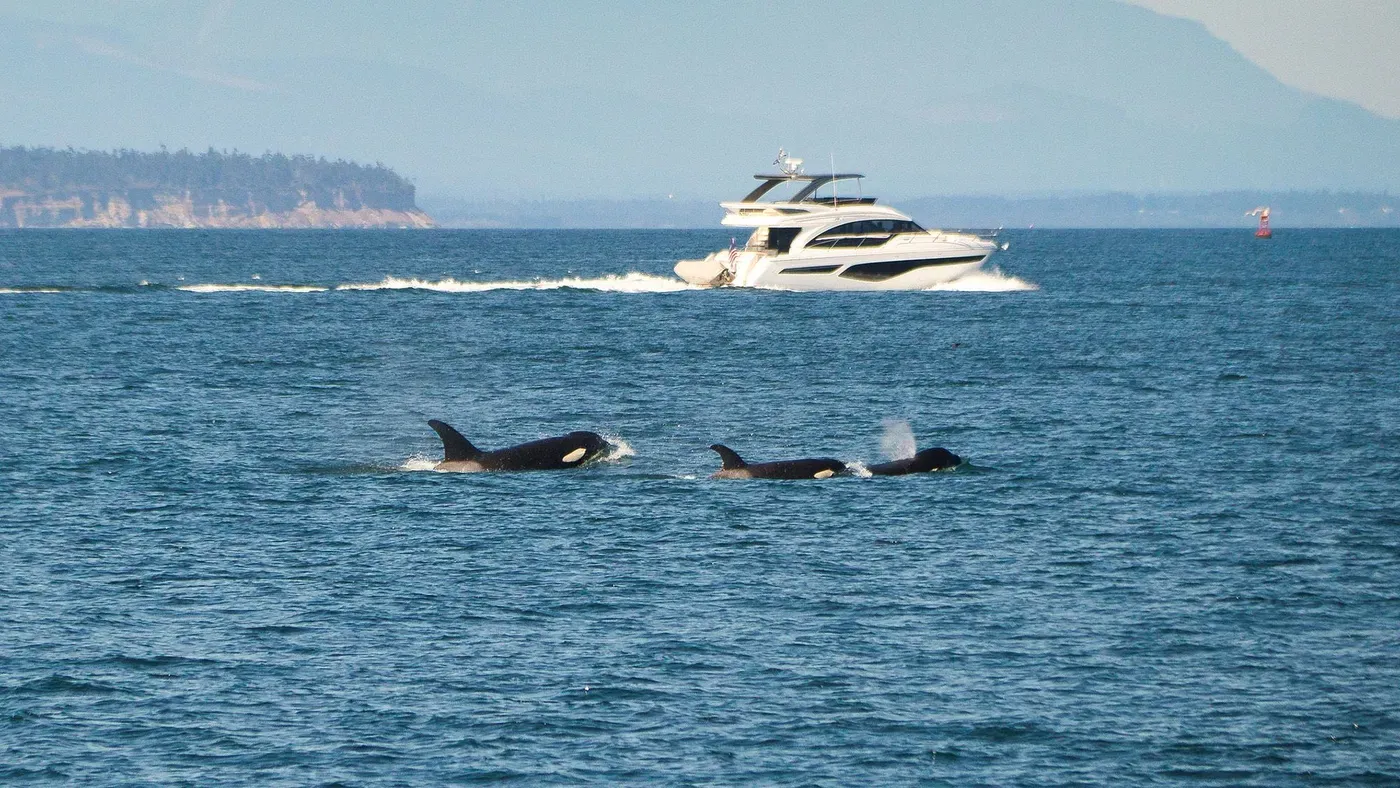
Over the past six years, a peculiar behavior has been observed in orcas - some individuals have repeatedly damaged or destroyed rudders on boats, sparking a range of explanations for their actions.
Theories abound, from playful interactions to revenge and warnings against getting too close to the pod, but one cognitive psychologist believes that orcas may be engaging in deliberate action. Christian Frings, chair of general psychology and methodology at Trier University in Germany, thinks that understanding human behavior could provide insight into this orca behavior.
While Frings doesn't study orcas directly, he suggests that they could serve as a "test case for whether species can anticipate the consequences of their actions and take deliberate steps to achieve specific goals. His theory proposes that orcas may be able to predict how damaging a rudder would change the boat's environment.
Frings published his commentary on this topic in the journal Animal Cognition, suggesting that orcas' behavior could be driven by a desire for a specific outcome rather than malicious intent. According to Frings, it's possible that orcas enjoy the sensation of smashing into a rudder or interacting with a wonky boat.
The psychologist's theory doesn't aim to explain why orcas might seek to damage boats, but rather focuses on understanding their ability to anticipate and achieve desired outcomes. In an email to Live Science, Frings clarified that his theory addresses only the question of whether orcas can take deliberate action, leaving open the inquiry into their motivations.
Frings' work challenges traditional views of animal behavior, suggesting that species may be more capable of complex thought processes than previously thought. By studying orca behavior through a human lens, he hopes to shed new light on the cognitive abilities of these marine mammals.
The implications of Frings' theory are significant, offering a fresh perspective on the complex interactions between humans and animals in their shared environment.
Cognitive psychologists often study human behavior, but Christian Frings has been exploring a unique connection between his field and animal cognition. As the director of the Institute for Cognitive and Affective Neuroscience at the University of Trier in Germany, Frings is well-equipped to analyze complex interactions.
While he acknowledges that orcas are not typically part of his research focus, Frings sees value in comparing human action control with animal behavior. By examining how humans execute motor behaviors, researchers may uncover insights into how other intelligent animals operate in their environments.
In cognitive psychology, theories known as action-control frameworks describe how humans plan and execute actions. These frameworks suggest that individuals anticipate the consequences of their actions before taking them. This anticipation is thought to be a crucial aspect of human behavior, but could it also apply to other complex animals?
To understand this concept, consider turning on a light switch. Instead of starting with the physical action of pressing the button, humans first imagine the visual effect of the light coming on. This mental picture then retrieves a stored motor program that produces the desired outcome.
This approach to understanding human behavior has been widely adopted in cognitive psychology. The anticipation of action effects is seen as a fundamental aspect of how humans control their actions. But could it also be relevant to other animals, such as orcas?
By exploring these parallels between human and animal cognition, researchers may gain new insights into the complex behaviors exhibited by intelligent species like orcas. This line of inquiry has the potential to reveal fresh perspectives on the interactions between humans and animals in shared environments.
The implications of this research are far-reaching, offering a unique opportunity for cognitive psychologists to contribute to our understanding of animal behavior.
The psychologist's theory suggests that orcas may not simply be reacting to a stimulus or imitating cultural behavior when attacking boats. Instead, he proposes an additional layer of explanation: the animals anticipate the sensory consequences of their actions.
According to this idea, orcas consider how destroying the rudder would look and feel. This concept is similar to human babies' developmental stages, where they learn to move their arms and legs to produce effects in their environment. They also engage in babbling as a form of testing language skills.
This theory could be likened to an orca's behavior when it attacks a boat's rudder. The animal may not simply be responding to the stimulus of the rudder itself, but rather anticipating how its actions would affect the vessel.
The psychologist acknowledges that his theory is just one possible explanation for the observed behavior. He suggests that orcas might be testing the effects of their actions on the boat, much like human babies experiment with movement and language development.
When asked if the orca's goal was to render the boat impossible to steer, the psychologist clarified that this was not necessarily the case. Instead, he proposed that the animal may simply want to produce a specific effect by destroying the rudder.
The idea of orcas anticipating the sensory consequences of their actions raises interesting questions about their cognitive abilities and decision-making processes. It also highlights the complexity of animal behavior and the need for continued research in this area.
The psychologist's theory is just one piece of a larger puzzle, and further study is needed to fully understand the motivations behind orca attacks on boats. However, his proposal offers a unique perspective on this complex issue.
The psychologist's theory suggests that orcas are not intentionally attacking boats due to a desire for revenge or territorialism, but rather because they have learned to associate certain actions with specific outcomes.
When an orca encounters a boat, it anticipates the outcome of its actions and uses this anticipation to retrieve the necessary information from its memory to produce the desired effect. This process is not necessarily linked to complex thinking or higher-order cognition.
In fact, the psychologist argues that we don't need to attribute human-like intentions to the orcas in order to understand their behavior. Instead, we can view their actions as a simple matter of cause and effect, much like turning on a light switch.
The key concept here is action effects," which refers to the idea that an orca's actions are guided by its anticipation of the outcome of those actions. This perspective allows us to see orca behavior in a new light, one that focuses on the consequences of their actions rather than their motivations.
If the psychologist's theory holds true, it could have significant implications for our understanding and management of orca behavior. By manipulating the action effects associated with boat encounters, we may be able to influence orcas' behavior in ways that reduce the risk of attacks.
One possible approach would be to modify the design of boats to change the way orcas perceive their actions. For example, altering the material used for rudders or shells could affect how orcas perceive the outcome of their actions and potentially lead them to alter their behavior.
However, this approach also raises concerns about unintended consequences, as changing the action effects associated with boat encounters may elicit different behaviors from orcas that are even more unpredictable and dangerous.
This approach offers a unique opportunity to manipulate orca behavior by altering the action effects associated with boat encounters. By modifying the rudder of a boat, researchers could potentially change the way orcas respond to such interactions. This could involve testing different versions of the rudder to see if it affects the outcome of an encounter.
However, this method also carries some risks. If the link between the orca's planned actions and the desired outcome is disrupted, the orcas may become more aggressive in their behavior. They might attempt to achieve the same goal through alternative means, which could be even more unpredictable.
The researcher views the orcas as a case study for testing this framework, providing valuable insights into how action effects influence behavior across different species. The ultimate goal is to develop generalizable action-control models that can be applied not just to humans or great apes but also to other animals like orcas.
One of the key aspects of this research is its focus on wild behavior rather than lab conditions. Most studies on action control are conducted in controlled environments, whereas this study involves observing orcas in their natural habitat. This shift from a laboratory setting to the wild adds an extra layer of complexity and realism to the research.
The researcher emphasizes the importance of developing action-control frameworks that can be applied across different species, rather than creating models specific to one particular animal. By doing so, scientists may uncover commonalities in how various creatures respond to action effects, leading to a deeper understanding of behavior and decision-making processes.
This approach has significant implications for our understanding of orca behavior, as well as the development of more effective conservation strategies. By identifying the underlying mechanisms driving their actions, researchers can better predict and manage interactions between humans and orcas in the wild.
The study's focus on action effects highlights the need to consider the long-term consequences of disrupting these relationships. As the researcher cautions, altering the environmental consequences of an encounter may have unintended effects on orca behavior, potentially leading to more aggressive actions.
The idea that lab models cannot be applied to real-world behavior is a misconception that extends far beyond orcas. In fact, researchers have used laboratory models to successfully explain and predict human behavior in various contexts. This challenge to conventional thinking highlights the potential for interdisciplinary research to shed new light on complex phenomena.
One notable example of this approach is a recent study that demonstrated the effectiveness of lab models in explaining real-world behavior. By using these models, scientists can gain valuable insights into the underlying mechanisms driving an organism's actions, allowing them to make more accurate predictions about future behavior.
This shift in perspective has significant implications for our understanding of orca behavior and its relationship with their environment. Rather than viewing orcas as simply aggressive animals, researchers can now explore the complex interactions between orcas and their surroundings that may be contributing to these attacks on boats.
Ultimately, this approach offers a more nuanced and accurate understanding of orca behavior, one that recognizes the intricate balance between an organism's internal drives and its external environment.
Facts based on reporting originally published by Live Science.
You may republish this story, in full or in part, if you credit News Central Site and link to it (licence CC BY 4.0). Photos are not included.