Nigerian President Bola Tinubu Protests Spark Debate on Dissent Limits
Protests against Nigerian President Bola Tinubu have been gaining momentum in the country's north, sparking a heated debate about the limits of political dissent.
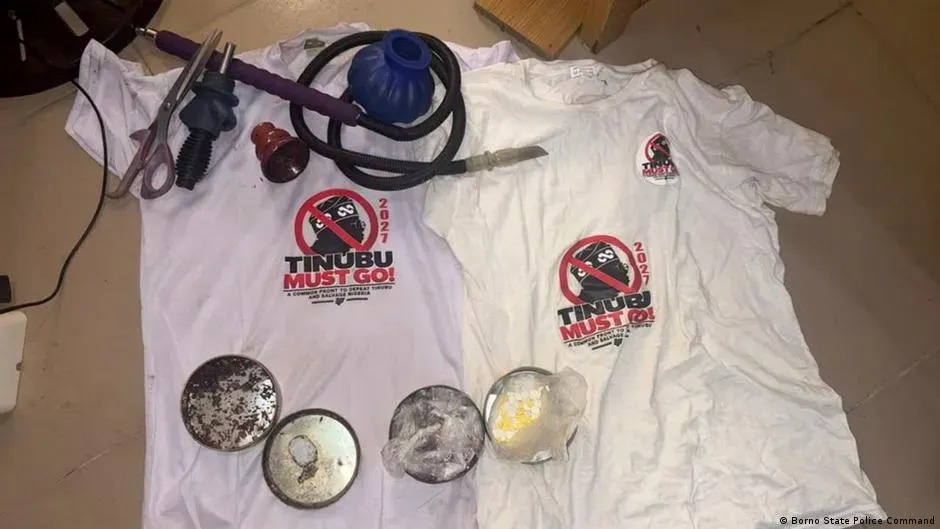
Protests against Nigerian President Bola Tinubu have been gaining momentum in the country's north, sparking a heated debate about the limits of political dissent.
The controversy centers around T-shirts bearing the slogan "Tinubu Must Go!, which police in the northeastern state of Borno arrested five men for wearing last month. The men, aged between 21 and 44, were accused of conspiring to produce and wear the shirts with the intention of breaching public peace.
Police claimed that during a routine patrol, they found illicit drugs and other items on the men, which led to their arrest and charges of criminal conspiracy, inciting disturbance, disturbance of public peace, and thuggery. However, human rights groups have criticized the move, arguing that the men were being prosecuted for expressing their political views rather than any actual wrongdoing.
The incident has raised concerns about the balance between legitimate security measures and the freedom to express dissenting opinions in Nigeria's democracy. The question remains whether citizens can challenge those in power without facing persecution or arrest.
The crackdown on dissenting voices in Nigeria has reached alarming levels, with citizens facing persecution and arrest for expressing opinions deemed critical of those in power. Activist Hassana Maina condemned the recent police action against supporters of the opposition African Democratic Congress (ADC) who wore T-shirts deemed to be a challenge to authority.
The incident highlights the growing trend of authorities suppressing dissenting voices through arbitrary arrests, intimidation, and harassment. Amnesty International has documented several cases of citizens being targeted for speaking out against government policies or criticizing those in power. In one such case, popular social media critic Abubakar Idris, known as Dadiyata, went missing after armed men seized him from his residence in Kaduna State.
Maina described the authorities' actions as despicable and a threat to people's freedom of expression. She argued that dissenting voices are essential for any democratic society, allowing citizens to hold their leaders accountable and pushing them to address pressing issues such as insecurity. The government's response has been to silence critics through arbitrary arrests and detention.
The case of Hamdiyya Sharif, an 18-year-old student who was arrested and remanded in prison for posting a TikTok video criticizing the Sokoto State governor's handling of security, is another example of the authorities' heavy-handed approach. The incident has sparked widespread outrage, with many calling for greater protection for citizens' rights to free speech and expression.
The Tinubu Must Go movement's focus on accountability extends beyond the current administration, as Nigerians grapple with severe economic hardship. The country is currently experiencing one of its worst economic crises in recent times, with food prices at an all-time high over the past 20 years.
High inflation rates and skyrocketing transportation costs are further exacerbating the cost of living crisis, making it increasingly difficult for citizens to make ends meet. In addition to economic woes, security concerns remain a pressing issue, particularly in rural communities across northern Nigeria.
The region has been plagued by militant Islamist groups such as Boko Haram and its factions, which have waged an extended armed rebellion against the state for over a decade. This insurgency has claimed hundreds of thousands of lives and displaced millions from their homes, severely disrupting livelihoods and economic activities in the region despite years of military operations.
The humanitarian impact of this conflict is dire, with many communities struggling to access basic necessities like food, water, and healthcare. The situation highlights the urgent need for effective governance and policies that address the root causes of these crises and provide relief to affected populations.
The clampdown on individuals wearing Tinubu Must Go!" T-shirts in Nigeria has sparked concerns over the repression of freedom of association and expression.
According to Amnesty International's executive director in Nigeria, Isa Sanusi, this development is part of a disturbing trend where people are being arrested and detained simply for expressing their opinions. He emphasized that citizens have the right to support or oppose any political party or candidate without fear of retribution.
Sanusi also pointed out that these actions by law enforcement authorities constitute an attack on democracy itself, undermining the fundamental principles of freedom and protection of rights. This is particularly concerning as Nigeria prepares for its next general elections, which are essential to democratic governance but not the only measure of a country's democratic health.
The situation has led Sanusi to conclude that the state of democracy in Nigeria is dire, with people being targeted for their political views or opinions, and opposition politicians facing obstacles in holding public gatherings.
The management of Arewa House, a research center in Kaduna, has revoked its approval for a book presentation deemed critical of the government, citing operational issues.
This development is seen as part of a broader trend where dissenting voices are being stifled in Nigeria. Lawyer and activist Hassana argues that strong opposition is essential to a thriving democracy, which is currently lacking in the country. She believes that opposing policies can be a genuine expression of patriotism.
Hassana rejects the government's attempt to question people's loyalty by criticizing its policies or actions. In her view, standing up against what one considers detrimental to the nation's development is a true display of patriotism and a fundamental right in a democratic society.
Facts based on reporting originally published by DW English.
You may republish this story, in full or in part, if you credit News Central Site and link to it (licence CC BY 4.0). Photos are not included.