NASA's Mars Rover Perseverance Tests Effects of Martian Dust on Spacesuit Materials
The NASA rover is testing how Martian dust affects spacesuit materials as it explores the Martian terrain.
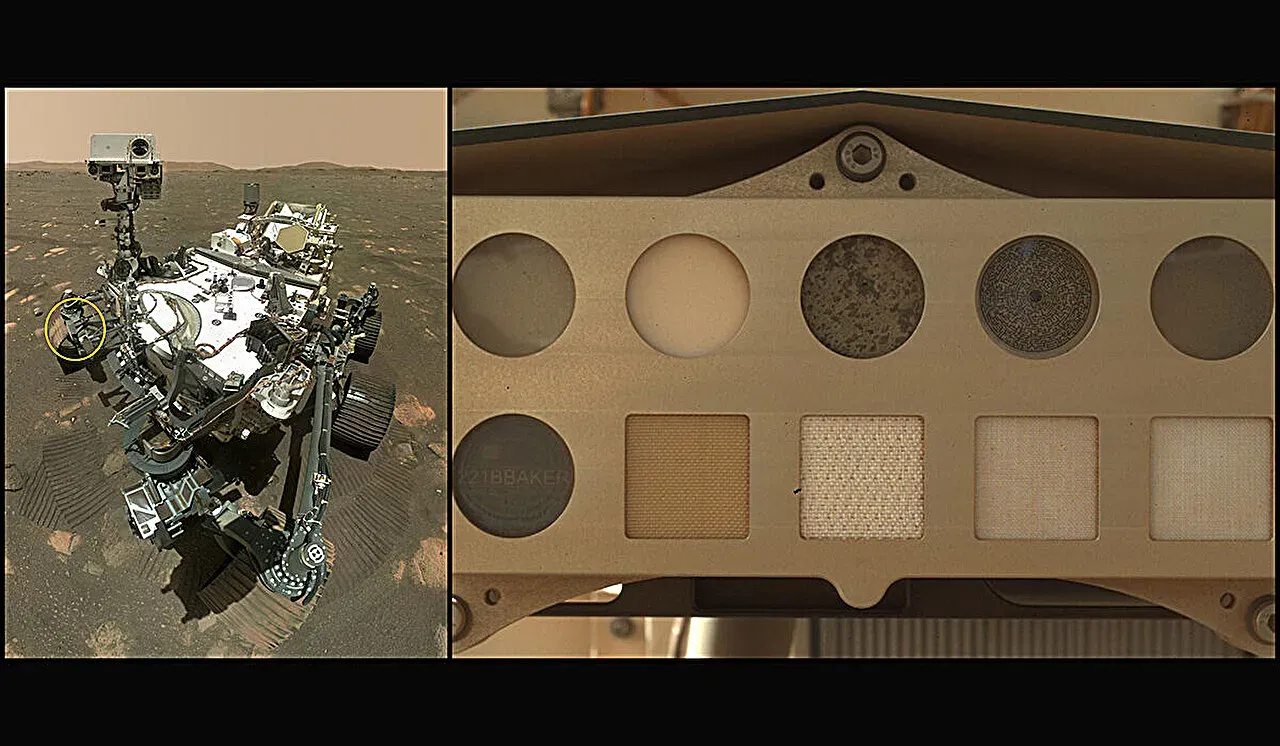
NASA's Mars rover Perseverance is carrying out a crucial task while exploring the Martian terrain - it's testing the effects of Martian dust on spacesuit materials. Small swatches of fabric have been attached to the rover, each about the size of a postage stamp, to simulate the impact of Martian dust on astronauts' protective gear.
The researchers behind this experiment acknowledge that Mars is a very dusty planet, and any future mission to the Red Planet will need to take into account the potential damage caused by the abrasive dust. Scott VanBommel, a research assistant professor at Washington University in St. Louis, notes that astronauts will have to be prepared for the harsh Martian environment.
The data collected from these experiments is being used to assess the interaction between Martian dust and various materials, including Teflon. This information is crucial in understanding how spacesuits would hold up on Mars and whether they need to be modified or replaced with more durable fabrics.
As part of this research, a new paper has been published in the Proceedings of the National Academy of Sciences, led by VanBommel and co-authored by Abigail Knight, a staff scientist at Washington University. Both researchers are also fellows of the McDonnell Center for the Space Sciences.
Future Mars missions need to take into account the potential effects of Martian dust on equipment and human health. The experience of Apollo astronauts is a cautionary tale - lunar dust was found to be abrasive enough to scratch visors and degrade spacesuits. Moreover, when particles from their suits contaminated the air inside the lunar module, they caused respiratory issues similar to hay fever in some cases.
The latest research suggests that Martian dust may not be as harsh on equipment or human health as previously thought. Swatches of Martian dust samples showed minimal wear after an extended period of exposure, which is a promising sign for future Mars visitors. This finding could alleviate concerns about the potential impact of Martian dust on spacesuits and other essential gear.
A closer examination of the Martian dust particles revealed that they are smoother than those found on the moon. The researchers suggest that this is because the Martian particles have been shaped by billions of years of wind erosion, resulting in rounded shapes similar to pebbles in a river. This could mean that Martian dust is less likely to cause scratches or irritate human lungs.
The study also highlighted another issue with Martian dust: its extremely fine texture. Researchers used a method to estimate the size of individual particles, which revealed that some were as small as 100 nanometers - an incredibly tiny measurement equivalent to one ten-thousandth of a millimeter.
The microscopic hazards posed by Martian dust are a concern for engineers designing habitats and spacesuits for future astronauts. These tiny particles can penetrate deep into the lungs and enter the bloodstream on Earth, where they pose a significant health threat from air pollution. Although astronauts won't breathe the Martian atmosphere directly, these risks must still be accounted for in mission planning.
The electrostatic properties of Martian dust are likely causing it to stick preferentially to certain surfaces, according to researchers. This could have implications for the design and maintenance of equipment on Mars. The presence of electrostatic forces also suggests that Martian dust may behave differently from lunar dust, which has been studied extensively in laboratory settings.
Analysis of the particles' chemical composition using data from Perseverance's PIXL instrument revealed some significant differences between Martian and lunar dust. For instance, Martian dust contains perchlorates and other potentially toxic compounds, as well as higher levels of sulfur, iron, and silica. These substances may pose a risk to astronauts' health if they come into contact with them.
The presence of these substances adds another layer of complexity for mission planners to consider when designing protective gear and habitats for future Mars missions. While brief exposure is unlikely to cause serious harm, the cumulative effect of repeated exposures could still be a concern.
The study suggests that Martian dust may be less abrasive than lunar dust, as evidenced by samples collected from spacesuits. This finding could have significant implications for future crewed missions to Mars.
The researchers analyzed data from rovers that have been operating on the Martian surface for over 20 years and found that while dust is a challenge, it's one that can be prepared for and overcome.
Facts based on reporting originally published by Phys.org.
You may republish this story, in full or in part, if you credit News Central Site and link to it (licence CC BY 4.0). Photos are not included.