MonoRace Drone System Completes Championship Course in Record Time
Researchers at Delft University of Technology have developed a drone system called MonoRace that completed a challenging championship course in record time without external aids.
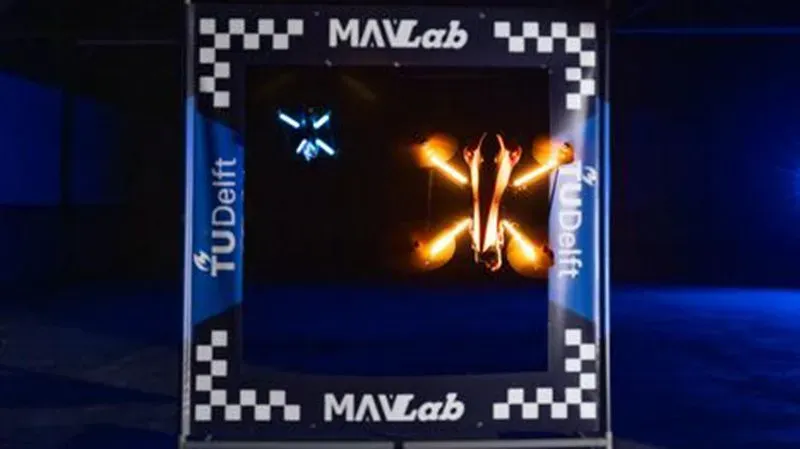
A groundbreaking achievement in artificial intelligence has been reached by researchers at the Delft University of Technology's Micro Air Vehicles Lab in the Netherlands. Their AI-powered drone system, called MonoRace, has successfully completed a challenging championship race course in record time.
The remarkable feat was achieved without relying on external aids such as GPS or motion-capture systems. The drone instead used its onboard computer and a single forward-facing camera to navigate through the demanding course at speeds of over 60 mph (100 km/h). This achievement is particularly impressive given that the system did not require any preloaded maps of the course.
The MonoRace system even outperformed some of the world's best human drone pilots, posting faster times than three former champions. This suggests a significant leap forward in autonomous flight technology and its potential applications. The researchers' focus on developing an onboard autonomous model is particularly noteworthy, as it paves the way for more efficient and versatile AI-powered systems.
The system's reliance on monocular vision, using just one camera to monitor its surroundings, demonstrates the capabilities of modern computer vision algorithms. This design choice also highlights the ability of AI to process complex visual information in real-time, allowing the drone to make quick decisions and adjustments during flight.
MonoRace achieved this impressive performance without any external assistance, relying solely on its onboard sensors and processing power. The system's success raises exciting possibilities for future applications in fields such as search and rescue, surveillance, and transportation.
The neural network that powers the drone's flight is a key component of its success. This machine-learning model uses artificial neurons to identify patterns in data and make decisions, much like the human brain does. By analyzing sensor information from the drone, it can estimate its position and motion, as well as detect racing gates.
This information is then used to generate motor commands at an incredible rate - 500 times per second. These commands are sent to the drone's four propellers through its flight controller, allowing it to navigate complex courses with ease. The system's compact design enables it to operate entirely within the drone itself.
The MonoRace hardware has been integrated into a lightweight drone that weighs just 966 grams and measures approximately 11.8 x 11 x 3.9 inches. This compact size allows for efficient operation, making it possible to run the entire system on board the drone without any external assistance.
On the Abu Dhabi course, the MonoRace-equipped drone completed two laps around 11 gates in an impressive 16.56 seconds. It reached a top speed of approximately 63 mph during this time, demonstrating its exceptional agility and control.
A recent video showcases the development and performance of MonoRace in competition, featuring real flight sequences that highlight its capabilities. However, some of these sequences are computer-generated, with professor Guido de Croon explaining that they are intentional visual effects added to enhance the footage.
The training process for the MonoRace model involved a stripped-down physics simulator that ran at high speed, allowing the drone to learn complex maneuvers without the need for real-world crashes or damage.
In this virtual environment, the control neural network received an estimated state as input from a separate perception and state estimation process, which was not based on simulated vision. This approach enabled the system to focus on developing its motor skills and learning to navigate the track with precision.
The real footage captured during the drone's racing sessions includes overlays that highlight how it interprets its camera feed in real-time. These visual aids show how the convolutional neural network segments the gates, detects corners, and estimates gate edges, providing a unique insight into the drone's decision-making process.
As the training progressed, the MonoRace model learned to translate the drone's position, velocity, and orientation directly into motor commands, allowing it to fly with increasing speed and agility. Early stages of training focused on basic skills such as avoiding crashes and reaching the first gate, but as the system gained experience, it began to advance farther along the course.
The reinforcement learning method used in the training process relies on trial and error, requiring millions of attempts for the agent to learn from its successes and failures. This approach enabled the MonoRace model to develop a deep understanding of the racing environment and adapt its flying skills accordingly.
The researchers took a unique approach to training the MonoRace model by exposing it to a wide range of drone variations. They intentionally introduced differences in factors such as weight, voltage, drag, sensor noise and propeller condition to simulate real-world imperfections.
This training method allowed the AI system to develop flexibility and adaptability, enabling it to control different drones with ease. According to the researchers, this approach ensures that the trained network can effectively manage various drone configurations.
The potential applications of MonoRace go beyond racing, with its creators envisioning it as a tool for human drone pilots to hone their skills. The model's ability to simulate complex environments and adapt to changing conditions could make it an invaluable training resource.
By demonstrating advancements in physical AI, the researchers have shown that sophisticated control systems can be achieved using limited sensing and computing power. This breakthrough has significant implications for robotics, particularly in the development of energy-efficient controllers that can optimize performance while minimizing power consumption.
The development of AI-powered racing drones has reached a new milestone, as researchers have created a machine that outflies even the best human pilots. This achievement is significant not just for its speed but also for its implications on energy efficiency.
The drone's advanced controller system allows it to optimize performance while minimizing power consumption, paving the way for more efficient and agile robotic systems in various fields.
Facts based on reporting originally published by Live Science.
You may republish this story, in full or in part, if you credit News Central Site and link to it (licence CC BY 4.0). Photos are not included.