Researchers find way to make iridium catalysts last longer in hydrogen production
Scientists have developed a new design for iridium-based catalysts that can withstand degradation during water electrolysis, a process used to produce hydrogen from renewable energy sources.
Researchers have found a way to make iridium catalysts used in hydrogen production last longer.
Water electrolysis is one method for producing hydrogen that doesn't involve burning fossil fuels and releasing carbon dioxide into the atmosphere. This process splits water into hydrogen and oxygen using electricity, which can be generated from renewable sources like wind and solar power.
Proton exchange membrane (PEM) electrolysis is a variation of this technology that's particularly well-suited to work with intermittent energy sources. It can quickly adjust to changes in electricity supply, making it more practical for widespread use.
However, iridium-based catalysts used in PEM electrolysis have limitations. They're expensive due to the rarity of iridium, and they gradually lose their effectiveness over time.
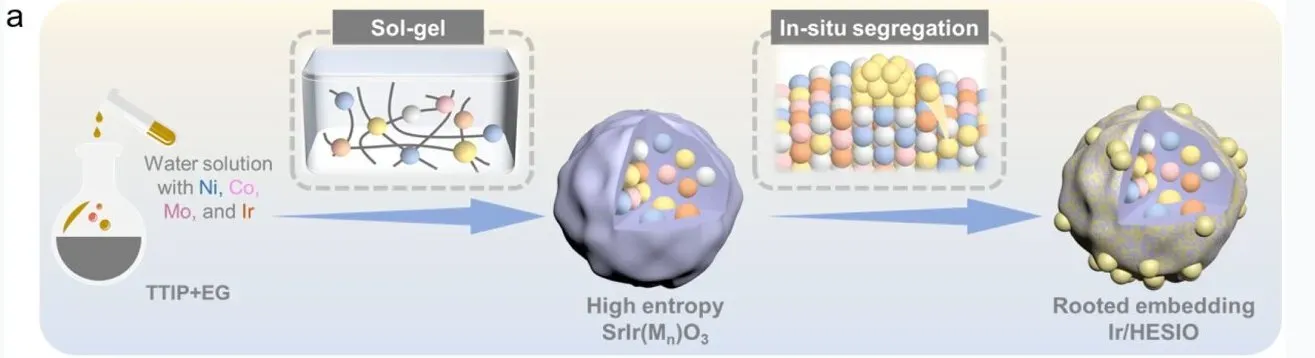
To address this issue, scientists have developed a new design that protects iridium nanoparticles from degradation. This involves embedding them in a specially designed material called high-entropy perovskite.
This unique structure holds the iridium particles firmly in place while controlling their electronic environment.
The high-entropy perovskite material's unique structure allows researchers to carefully control its electronic environment and protect iridium particles from degradation.
To convert this material into a catalyst, the researchers employed a process called exsolution, which involves heating the material under specific conditions. This process causes some of the iridium inside the material to move to the surface, forming nanoparticles.
The formation of these nanoparticles is distinct from conventional catalysts, where they are typically deposited onto a supporting surface. Instead, they emerge from within the material itself, remaining firmly in place and preventing them from clumping together or becoming dislodged.
By regulating how electrons interact with iridium, the high-entropy perovskite helps protect it during water electrolysis, a process where iridium can lose electrons and become unstable. The researchers used experiments and computer simulations to investigate this phenomenon.
The new catalyst's performance was put to the test in a PEM water electrolyzer, which ran for over 3,800 hours with minimal loss of efficiency under normal conditions. Under more demanding conditions, it operated for more than 3,200 hours, demonstrating its potential for longer-lasting hydrogen production.
The researchers' innovative approach to designing iridium catalysts has led to a significant improvement in their durability. By carefully crafting the material surrounding iridium, they have been able to create more reliable and long-lasting catalysts for hydrogen production.
This breakthrough is particularly significant for water electrolysis systems, which are crucial for green hydrogen production on a larger scale. The team's findings suggest that their method could contribute to the development of more affordable and efficient water electrolysis systems.
Facts based on reporting originally published by Phys.org.
You may republish this story, in full or in part, if you credit News Central Site and link to it (licence CC BY 4.0). Photos are not included.